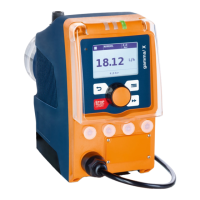
What does 'Invalid parameter' mean on my ProMinent gamma/ X GMXa Water Pump?
- DDarin WhiteSep 10, 2025
If your ProMinent Water Pump displays 'Invalid parameter', it indicates that a set parameter is invalid. Adjust the parameter.
What does 'Invalid parameter' mean on my ProMinent gamma/ X GMXa Water Pump?
If your ProMinent Water Pump displays 'Invalid parameter', it indicates that a set parameter is invalid. Adjust the parameter.
What does 'Defective stroke metering' mean on my ProMinent Water Pump?
If your ProMinent Water Pump displays the message 'Defective stroke metering', it means that the dosing monitor reported more defective strokes than was set in the Inputs/Outputs menu. Press the [Clickwheel] and then investigate and clear the cause.
What does 'Invalid metering volume' mean on my ProMinent gamma/ X GMXa Water Pump?
If your ProMinent Water Pump displays 'Invalid metering volume', it means the set metering volume in concentration mode cannot be metered. Adapt the metering parameters.
What to do if my ProMinent gamma/ X GMXa shows 'Diaphragm rupture'?
If the ProMinent Water Pump displays the message 'Diaphragm rupture', it means the diaphragm is broken. Replace the diaphragm and clean the diaphragm rupture indicator.
What to do if my ProMinent gamma/ X GMXa Water Pump displays 'Overload'?
If the ProMinent Water Pump displays the message 'Overload', it indicates that the pump has detected too high a back pressure. You should rectify the cause of the high back pressure.
Why is my ProMinent gamma/ X GMXa Water Pump not priming?
If your ProMinent Water Pump isn't priming despite full stroke motion and bleeding, it could be due to minor or serious crystalline deposits on the ball seat because the valves have dried out. For minor deposits, take the suction hose out of the storage tank and thoroughly flush out the liquid end. For serious deposits, dismantle and clean the valves.
What to do if my ProMinent gamma/ X GMXa shows 'Input signal > 20 mA'?
If your ProMinent Water Pump shows 'Input signal > 20 mA', the pump is in 'Analogue operating mode,' a fault behavior has been programmed in the Analogue menu, and the control current has risen above 20 mA. Eliminate the cause of the high control current or switch the programming of the fault behavior to 'off'.
What does 'Underpressure' mean on my ProMinent gamma/ X GMXa Water Pump?
If the ProMinent Water Pump displays the message 'Underpressure', it indicates that the pump has detected too low a back pressure. You should rectify the cause.
What does 'Level' mean on my ProMinent Water Pump display?
If your ProMinent Water Pump displays 'Level', it means the fluid level in the storage tank has reached 'Liquid level low 1st stage'. Top up the storage tank.
What to do if my ProMinent Water Pump displays 'Temperature' and stops?
If your ProMinent Water Pump displays 'Temperature' and stops, it means the ambient temperature is either too high or too low. Change the ambient temperature or rectify the cause of the high temperature. The pump should start automatically.

Explains signal words and warning signs used to denote danger.
Specifies correct and prohibited uses, limitations, and requirements for the pump.
Provides critical safety warnings regarding personal and material damage from operation.
Outlines emergency procedures, including disconnection and handling of chemical escapes.
Defines required qualifications for personnel performing various tasks on the pump.
Presents a detailed overview of the pump's complete equipment with numbered components.
Describes the various control elements on the pump, including keys, indicators, and terminals.
Provides a detailed overview of the pump's control elements, including keys and indicators.
Explains the functions of the pump's keys and how they operate in different modes.
Details the function of the liquid end in the dosing process.
Describes how the diaphragm is driven by an electromagnet controlled by an electronic controller.
Explains how pump capacity is set using stroke length and stroke rate.
Details the self-bleeding capabilities of SER and SEK liquid ends.
Describes the different operating modes available for the pump, such as Manual, Contact, Batch, and Analog.
Outlines various functions like Calibrate, Degassing, Timer, Flow, Level switch, and Pause.
Describes the available relay options and their functions, such as fault indication and pacing.
Explains the meaning of the LED indicators for fault, warning, and operation status.
Details the priority order of operating modes, functions, and fault statuses affecting pump reactions.
Details the correct procedures and precautions for installing hose lines, with and without degassing.
Specific installation instructions for hose lines on pumps without a degassing function.
Specific installation instructions for hose lines on pumps with a degassing function.
Specific installation instructions for hose lines on pumps with self-degassing (SEK type).
Provides general safety notes and precautions for hydraulic installation, covering component rupture and chemical escape.
Details the connection of the power supply, including warnings about unexpected start-up.
Describes the connection of the HMI to the pump's CAN socket and related safety precautions.
Details the function and connection of various terminals on the pump.
Explains the 5-pin panel terminal for external control functions like auxiliary capacity and mA input.
Describes the connection for a 2-stage level switch or suction lance for level measurement.
Details the connection option for a metering monitor.
Explains the connection and electrical interface for a diaphragm rupture indicator.
Details the various relay functions, types, and their effects in different menu settings.
Lists and explains the functions of different relay types, including fault indicating and pacing relays.
Explains the order option and functionality of the fault indicating relay output.
Describes the output options for other relays, including fault indicating and pacing relays.
Details the option of a relay combined with a current output for signaling faults or pacing.
Explains the basic principles of navigating menus and setting up controls, using language selection as an example.
Guides on how to check current settings of adjustable variables using continuous and secondary displays.
Explains how to access the Setting mode, including password protection if applicable.
Describes the 'Information' menu, which provides details on pump parameters and counters.
Details the extensive 'Settings' menu, covering operating modes, calibration, system configuration, and more.
Explains the 'Operating mode' settings, including Manual, Contact, and the adaptive/memory functions.
Describes the 'Manual' operating mode for direct pump control and setting capacity/stroke rate.
Details the 'Contact' operating mode for triggering strokes via external pulses and its adaptive/memory features.
Explains the 'Batch' operating mode for pre-selecting large metering volumes and triggering strokes.
Describes the 'Analog' operating mode for controlling pump capacity via current signals (0-20mA, 4-20mA, Linear curve, etc.).
Explains the 'Automatic' operating mode for setting direct values like capacity, volume, or time, instead of stroke length/rate.
Details how to manually enter and adjust the stroke length for precise metering control.
Covers settings related to metering, including discharge stroke profiles (optimum, fast, sine mode, etc.).
Explains how to match the pump metering flow to application requirements by selecting discharge stroke profiles.
Details how to adjust the suction stroke to prevent inaccurate metering with high viscosity or gaseous chemicals.
Explains the programmable 'Pressure rating' function to reduce pump pressure and minimize rupture risk.
Covers monitoring functions like Air lock, Sensitivity air detect, Message with overpressure, and Cavitation.
Explains how to handle 'Air lock' messages, indicating gas in the liquid end.
Details the 'Sensitivity air detect' function for adjusting air detection sensitivity to minimize false alarms.
Describes the 'Compensation' function to minimize back pressure oscillations for improved dosing precision.
Explains how to set the desired mass concentration of feed chemical in the dissolving medium.
Details concentration input settings for 'Manual' mode, intended for metering into a flowing medium.
Explains concentration input settings for 'Contact' mode, for metering into a medium with variable flow.
Details concentration input settings for 'Batch' mode, for metering into a storage tank.
Explains concentration input settings for 'Analog' mode, using a flow meter with analogue output.
Guides on pump calibration procedures, including using calibration factors and calibration by measurement.
Covers system configuration including dosing head, volume unit, pressure unit, and pressure adjustment.
Defines the pump's start behaviour after power supply is switched on (always STOP, always on, last status).
Details the configuration of inputs and outputs, including auxiliary capacity, relays, flow monitor, and pause input.
Explains the 'Auxiliary capacity'/'Auxiliary frequency' function for switching to an additional capacity/stroke rate.
Describes the setting options for Relay1, available only if a relay is fitted.
Details how to set the metering volume for which the pacing relay switches.
Explains how to configure output signals similar to pump capacity and set pump response behavior.
Describes the 'Flow control' function, available if a flow control is installed.
Explains how to configure the pump to generate a warning or error message upon diaphragm rupture.
Details how to select pump switching behavior for 'Pause' using input contact signals.
Describes how to select the measuring principle for level monitoring (2-stage or continuous).
Explains configuring 2-stage level switches for 'Level warning' and 'Error' with break or make contact signals.
Describes calibrating continuous level measurement and configuring warning/fault thresholds.
Explains the 'Bleeding' function for controlled bleeding of the liquid end, including triggering methods and hardware options.
Details how to select the duration for the priming process after pressing the [Priming] key.
Guides on how to set the pump's time, including automatic summertime adjustments.
Explains how to set the pump's date.
Introduces the timer function, outlining its capabilities for controlling pump operations based on time or events.
Explains how to activate or deactivate the timer function for programming and operation.
Details the process of creating timer programs by defining commands, triggers, and actions.
Guides on how to create new program lines for the timer function.
Explains the basic structure of a timer program line, including trigger and action.
Details how to view and check programmed timer lines or instructions.
Explains how to modify existing timer program lines.
Guides on how to delete individual timer program lines.
Explains how to clear all programmed timer lines at once.
Provides examples of timer programming, including weekday metering scenarios.
Offers information on timer status, effective settings, and storage period.
Highlights common issues and potential faults encountered with the timer function.
Provides brief explanations of timer functions like Time event (trigger), Actions, Initialisation, and Outputs.
Covers service-related functions such as access protection, password, clearing counters, and error log book.
Details options for locking menu parts or the entire menu for security purposes.
Explains how to set or change the password for access protection.
Guides on resetting various counters like stroke count, volume count, and contact memory.
Explains how to view and filter the pump's error log book for troubleshooting.
Details how to obtain more information about specific entries in the log book.
Covers diaphragm replacement, display settings, factory resets, and part numbers for diaphragms and kits.
Explains how to select the desired operating language for the pump interface.
Details manual operations like stopping/starting the pump, priming, starting a batch, and acknowledging errors.
Provides a visual overview of control options using keys and locking mechanisms.
Details quarterly maintenance tasks for standard liquid ends, including checks on lines, valves, connections, and housing.
Details quarterly maintenance tasks for liquid ends with vent valves, including checks on bypass lines and vent valve operation.
Provides detailed step-by-step instructions for replacing the pump diaphragm, including exploded views and part numbers.
Explains the replacement procedure for vPTFE diaphragms and lists associated spare parts kits.
Details the cleaning and testing procedure for the diaphragm rupture indicator after it has been triggered.
Provides information on cleaning the pump's valves, referring to exploded drawings and spare parts kits.
Lists common faults without LCD error messages, their causes, remedies, and required personnel.
Details faults that trigger error messages on the LCD screen, including identifiers, causes, remedies, and personnel.
Explains the meaning of specific fault messages appearing on the LCD screen and the corresponding actions.
Lists warning messages appearing on the LCD screen, their causes, remedies, and personnel.
Advises contacting ProMinent for faults not covered in the previous sections.
Explains the pump's log book, covering fault messages and warning messages.
Details the fault messages recorded in the log book, including their description and acknowledgment status.
Lists warning messages recorded in the log book, providing their descriptions.
Lists various event messages recorded in the log book, such as parameter changes and calibration events.
Explains how to access detailed information for each log book entry.
Outlines the steps for decommissioning the pump, including disconnecting power, depressurizing, and draining the liquid end.
Provides warnings about eye injury from compression springs and environmental hazards from electronic waste, along with disposal guidelines.
Details the pump's performance characteristics at specific strokes/minute and stroke length, across various models.
Provides performance data specifically for pumps fitted with vPTFE diaphragms.
Outlines the accuracy specifications for standard and self-bleeding liquid ends.
Details the capacity range and reproducibility for standard liquid ends.
Explains the limitations regarding accuracy and reproducibility for self-bleeding liquid ends with outgassing media.
Lists suitable viscosity ranges for different liquid end designs and provides general selection information based on viscosity.
Details the material specifications for dosing heads, valves, seals, and balls used in standard liquid ends.
Provides electrical specifications including nominal power, current, peak current, and fuse types.
Lists temperature specifications for storage, transport, operation, and medium, including material-specific limits.
Specifies maximum air humidity and testing conditions for climate resistance.
States the maximum altitude of operation for the pump.
Details the degree of protection (IP, NEMA) and safety requirements, including mains connection with protective earth.
Specifies the pump's protection against contact and moisture according to IP and NEMA standards.
Outlines safety requirements, specifically regarding the mains connection with a protective earth conductor.
Specifies the degree of pollution rating for the pump's environment.
Lists components compatible with the gamma/L product range, and points where compatibility is not guaranteed.
Provides shipping weight information for different gamma/X types based on material.
States the sound pressure level according to EN ISO 20361.
Shows exploded diagrams of various liquid end assemblies for parts identification.
Lists retrofit kits with part numbers and provides additional sources for spare parts and accessories.
Shows dimensional drawings and specifications for gamma/X pumps with PP_2 material versions.
Shows dimensional drawings and specifications for gamma/X pumps with NP_2 material versions.
Shows dimensional drawings and specifications for gamma/X pumps with PVT2 material version.
Shows dimensional drawings and specifications for gamma/X pumps with PVT4 material version.
Shows dimensional drawings and specifications for gamma/X pumps with TTT0 material version.
Shows dimensional drawings and specifications for gamma/X pumps with SST0 material version.
Shows dimensional drawings and specifications for gamma/X pumps with PPB9 material version.
Shows dimensional drawings and specifications for gamma/X pumps with NPB9 material version.
Provides capacity and correction factor diagrams for GMXa 0220, 2504, 1009, and 0715 models.
Provides capacity and correction factor diagrams for GMXa 0424 models.
Details auxiliary displays available in the continuous display for different operating modes, showing capacity, stroke rate, and other parameters.
| Stroke Length | Adjustable |
|---|---|
| Protection class | IP65 |
| Type | Solenoid-driven diaphragm metering pump |
| Power Supply | 100 – 230 V, 50/60 Hz |
| Control | Manual, PROFIBUS |
| Materials | PVDF, stainless steel |


Loading...