23
Rear Panel
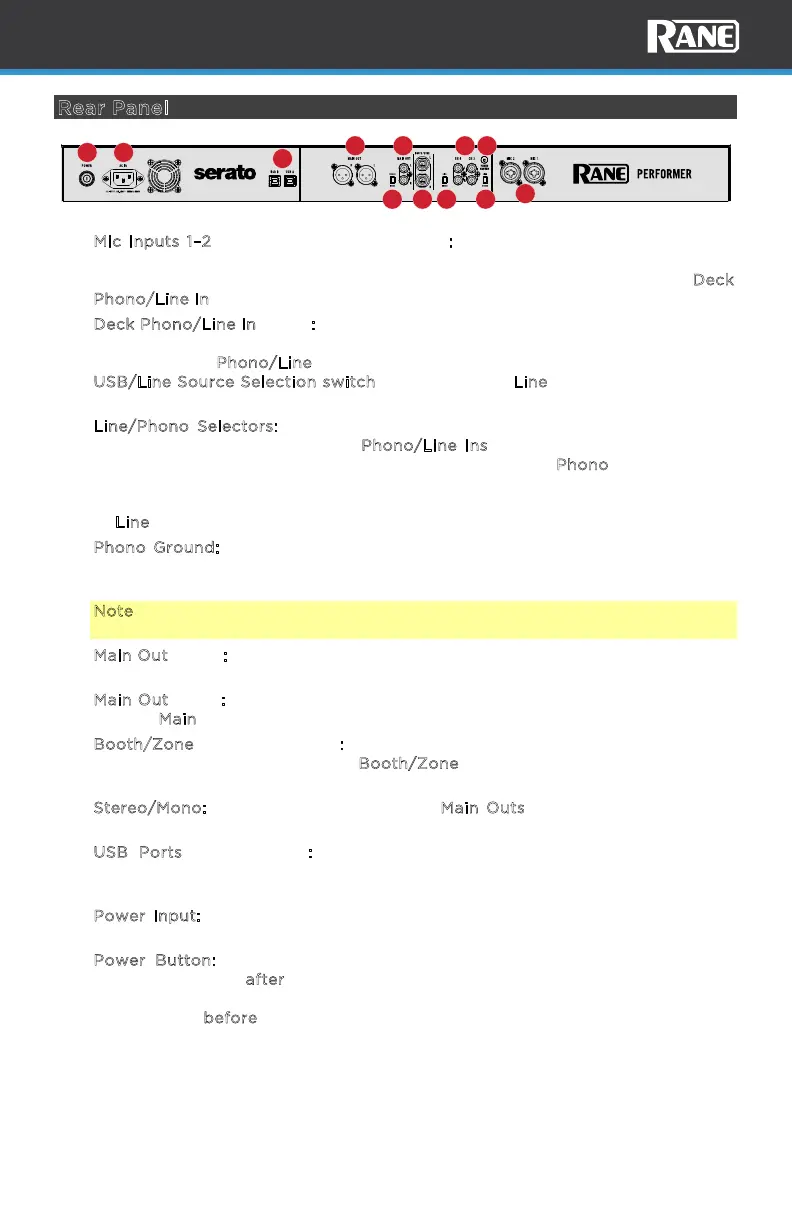
1. Mic Inputs 1–2 (XLR / 1/4" [6.35 mm] TRS): Connect dynamic microphones to
these mono inputs. Their mono audio signals are split and routed directly to the
stereo program mix and cue channel. If you prefer a stereo line input, the D
eck
P
hono/Line In may be used.
2. D
eck Phono/Line In (RCA): Connect these inputs to an external audio source or
to a turntable, CD player, or other line-level device. Remember to set the
corresponding P
hono/Line selector to the appropriate position and to set the
U
SB/Line Source Selection switch for that deck to Line to play its audio signal
on that deck.
3. L
ine/Phono Selectors: Set this switch to the appropriate position, depending
on the device connected to the P
hono/Line Ins of the corresponding deck. If
you are using phono-level turntables, set this switch to P
hono to provide the
additional amplification needed for phono-level signals. If you are using a line-
level device, such as a line-level turntable, CD player or sampler, set this switch
to L
ine.
4. P
hono Ground: If you are using phono-level turntables with a grounding wire,
connect the grounding wire to this terminal. If you experience a low “hum” or
“buzz”, this could mean that your turntables are not grounded.
Note: Some turntables have a grounding wire built into the RCA connection, so
nothing needs to be connected to the grounding terminal.
5. Main Out (RCA): Connect these outputs to another mixer, recording device, etc.
The program mix will be sent to these outputs.
6. M
ain Out (XLR): Connect these outputs to loudspeakers or an amplifier system.
Use the M
ain knob on the top panel to control the volume level.
7. B
ooth/Zone (1/4" [6.35 mm]): Connect these outputs to booth monitors or a
booth amplifier system. Use the B
ooth/Zone knob on the top panel to control
the volume level.
8. S
tereo/Mono: Set this switch to have the Main Outs output a stereo or mono
audio signal.
9. U
SB Ports (USB Type-B): Use USB cables to connect these USB ports to
available USB ports on your computer. These connections send and receive
audio and MIDI control information to and from the computer.
10. P
ower Input: While PERFORMER is powered o, connect the included power
cable to this input and then to a power outlet.
11. P
ower Button: Use this button to power PERFORMER on or o. Power on
PERFORMER only a
fter you have connected all your input devices and before
you power on your amplifiers and loudspeakers. Power o your amplifiers and
loudspeakers b
efore powering o PERFORMER.
1
2
3
4 5 6
7 3 8
9
10 11


 To Next Page