8540573 • 16/09/2016 • Rev.20 17
MULTIPLE SYSTEMS
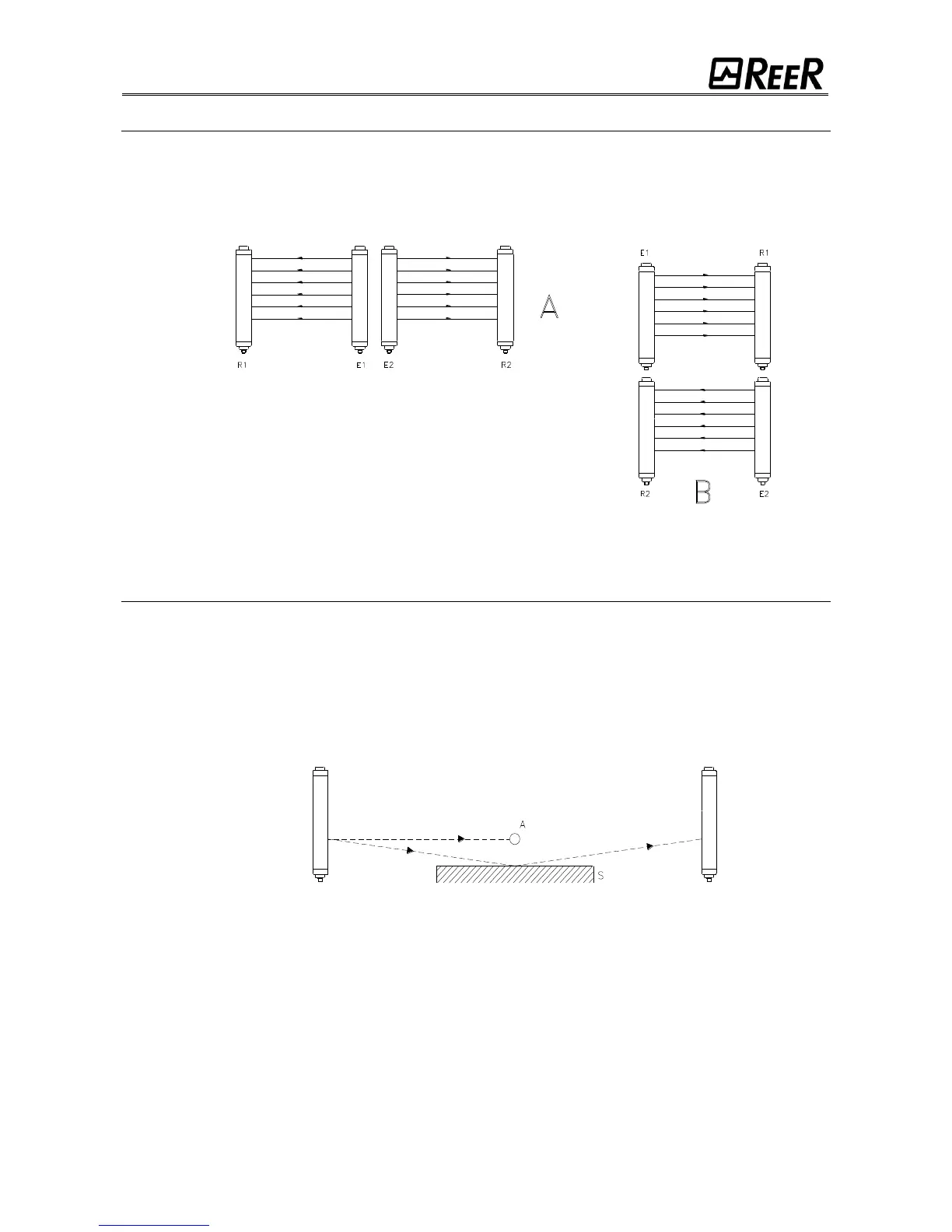
When several JANUS systems are used, these must not interfere optically with each other.
Position the elements so that the beam emitted by the Emitter of a system is received only by the
respective Receiver.
Figure 21 provides various examples of correct positioning of two photo-electric systems.
Incorrect positioning could generate interference and possibly result in irregular functioning.
Figure 21
DISTANCE FROM REFLECTIVE SURFACES
The presence of reflective surfaces close to the light curtain may cause spurious reflections that
prevent detection. Referring to Figure 22, object A is not detected because of surface S which,
reflecting the beam, closes the sensing field between the Emitter and Receiver. A minimum
distance d must therefore be maintained between any reflective surfaces and the protected area.
The minimum distance d must be calculated according to the distance l between Emitter and
Receiver and taking into account that the angle of projection and reception is equal to 4º.
Figure 22
Figure 23 indicates the values of the minimum distance d to be complied with as the distance l
between Emitter and Receiver varies.


 To Next Page