R 17A User’s Manual – Page 76
4. Performing tests
4.1 Pure Tone Audiometry (AC)
Pure Tone Audiometry represents the basic test of auditory investigation aiming at evaluating the
auditory function and assessing the hearing threshold. The term hearing threshold indicates the minimum
level perceived by the test subject.
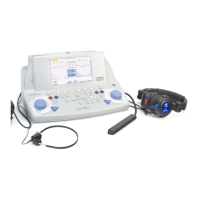
The test is performed by administering pure tones using the included earphones (Air Conduction – AC).
Threshold estimation can be done either for one ear and then for the other, for all tones, or on both sides
for each tone.
The test can estimate the AC loss but cannot distinguish between abnormality in the conductive
mechanism and sensorineural mechanism.
Before perform the test, eliminate any obstructions which will interfere with the placement of the
earphone cushions on the ear (e.g. hair, eyeglasses, rings).
Place the right headphone (identified by red color on the transducer) on the right side and the left
(identified by blue color on the transducer) on the left.
Ensure that the cushions are clean to avoid any potential infection’s transmission.
Adjust the headband of the headphones sitting on the two metallic bars, to achieve the correct pressure
on the ear and the correct alignment of transducer to ear canal.
During BC threshold determination, place the bone vibrator on the mastoid area where the tones are best
heard by the patient.
Instruct the patient, before performing the test, to signal pressing the pushbutton (or to raise his/her
hand) when he/she hears a sound, and to keep the pushbutton depressed (or his/her hand up) as long as
he/she hears it.
Threshold determination: The test begins at 1000 Hz on the patient’s better ear.
Present pure tones at 1000, 2000, 4000, 8000 Hz then 500, 250 and 125 Hz*.
Start presenting the tone at a level loud enough to ensure audibility. The patient will thus be able to
identify the type of signal to be expected exactly and give clear responses.
Should levels close to threshold be used when starting the test, the patient may fail to
respond as he/she is unsure of what he/she should hear. Should the level prove insufficient
to elicit clear responses, increase the level until the patient responds reliably.
To assess threshold level, proceed as follows:
− When the stimulus is clearly perceived by the patient, reduce progressively its level in 10 dB steps.
− When reaching a level, at which the patient fails to respond, further decrease the level by 10 dB
and, interrupting the tone manually, begin increasing its level in 5 dB steps, until the patient
responds again.
− Decrease this level once more until the patient fails to respond.
The true pure tone test threshold corresponds to the level evoking patient’s response in 50%
of presentations.
In tinnitus cases, use of pulsed tones (rather than continuous) is preferable.
Avoid any noisy environments because background noise can produce false test results, especially at
lower frequencies.



 To Next Page