weight of 2 100 g can be additionally mounted. The best results are generally achieved with
amplitudes from 1.0 to 1.5 mm.
Example 1:
By using the add-on mass, the maximum attainable amplitude amounts 3 mm. Without the add-
on mass, the maximum attainable amplitude would only be ~ 2.5 mm.
7.6 Time
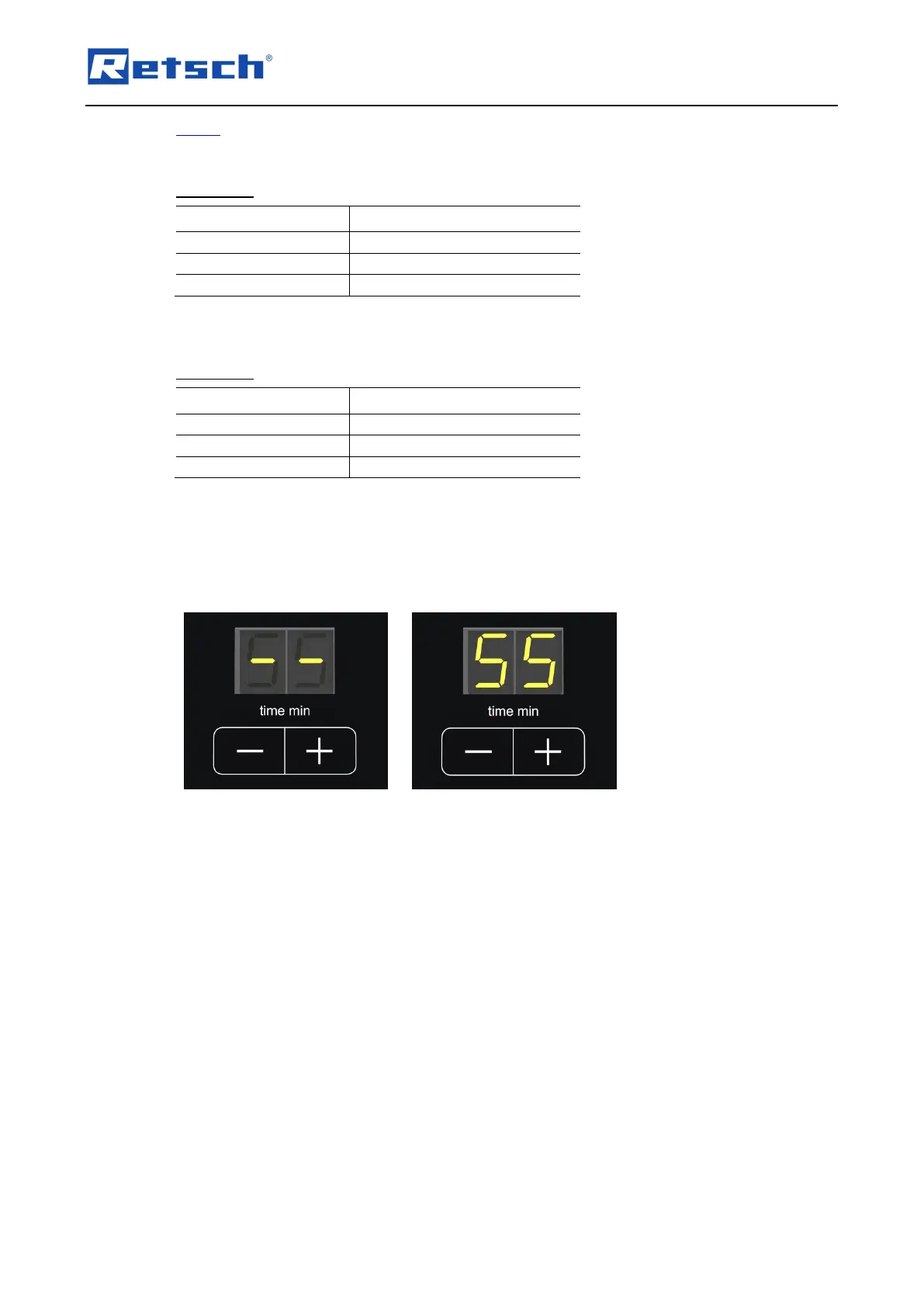
The AS 200 control can be operated either in continuous operation or for a certain time between
1 and 99 minutes. When the device is switched on, the last used setting is displayed.
Press the "+" or "-" button of the time display (H5) to set the desired process time.
Press and hold the "+" or "-" button to extend or reduce the process time in steps of ten
minutes, respectively.
To change to the continuous operation, fall below the duration of 1 min by pressing the "-"
button, or exceed the duration of 99 min by pressing the "+" button. The time display (H5)
now indicates " ".
The process time can also be changed during operation by pressing the "+" or "-" button.
7.7 Optimisation of Time and Amplitude
The settings of the optimum sieving time and amplitude depend on the sample material. These
settings have a substantial influence on the measurement result. Generally, national and
international standards, internal regulations and standards provide detailed information on
product-specific sieve analyses and the associated sieving parameters. If such basic



 To Next Page