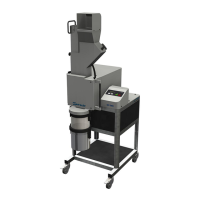
Benefits
– Reproducible grinding results due to "Cardan drive" (grinding jar has 3-dimensional
movement during grinding)
– Extremely short grinding time
– No sample loss thanks to optimal O-ring seal
– Large selection of materials for neutral-to-analysis grinding
– Closed, noise inhibiting grinding chamber
– Pneumatic clamping of grinding jars (automatic)
Range of application of the device
Long-term operation
− This laboratory device is designed for eight-hour single-shift operation
with a duty cycle of 30 %.
• This device may not be used as a production machine nor is it
intended for continuous operation.
4.2 Grinding jar nominal volume
Hardened steel:
Standard steel:
100 / 800 / 1000 / 2000 ml
100 / 800 / 1000 / 2000 ml
Stainless steel 1.4401:
Silicon nitride:
Wear or damage to the grinding set
Insufficient fill quantity
− Increased wear or damage to the grinding set is possible if the grinding
set is operated with insufficient fill quantity.
− The grinding set must be filled to at least 1/3 of the nominal
volume.
4.3 Feed size
The maximum feed size depends on the grinding jar volume and the hardness of the sample
material .
Grinding set 100 ml = max. particle size < 10 mm
Grinding set 800 ml = max. particle size < 15 mm
Grinding set 1000 ml = max. particle size < 15 mm
Grinding set 2000 ml = max. particle size < 20 mm



 To Next Page