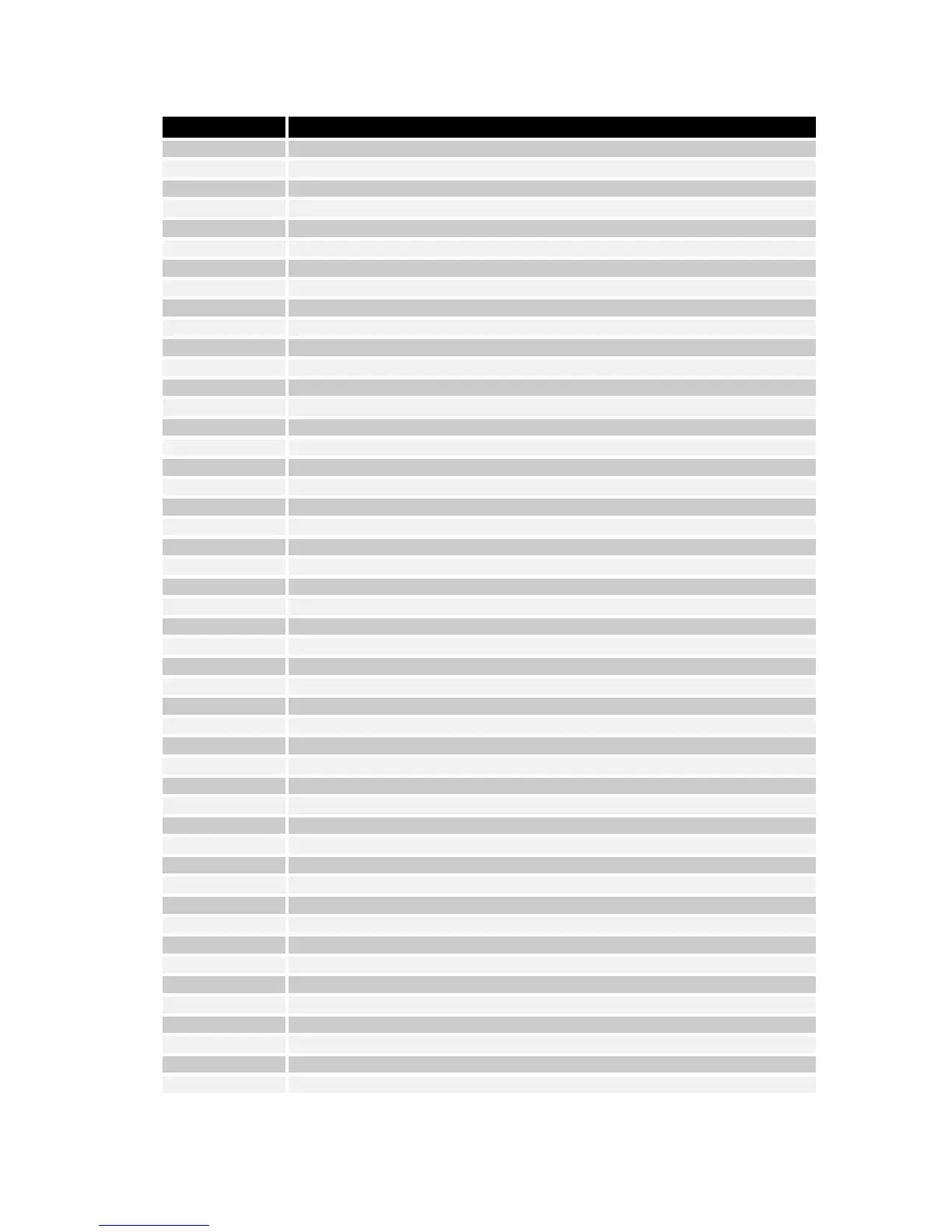
LOCK: Indicates an inhibit of the UPS or a component caused by a failure. A lock is normally preceded by an alarm. In
the event of a fault and consequential inverter lock, the inverter will switch off and power to the load via the bypass line
(this procedure is excluded for locks caused by serious and persistent overloads and for those caused by a short circuit).
Incorrect auxiliary power supply
Disconnection of one or more internal cables
Phase1 input fuse broken or input contactor locked (does not close)
Phase2 input fuse broken or input contactor locked (does not close)
Phase3 input fuse broken or input contactor locked (does not close)
Positive BOOST stage overvoltage
Negative BOOST stage overvoltage
Positive BOOST stage undervoltage
Negative BOOST stage undervoltage
Static bypass switch fault
Phase1 inverter overvoltage
Phase2 inverter overvoltage
Phase3 inverter overvoltage
Phase1 inverter undervoltage
Phase2 inverter undervoltage
Phase3 inverter undervoltage
Continuous voltage on inverter output or Phase1 sinusoid inverter deformed
Continuous voltage on inverter output or Phase2 sinusoid inverter deformed
Continuous voltage on inverter output or Phase3 sinusoid inverter deformed
Phase1 output short-circuit
Phase2 output short-circuit
Phase3 output short-circuit
Phase1 output fuse broken or output contactor locked (does not close)
Parallel synchronization error
Parallel synchronization signal fault
Phase2 output fuse broken or output contactor locked (does not close)
Phase3 output fuse broken or output contactor locked (does not close)
Phase1 dissipator overtemperature
Phase2 dissipator overtemperature
Phase3 dissipator overtemperature
Battery charger overtemperature
Phase1 dissipator temperature sensor fault
Phase2 dissipator temperature sensor fault
Phase3 dissipator temperature sensor fault
Battery charger temperature sensor fault
BOOST 1 battery fuse broken
BOOST 2 battery fuse broken
BOOST 3 battery fuse broken
Parallel communication fault



 To Next Page