the propeller causes an upward thrust which pushes the boat’s bow
downward as shown on Figure 5.3.
By gradually shifting the drive unit from its innermost adjustment
towards the outermost adjustment, the propeller thrust pushes in a
downward motion. This motion, the opposite of that shown in
Figure 5.3, tends to lift the bow.
After reaching plane, under certain load conditions, your boat could
have a tendency to bury its forward V-ed section. The boat will
begin to plow and lose speed. If the water is choppy the boat will
yaw. A boat will spin out if its bow is excessively buried. The only
way to correct this situation is to increase the angle and swing the
drive unit outward.
If the drive unit is angled out too far, your loaded boat will be slug-
gish in coming to plane. Once on plane, your boat will tend to
porpoise. To correct this motion, move the propeller inward to
decrease the angle between the drive shaft and the transom.
Very often, the optimum drive unit angle setting for the highest
speed while carrying a light load will be just short of the porpoise
point. However, such a setting is unsuitable when you have a heavy
load or are pulling skiers. By reducing the drive angle, you will find it
easier to maneuver the boat and to pull skiers to the surface.
Trim Tabs
Trim tabs also help the operator trim the boat. Trim tabs are
mounted on the port and starboard transom below the water line.
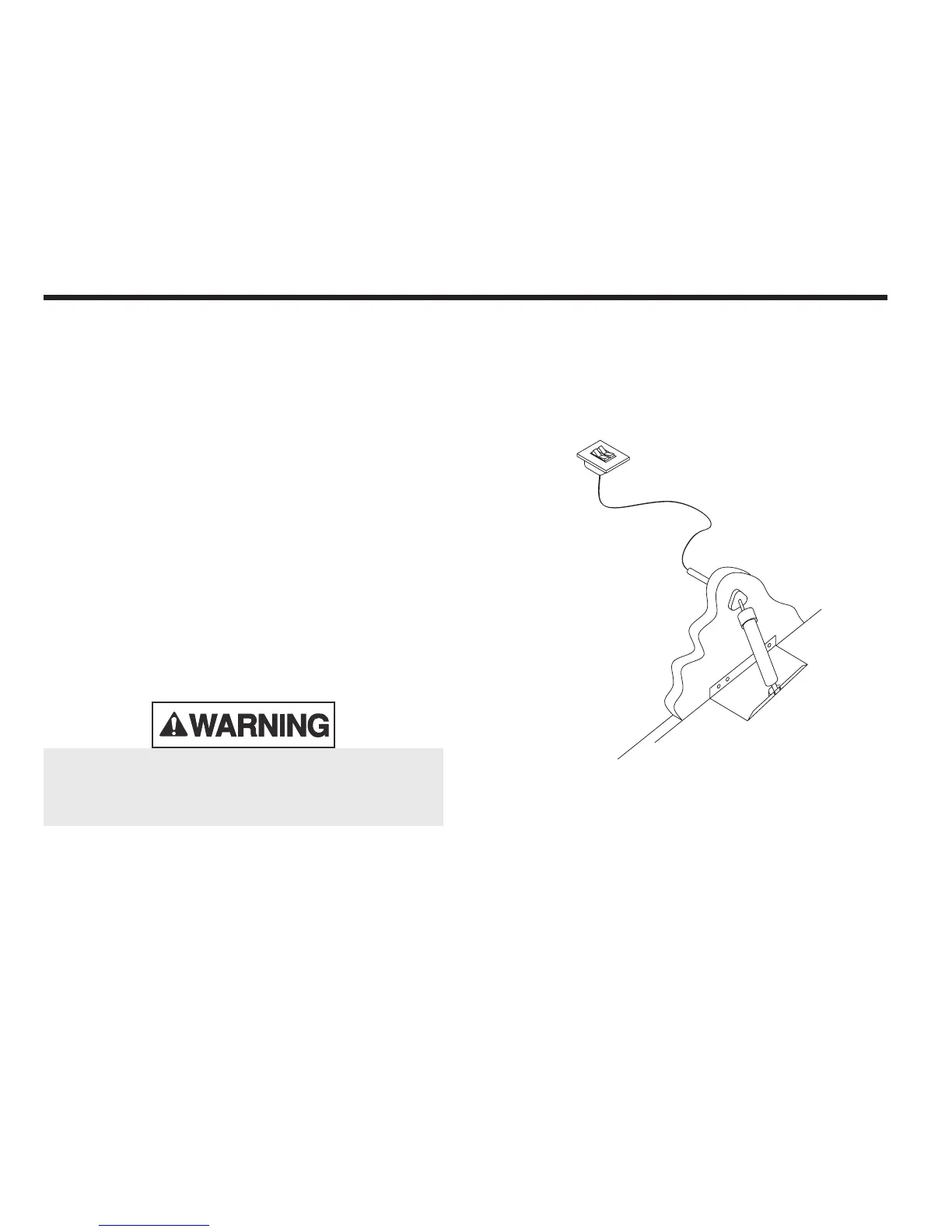
The operator can control the trim tabs at the helm with rocker
switches. (Figure 5.4) Pushing the switch activates the system
which moves its tab up or down.
If the trim tabs are angled down, they cut into the water as it passes
under the hull to force the stern up and the bow down (Figure 5.5).
Trim tabs also compensate for uneven loads in the boat by allowing
the operator to trim up one side of the boat or the other.
5-10
Figure 5.4 Trim Tab and Switch
WARNING: Excessive trim decreases maneuverability,
changes steering characteristics, and may cause “porpoising”
(bow oscillates up and down) or “chine walking” (rocking side to
side). Use power trim with care.



 To Next Page