11-3 AC VOLTAGE
IS
NORMAL AT NO-LOAD, BUT THE LOAD CANNOT BE APPLIED.
11-3-1 CHECK THE ENGINE SPEED.
7
If the engine speed is low, adjust it to the rated r.p.m.
'Refer to Step
11
-2-1
for engine speed adjustment.
11-3-2 CHECK THE TOTAL WATTAGE OF APPLIANCES CONNECTED
TO
THE GENERATOR.
Refer to Section
7
"RANGE
OF
APPLICATIONS for the wattage of the appliances.
If
the generator is over-loaded, reduce the load to the rated output of the generator.
11-3-3
CHECK THE APPLIANCE FOR TROUBLE.
If
the appliance is faulty, repair
it.
11-3-4 CHECK
IF
THE ENGINE
IS
OVERHEATED.
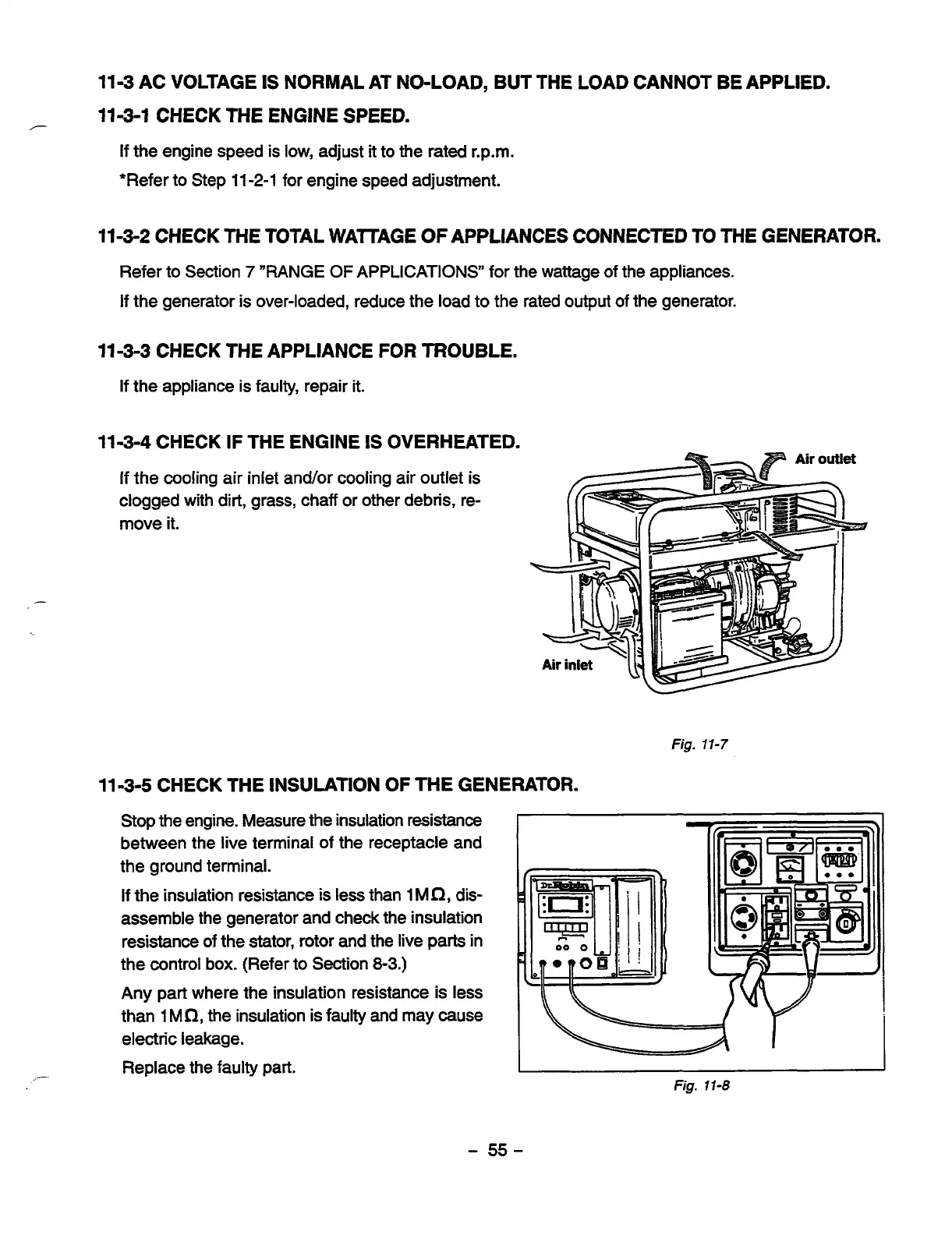
If the cooling air inlet and/or cooling air outlet is
clogged with dirt, grass, chaff
or
other debris, re-
move it.
Fig.
11-7
11-3-5 CHECK THE INSULATION
OF
THE GENERATOR.
Stop the engine. Measure the insulation resistance
between the live terminal of the receptacle and
the ground terminal.
If the insulation resistance is less than
1
M Q, dis-
assemble the generator and check the insulation
resistance of the stator, rotor and the live parts in
the control box. (Refer to Section
8-3.)
Any part where the insulation resistance
is
less
than
1
MQ, the insulation
is
faulty and may cause
electric leakage.
Replace the faulty part.
Fig.
11-8
-
55-


 To Next Page