Quick Installation Guide
00825-0100-4663, Rev BC
December 2012
Rosemount 8732
8
Flanged Sensors
Gaskets
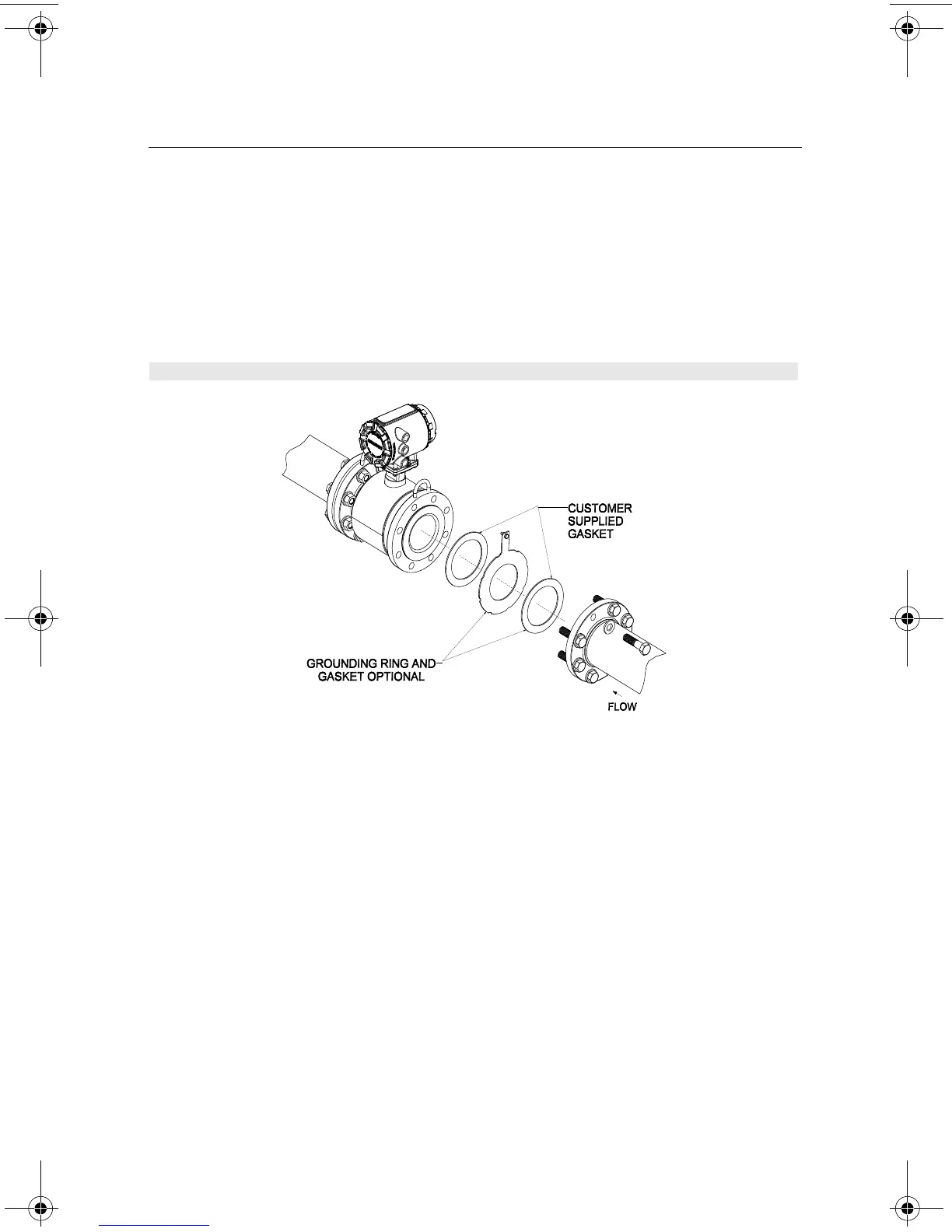
The sensor requires a gasket at each of its connections to adjacent devices or piping. The
gasket material selected must be compatible with the process fluid and operating conditions.
Metallic or spiral-wound gaskets can damage the liner. Gaskets are required on each side of
a grounding ring. All other applications (including sensors with lining protectors or a
grounding electrode) require only one gasket on each end connection.
Flange Bolts
NOTE
Do not bolt one side at a time. Tighten each side simultaneously. Example:
1. Snug left
2. Snug right
3. Tighten left
4. Tighten right
Do not snug and tighten the upstream side and then snug and tighten the downstream side.
Failure to alternate between the upstream and downstream flanges when tightening bolts
may result in liner damage.
Suggested torque values by sensor line size and liner type are listed in Table 1 for ASME
B16.5 and Table 2 for EN flanges. Consult the factory if the flange rating of the sensor is not
listed. Tighten flange bolts on the upstream side of the sensor in the incremental sequence
shown in Figure 7 to 20% of the suggested torque values. Repeat the process on the
downstream side of the sensor. For sensors with more or less flange bolts, tighten the bolts
in a similar crosswise sequence. Repeat this entire tightening sequence at 40%, 60%, 80%,
and 100% of the suggested torque values or until the leak between the process and sensor
flanges stop.
If leakage has not stopped at the suggested torque values, the bolts can be tightened in
additional 10% increments until the joint stops leaking, or until the measured torque value
Figure 6. Flanged gasket placement
4663RevBCQIG.fm Page 8 Thursday, January 10, 2013 5:33 PM


 To Next Page