• When disassembling or tting heavy vehicle
parts, watch out for dangerous shifts in the weight
balance, in particular when the vehicle is supported
by extension arm. Secure the vehicle beforehand.
• Always fully lower, switch off and secure main lifts
to prevent unauthorized use after completion of
work (turn main switch to "OFF“ and lock).
• Follow the maintenance and service schedule,
record performance of maintenance and servicing
(Chapter 9).
• Installation, maintenance and servicing may
only be carried out by authorized specialists
(maintenance contractors) (Chapter 9).
• Only qualied electricians may work on the elec-
trics.
• Only trained people with knowledge of hydraulics/
pneumatics may work on hydraulic or pneumatic
equipment.
• Appropriate personal protective equipment must
be worn when working in the area of the lift in
accordance with the applicable health & safety
and accident prevention regulations. For example,
protective gloves, protective goggles, safety shoes.
• Only original spare parts from the manufacturer
may be used.
• The lift must be inspected by a specialist after
repairing any supporting parts.
2.3 Permitted axle loads and weight
distribution
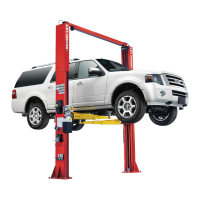
Before lifting the vehicle, you must ensure that the
weight distribution is correct.
When the weight distribution is correct (default
position in direction of motion) the main load is
located at the front (e. g. engine).
2. Safety
2.1 Operators
The post lift may only be operated without super-
vision by persons who:
• Are 18 years old and above.
• Are familiar with the basic regulations on health &
safety and accident prevention.
• Have been trained to handle and operate the post
lift.
• Have proven their ability to do so to the company.
• Have been expressly appointed in writing to ope-
rate the lift.
• Have read and understood the operating manual.
2.2 Basic safety requirements
• Only operate the post lift after a specialist has ce-
tied in the inspection log that it has been correc-
tly set up.
• Always follow the operating instructions (labels on
the post lift).
• If several people work on the post lift, a supervis-
or must be appointed by the company.
• The post lift may only be operated in technically
sound condition with regard to safety and with all
safety mechanisms in place.
• The control box or control unit may only be open-
ed by a qualied electrician.
• Safety inspections must be conducted regularly, at
least once annually.
• If signs of a defect appear, immediately shut down
the post lift, inform a supervisor and contact the
customer service if necessary.
• Keep the work area clean and free of oil, grease,
and contamination.
• Before standing or working in the danger zone
underneath the lift, lower it into the lock position
(latch bars) using the "Down“ button.
• There must be no obstacles in the path of the main
lift .
• Always monitor the load carefully when lifting and
lowering.
• Always stop the vehicles safely, centered on the
columns. Secure the vehicle against shaking with
pick up points.
• Take steps against trafc in the area of the post lift.
Do not park other vehicles in the danger zone.
• Do not load lifts beyond the permitted capacity,
comply with the permitted axle loads and load
distribution in accordance with Chapter 2.3.
Risk of injury through toppling of
the vehicle when incorrectly loaded.
Comply with the permitted load capacity as in
Fig. 3 and 4.
Comply with the permitted weight distribution
as in Fig. 3 and 4.
9


 To Next Page
 Loading...