SAMLEX AMERICA INC. | 47
SECTION 3 | Installation
3.6.1.2 AC Output Connection Through Ground Fault Circuit Interrupter (GFCI)
An un-intentional electric path between a source of current and a grounded surface is referred to as a “Ground Fault”.
Ground faults occur when current is leaking somewhere. In effect, electricity is escaping to the ground. How it leaks is
very important. If your body provides a path to the ground for this leakage (dry human body has a low resistance of only
around 1 K Ohm), you could be injured, burned, severely shocked or electrocuted. A Ground Fault Circuit Interrupter
(GFCI) protects people from electric shock by detecting leakage and cutting off the AC source. The leakage detection
circuit compares the current sent to the load and returned back from the load. If the returned current is less by 5 to 6
mA due to leakage, the GFCI trips. The GFCI also trips if it sees Neutral to Ground bond on the load side of the GFCI.
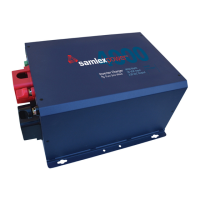
The AC output of EVO-1212F and EVO-1224F is available through a NEMA5-15R GFCI Duplex Receptacle (10 in Figs
2.1 and 3.9.1). The Neutral slot of this receptacle (longer rectangular slot) is internally bonded to the metal chassis of
the inverter.
Self Monitoring GFCI: The GFCI is “Self Monitoring Type” as per UL Standard Ul-943. As soon as the Inverter is switched
ON and 120 VAC is available on the internal Line Side of the GFCI, Red LED marked “Life End Alarm” (10c in Figs 2.1
and 3.9.1) will ash once and then will remain OFF. The Green LED (10d in Figs 2.1 and 3.9.1) will switch ON indicating
that AC power is available at the Load Side outlets.
As soon as the Inverter is switched OFF and 120 VAC is removed from the internal Line Side of the GFCI, Red LED
marked “Life End Alarm” (10c in Figs 2.1 and 3.9.1) will ash once and then will remain OFF. The Green LED (10d in
Figs 2.1 and 3.9.1) will switch OFF indicating that AC power is NOT available at the Load Side outlets.
The Self Monitoring Function inside the GFCI will monitor proper operation of ground fault protection circuitry every 1
to 10 minutes. If defect in the ground fault protection circuit is detected, the Red LED marked “Life End Alarm” (10c in
Figs 2.1 and 3.9.1) will remain ON and the GFCI will have to be replaced.
Monthly Testing of GFCI: Test the operation of the GFCI monthly as follows:
• Switch ON the inverter. As soon as 120 VAC output from the inverter is available on the internal Line Side of
the GFCI, Red LED marked “Life End Alarm” (10c in Figs 2.1 and 3.9.1) will ash once within 5 sec and then will
remain OFF. The Green LED (10d in Figs 2.1 and 3.9.1) will switch ON indicating that AC power is available at the
Load Side outlets.
• Plug a test lamp into the outlet and switch ON the test lamp.
• Press the “Test Button” (10a in Figs 2.1 and 3.9.1). The “Reset Button” (10b in Figs 2.1 and 3.9.1) will pop out.
The GFCI will be forced to trip and cut off AC power to the load side outlets. Green LED (10d in Figs 2.1 and
3.9.1) will switch OFF. The test lamp will also switch OFF.
• Press the “Reset Button” (10b in Figs 2.1 and 3.9.1). The GFCI will reset and AC power to the load side outlets
will be restored. Green LED (10d in Figs 2.1 and 3.9.1) will switch ON. The test lamp will also switch ON.
• If the above Test / Reset operation cannot be carried out, replace the GFCI.
GFCI Tripping and Reset: If there is a leakage of 5 to 6mA due to ground fault on the load side or , there is a Neutral
to Ground bond on the load side, the GFCI will trip and the “Reset Button” (10b in Figs 2.1 and 3.9.1) will pop out. AC
power to the load side outlets will be cut off. Green LED (10d in Figs 2.1 and 3.9.1) will switch OFF. Remove the ground
fault in the load circuit. Press the “Reset Button” (10b in Figs 2.1 and 3.9.1). The GFCI will reset and AC power to the
load side outlets will be restored. Green LED (10d in Figs 2.1 and 3.9.1) will switch ON.


 To Next Page