19
3. Settings.
3.1.2 Saddle adjustment
You can find our selection of saddle forms on
page 9 of these Instructions for use.
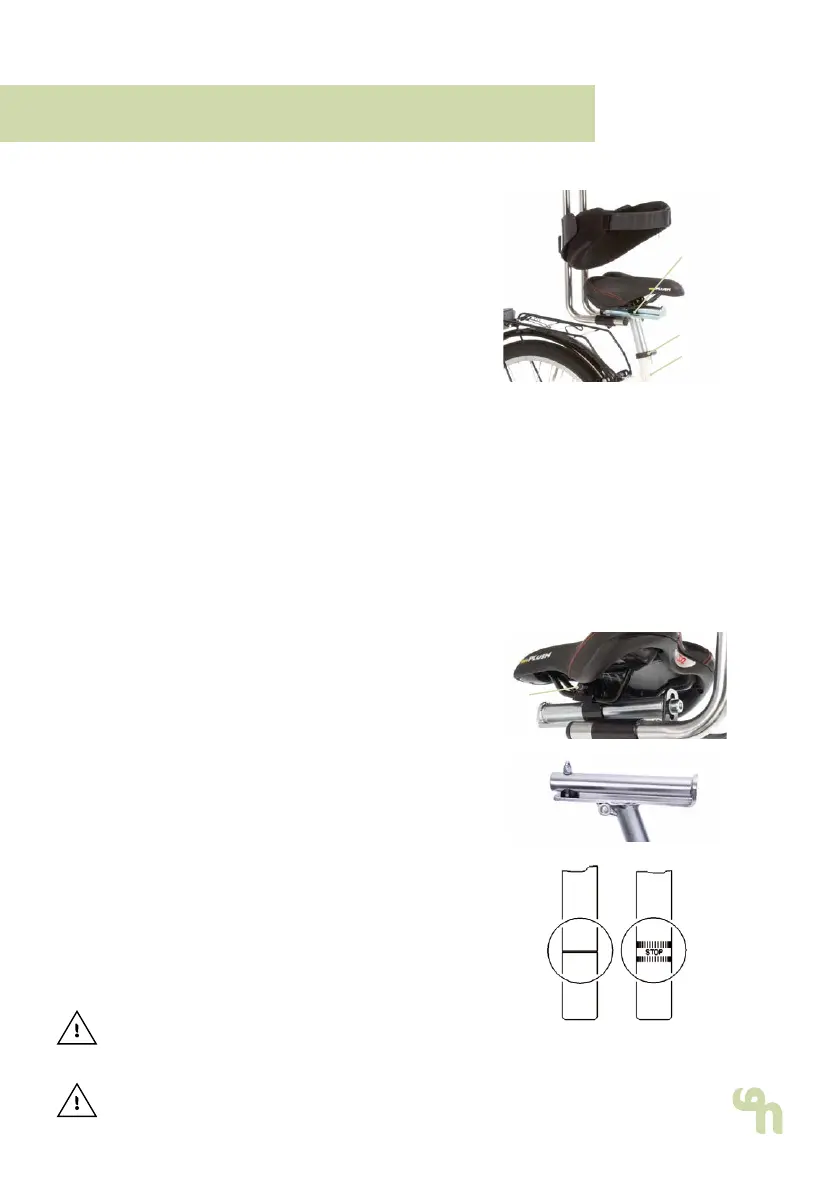
Saddle height
The height of the saddle can be adjusted
on the frame saddle tube (A) by pulling the
saddle post in or out. In order to adjust the
height, please loosen the clamp (B) and bring
the saddle into the required height. Align the
saddle and tighten the clamp (B) so tightly
that the saddle support no longer twists. The saddle height is to be re-
set based on the inseam length. Here any contractures of the knees must
be taken into consideration. The saddle height should be inspected when
the user is sitting on the saddle. The leg extension should not total 0°. In
the upper position of the pedal, the knee flexion should not be more than
90°. Should it not be possible to achieved this setting through the saddle
height, it is possible to undertake further settings through crank shortening
(see point 4.9 - 4.11).
Adjusting the saddle horizontally
Every saddle (except for the unicycle saddle)
can be minimally adjusted horizontally. To do
this, loosen the nuts (D) with a size 13 wrench
and push the calliper block (C) forwards or
backwards on the seat stays.
Adjusting the saddle with t-saddle post
horizontally
In order to check the horizontal saddle position,
turn the pedal crank horizontally forwards
and put the foot (while the rider is sitting on
the saddle) onto the pedal. Once the lower
leg is vertical, the saddle position is correct.
You can also loosen the two nuts (D) under
the saddle using a size 13 wrench, push the
saddle to the rear or forwards and re-tighten
the nuts.
During adjustment, the saddle post may not be
pulled out over the respective marking, as in this
case sufcient clamping cannot be guaranteed.
The markings are in part designed differently.
After each adjustment, please retighten all screw connections!
C
B
A
D


 To Next Page