06
2. Product description.
2.1 General information
All base frames are made of aluminium, which is non-corroding and pow-
der-coated. All other materials used are protected against corrosion
through the use of stainless steel, aluminium or plastic. All important parts,
such as the saddle, handlebars or also the pedals, can be individually
adapted to the individual requirements. Thanks to special accessories
the user can be positioned e.g. at the torso or in the calf area / foot area.
The tricycles generally have a brake hub / backpedal hub brake on the
rear wheel (except for those with a rigid sprocket) and an air pressure-
independent parking brake on the front wheel.
2.2 Handling and transport
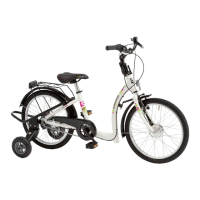
The momo therapy bicycle. is not intended for carrying since it is equipped
with tyres. Should you have to carry the equipment due to obstacles,
ensure that all moving parts are tightened. Subsequently, stand in twos
on either side of the therapy bicycle, hold the frame from the left and
right and carry it to the desired location. In order to transport the therapy
bicycle, reduce all adjustments to their most compact size (saddle height,
handlebar height, remove accessories etc.).
2.3 Application areas, use according to the intended purpose
The momo therapy bicycle. is a medical product of risk class 1 and
is designed for children, youths and adults for outdoor use. The
momo therapy bicycle. permits users with disabilities (see indications) to
move independently. The physiotherapeutic treatment is supported and
the support and balance reactions as well as movement coordination
are trained. Any other use or use over and above this purpose shall be
considered not in accordance with the intended purpose.
2.3.1 Indications
The momo therapy bicycle. is suitable for users with considerable to fully pro-
nounced impairment of mobility/ walking with structural and/or functional
damage to the lower extremities (musculoskeletal/neuromusculoskeletal
movement disorders, e.g. neuromuscular diseases with reduced or increa-
sed muscle tone, ataxias, hemiplegia, contractures and malformations or
general developmental retardation) and impaired sense of balance.
Further indications are:
• Suciently preserved strength and gripping function of arms/hands
and suciently preserved strength and coordination function of legs
• if no commercially available bicycles, even with commercially available
support wheels, can be used due to functional deficits caused by the
illness
• ensuring mobility in outdoor areas and participation in community life
(integration into a group of people of the same age)
• the improvement of the support and balance reaction/movement coor-


 To Next Page