Need help?
Do you have a question about the Scotsman C2648 and is the answer not in the manual?
Specifies limits for ice machine and remote condenser placement.
Explains the need for service access space around the ice machine.
Details environmental requirements for the ice machine operation.
Outlines environmental and power requirements for the remote condenser.
Provides general warranty coverage information for the product.
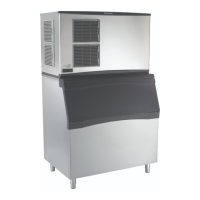
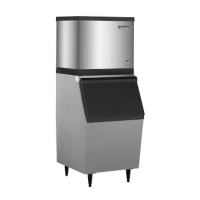
Describes the modular cuber, its components, and connection requirements.
Illustrates the breakdown of a typical model number.
Details available field-installable options for the ice machine.
Provides adapter information for standard bin applications.
Offers guidance on bin depth and upright bin recommendations.
Details electrical requirements, fuse sizes, and model specifications for the ice machine.
Provides dimensions for the remote condenser footprint and required bin top opening.
Lists requirements for connecting the ice machine to a central condenser coil.
Recommends triple head filters, specifically Scotsman SSM3 or ADS-AP3 AquaPatrol.
Specifies the minimum conductivity requirement for RO water supply.
Explains how airborne contaminants can affect sanitation and suggests filter types.
Describes the water purge feature for scale reduction and its automatic adjustment.
Guides on uncrating, attaching legs, checking gaskets, and placing the machine on the bin.
Defines maximum physical distances for rise, drop, and line set length.
Advises against specific routing configurations for the line set.
Demonstrates an acceptable calculation for remote condenser location.
Illustrates an unacceptable calculation for remote condenser location.
Provides instructions for securely attaching the remote condenser to a building’s roof.
Emphasizes verifying the correct pre-charged line set is used for installation.
Recommends minimum hole sizes for passing refrigerant lines through building structures.
Suggests coiling excess tubing horizontally inside the building for better management.
Details the initial steps for connecting the pre-charged refrigerant lines.
Outlines the procedures for tightening and checking the final connections of refrigerant lines.
Advises on installing new filter cartridges and checking existing ones.
Covers drain tubing attachment, routing, venting, and slope requirements.
Explains how electrical connections are made within the ice machine's junction box.
Provides typical ice making cycle times based on ambient and water temperatures.
Details the procedure for service technicians to adjust ice bridge thickness.
Explains how to adjust the water purge setting from automatic to manual or vice-versa.
Describes the function and meaning of the external indicator lights on the machine.
Mentions internal indicator lights, curtain switches, and their functions.
Lists optional field-installable controls like adjustable ice level and advanced feature control.
Explains the function and adjustment of the optional adjustable ice level control.
Describes the features of the Smart-Board option, including programmable settings and malfunction recall.
Explains how the cuber drops ice in sections and potential for large sections.
Notes that most heat is exhausted at the remote condenser.
Describes normal operational noises like compressor, pump sounds, and cracking before harvest.
Provides a caution regarding the acidic nature of the ice machine cleaner.
Details how to mix a recommended sanitizer solution for cleaning.
Provides instructions for cleaning the ice storage bin with scale remover and sanitizer.
Advises on checking and changing water filter cartridges based on time or pressure.
Guides on cleaning fingerprints, dust, and grease from stainless steel exterior panels.
Details how to clean the water sensor probes and probe housing for accurate readings.
Lists key technical aspects and components of the ice machine system.
Lists common reasons why the ice machine might automatically shut down.
Provides step-by-step instructions for manually resetting the ice machine.
Outlines the procedure for safely shutting down the ice machine.
Describes the mechanical remote cooled refrigeration system components.
Explains the functions of the water system components like the solenoid valve and purge valve.
Details the electronic control system and its sensors.
Describes the harvest system, including hot gas defrost and mechanical assist.
Lists the various electrical components used in the ice machine.
Lists and describes the machine's front panel indicator lights.
Explains the main codes and their meanings displayed by the controller.
References the manual for control operations like water light and de-scale notification.
Explains push button sequences for settings like water purge and de-scale notification.
Guides on modifying the interval for de-scale and sanitize notifications.
Details the operational steps and logic of the freeze cycle.
Describes the sequence of operations during the harvest cycle.
Explains the shutdown condition related to open curtains after a harvest cycle.
Describes the status of indicator lights during the freeze cycle.
Details the indicator light status during the harvest cycle.
Explains how the compressor is operated and controlled.
Describes the operation of the contactor and its control.
Details the operation of the water pumps and their control.
Explains the operation of the inlet water solenoid valve.
Describes the operation of the purge valve.
Explains when the remote condenser fan motor operates.
Describes the function of the high pressure cut out switch.
Explains the operation of harvest assist solenoids or motors.
Details the function of the liquid line valve in starting and stopping the unit.
Describes the operation of the hot gas valves.
Explains the transformer's role in supplying power to the controller.
Describes the three-probe conductivity sensor for water level detection.
Explains the single wire conductivity sensor for ice thickness detection.
Details the magnetic reed switches used for curtain position sensing.
Describes the thermistor used as a water temperature sensor.
Explains the thermistor used to measure discharge line temperature.
Specifies the refrigerant type (R-404A) and charge amount.
Provides compressor amp draw values during freeze and harvest cycles.
Describes the unified cell plate evaporators, material, and dimensions.
Identifies the water system as batch type, holding a full charge per cycle.
Explains the solenoid type water valve and its operation based on sensor probes.
Describes the unsealed pedestal type water pumps.
Identifies the water purge valve as a solenoid type.
Describes the three-probe conductivity water level sensor.
Details the ABS plastic water distributors and their function.
Summarizes the standard electronic controller's operation and features.
Lists the various connection points (J1-J11) on the controller board.
Specifies the maximum freeze time and the unit's reaction to exceeding it.
Defines the minimum freeze time and consequences of harvesting too early.
Sets the maximum harvest time and the unit's response to exceeding it.
Explains how the controller handles restarts after a power interruption.
Describes how the controller attempts to refill the reservoir after a water interruption.
Details the front accessibility and optional covering of the On/Off switches.
Explains how to set the water purge level using the control buttons.
Details the procedure to recall the last 10 diagnostic or error codes.
Outlines the method for clearing all prior diagnostic codes.
Provides the steps to reset the ice machine's control system.
Explains how to initiate the test mode for diagnostic purposes.
Describes how to lock or unlock the control panel to prevent unauthorized changes.
Details the procedure to manually empty the water reservoir.
Explains the sequence and events within the test mode.
Guides on modifying the interval for de-scale and sanitize notifications.
Lists common problems encountered with the ice machine and their likely causes.
Lists potential causes for various ice machine operational problems.
Provides probable solutions for troubleshooting identified ice machine problems.
Provides detailed procedures for testing the curtain switches using indicator lights and an ohmmeter.
Describes testing the sensor via the controller's indicator lights.
Outlines the procedure for testing the ice thickness sensor with an ohmmeter.
Explains how to test the sensor circuit by connecting a wire from J10 to ground.
Describes testing the sensor using the sump empty and sump full indicator lights.
Provides steps for testing the water level sensor with an ohmmeter.
Details how to test the water level sensor circuit by jumping harness wires.
Mentions checking the controller for out-of-range sensor calibration codes (5 or 7).
Guides on testing water and discharge temperature sensors using an ohmmeter and resistance charts.
Describes an alternate method for testing sensors using ice water.
Explains how to test water pumps using controller indicator lights.
Outlines the procedure for testing water pump motor windings with an ohmmeter.
Describes testing the purge valve using controller indicator lights.
Provides a note on the internal rectification of the purge valve coil and its resistance.
Explains testing the compressor contactor using indicator lights and voltage checks.
Guides on testing the contactor coil for continuity or shorts.
Details the procedure for testing the high pressure cut out switch using gauges and voltage.
Advises checking the transformer's secondary voltage output.
Mentions confirming controller software operation and diagnostic codes.
Describes testing the liquid line solenoid using controller indicator lights and test mode.
Outlines testing the liquid line coil resistance with an ohmmeter.
Explains how to test the inlet water solenoid valve using controller indicator lights.
Guides on testing the inlet water solenoid coil resistance with an ohmmeter.
Describes testing the harvest assist solenoid, noting it's no longer used.
Explains how to test the harvest assist motor using an ohmmeter.
Details testing procedures for hot gas or vapor valves using indicator lights and ohmmeters.
Mentions differences in water purge time settings between models.
Notes differences in maximum harvest time settings.
Highlights differences based on the number of evaporator plates.
Points out the connector for the lower light and switch panel on Prodigy Plus models.
Explains the service controller's selector switch for model compatibility.
Presents cycle times based on condenser intake air and water temperatures.
Lists suction pressure ranges for end of freeze and harvest cycles.
Provides discharge pressure ranges for end of freeze and harvest cycles.
Repeats compressor amp draw values for freeze and harvest cycles.
Provides step-by-step instructions for removing and replacing the inlet water solenoid valve.
Details replacement steps if the harvest assist is a solenoid.
Guides on setting the initial probe-to-evaporator gap and adjusting ice bridge thickness.
Provides procedures for removing and replacing the contactor.
Details the steps for replacing the ice machine's controller.
Outlines the procedure for removing and reinstalling a curtain.
Provides steps for removing and reinstalling a curtain switch.
Details the procedure for removing and replacing the purge valve.
Outlines the steps for removing and reinstalling the water level sensor.

 To Next Page

 General