MODES OF OPERATION SETUP
Set the receiver to the required mode; DGNSS, HP/XP/G2 or VBS.
Note! During certain situations it may take up to 40 min before normal operation
is achieved with regard to output of correctional data. Reasons for this
include:
First time power-up.
The unit has been moved for a longer distance without having GPS
track.
Without power for a longer period of time.
DGNSS mode setup
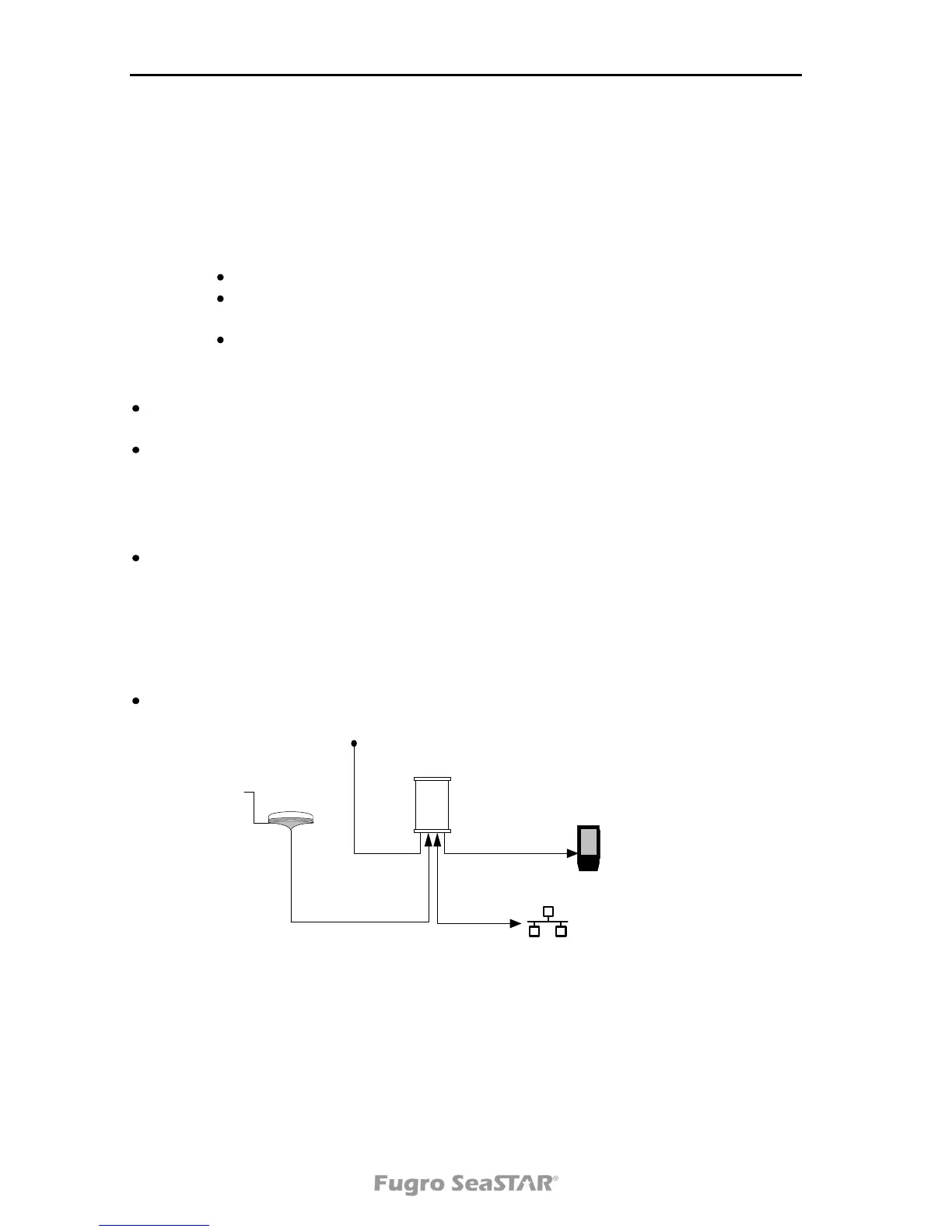
In DGNSS mode, the RTCM data will be available from the output ports A and/or B
or LAN.
In DGNSS mode, the GPS L1 output must be enabled. In addition, the GLO L1
output and Iono output could be enabled if GLONASS corrections and/or
ionospheric corrections shall be used.
HP/XP/G2 mode setup
In HP/XP/G2 mode, the HP/XP/G2 data will be available from output ports A
and/or B or LAN. Default port settings are initially configured, and will by default
change based upon the type of subscription. If different port settings are needed,
the ports will need to be set up to match the requirements of your GPS receiver
HP/XP/G2 ports. The Port Cfg menu item must then be used to set these
parameters (see page 17).
In HP/XP/G2 mode the HP/XP/G2 output must be enabled.
Figure 2. Operating in DGNSS or HP/XP mode
VBS mode setup
In VBS mode a composite set of RTCM corrections is computed from the GPS
network data sent over the link. The following information is required to compute
these corrections; time (supplied via the link), GPS almanac data (supplied via the


 To Next Page