EasyManua.ls Logo

Sequential PROPHET-600 - 5-2 PLAYBACK

Sequential PROPHET-600
92 pages
Print Icon
To Next Page IconTo Next Page
To Previous Page IconTo Previous Page
Loading...
2
THEORY
2-0
GENERAL
This
section
explains
the
Prophet-600's
theory
of
operation.
First
a
general
discussion
provides
a
functional
overview,
then
the
microcomputer
and
synthesizer
circuits
are
detailed.
Throughout
it
is
assumed
that
the
reader
is
both
familiar
with
operation
of
the
instrument
(see
Operation
Manual
CM600)
and
with
the
functions
of
common
linear,
TTL,
and
CMOS
integrated
circuits
(ICs).
Anyone
contemplating
repair
or
modification
work
on
the
Prophet-600
must
already
be
familiar
with
op
arnp
circuits
and
digital
logic.
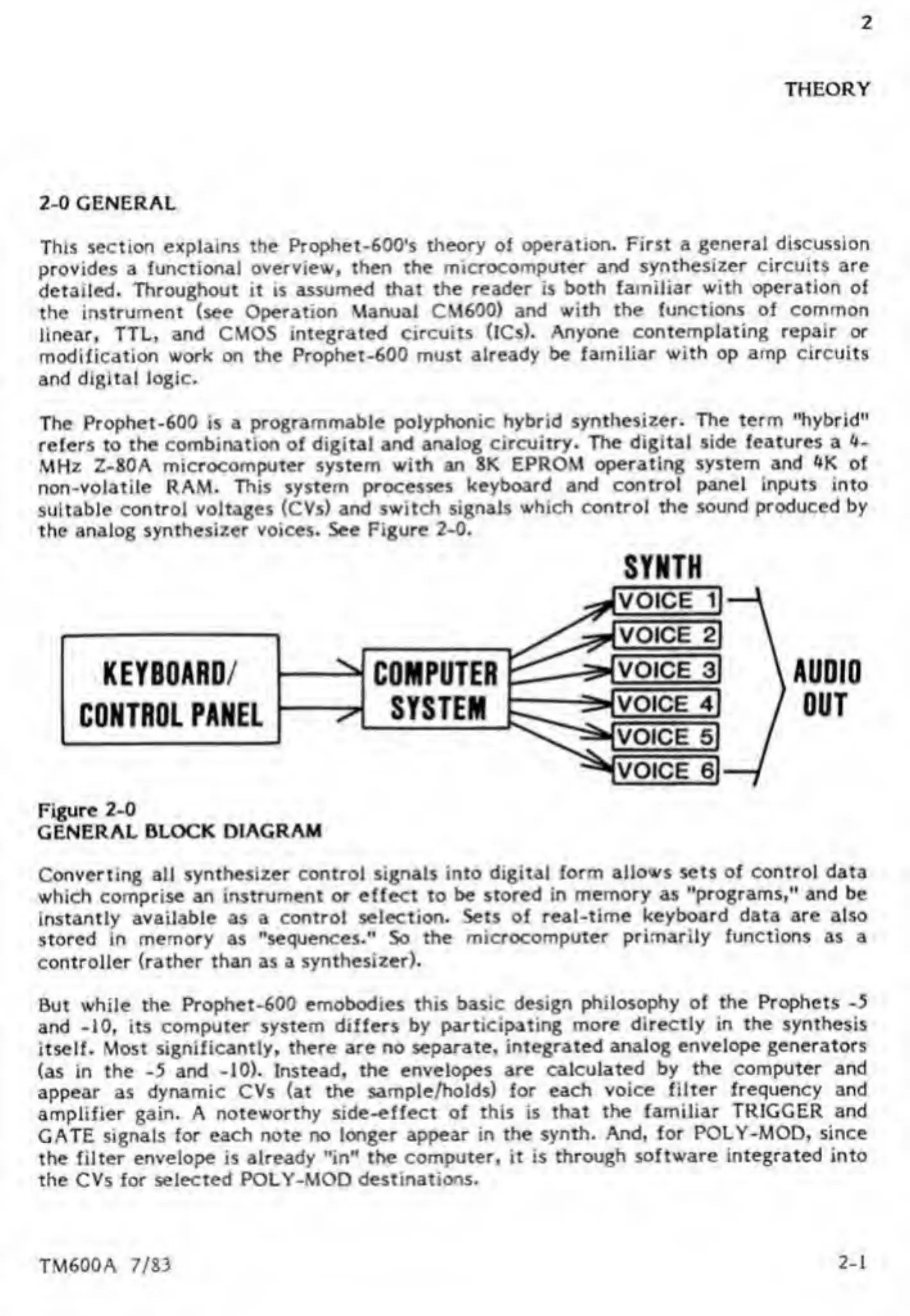
The
Prophet-600
is
a
programmable
polyphonic
hybrid
synthesizer.
The
term
"hybrid"
refers
to
the
combination
of
digital
and
analog
circuitry.
The
digital
side
features
a
<#-
MHz
2-80A
microcomputer
system
with
an
8K
EPROM
operating
system
and
4K
of
non-volatile
RAM.
This
system
processes
keyboard
and
control
panel
inputs
into
suitable
control
voltages
(CVs)
and
switch
signals
which
control
the
sound
produced
by
the
analog
synthesizer
voices.
See
Figure
2-0.
SYNTH
Figure
2-0
GENERAL
BLOCK
DIAGRAM
Converting
all
synthesizer
control
signals
into
digital
form
allows
sets
of
control
data
which
comprise
an
instrument
or
effect
to
be
stored
in
memory
as
"programs,"
and
be
instantly
available
as
a
control
selection.
Sets
of
real-time
keyboard
data
are
also
stored
in
memory
as
"sequences."
So
the
microcomputer
primarily
functions
as
a
controller
(rather
than
as
a
synthesizer).
But
while
the
Prophet-600
emobodies
this
basic
design
philosophy
of
the
Prophets
-5
and
-10,
its
computer
system
differs
by
participating
more
directly
in
the
synthesis
itself.
Most
significantly,
there
are
no
separate,
integrated
analog
envelope
generators
(as
in
the
-5
and
-10).
Instead,
the
envelopes
are
calculated
by
the
computer
and
appear
as
dynamic
CVs
(at
the
sample/holds)
for
each
voice
filter
frequency
and
amplifier
gain.
A
noteworthy
side-effect
of
this
is
that
the
familiar
TRIGGER
and
GATE
signals
for
each
note
no
longer
appear
in
the
synth.
And,
for
POLY-MOD,
since
the
filter
envelope
is
already
"in"
the
computer,
it
is
through
software
integrated
into
the
CVs
for
selected
POLY-MOD
destinations.
TM600A
7/83
2-1

Other manuals for Sequential PROPHET-600

Related product manuals