EasyManua.ls Logo

Sequential PROPHET-600 - 7-8 LFO-MOD; 7-9 POLY-MOD

Sequential PROPHET-600
92 pages
Print Icon
To Next Page IconTo Next Page
To Previous Page IconTo Previous Page
Loading...
To
obtain
a
better
understanding
of
the
DAC
function,
it
will
be
useful
to
actually
observe
Vdac
on
an
oscilloscope,
while
exercising
various
keyboard
and
control
operations.
For
example,
the
individual
FIL
and
AMP
CVs
will
be
seen
to
follow
envelope
movements.
The
effects
of
various
modulation
paths
can
be
easily
demonstrated.
The
two
sets
of
seven
voltages
at
the
end
of
the
strobe
are
the
wheel
and
control
successive-approximation
voltages
used
to
detect
changes
in
position.
This
technique
will
be
discussed
with
the
ADC.
U414
drives
four
CV
DMUX
ICs,
and
the
ADC
comparator
(see
below).
Referring
for
a
moment
to
sheet
D,
U329
(-CS05)
and
Y»
U330
latch
seven
CV
DMUX
ADDRESS
bits.
This
data
selects
the
destination
S/H
for
each
Vdac
value.
One
of
eight
S/H
on
each
4051
is
selected
with
lines
ABC.
The
10-13
(Inhibit)
lines
go
low
to
enable
the
active
DMUX
chip.
(Vee
of
each
4051
is
operated
from
-5V
because
this
lowers
the
operating
impedance
of
the
analog
switches
in
the
4051.
Vdac
is
always
positive.)
There
are
two
main
types
of
CVs:
polyphonic
and
monophonic.
Polyphonic
CVs
are
those
which
vary
with
the
keyboard.
In
this
class
are
the
six
separate
OSC
A,
OSC
B,
filter,
and
amplifier
CVs
which
are
demultiplexed
by
U415,
U416,
and
U417.
Of
the
eight
CVs
demultiplexed
by
U41S,
six
are
monophonic,
because
they
each
go
to
all
six
voices.
Similar
to
the
switch
bits,
these
voltages
are
basic
program
parameters.
The
basic
S/H
circuit
for
each
of
these
consists
of
a
low-leakage
capacitor
and
a
BIFET
opamp,
which
has
an
extremely
high
input
impedance.
The
4051
momentarily
connects
Vdac
to
the
S/H.
The
capacitor
charges
to
the
value
of
Vdac.
It
retains
this
value
while
the
demultiplexer
strobes
all
the
other
S/Hs.
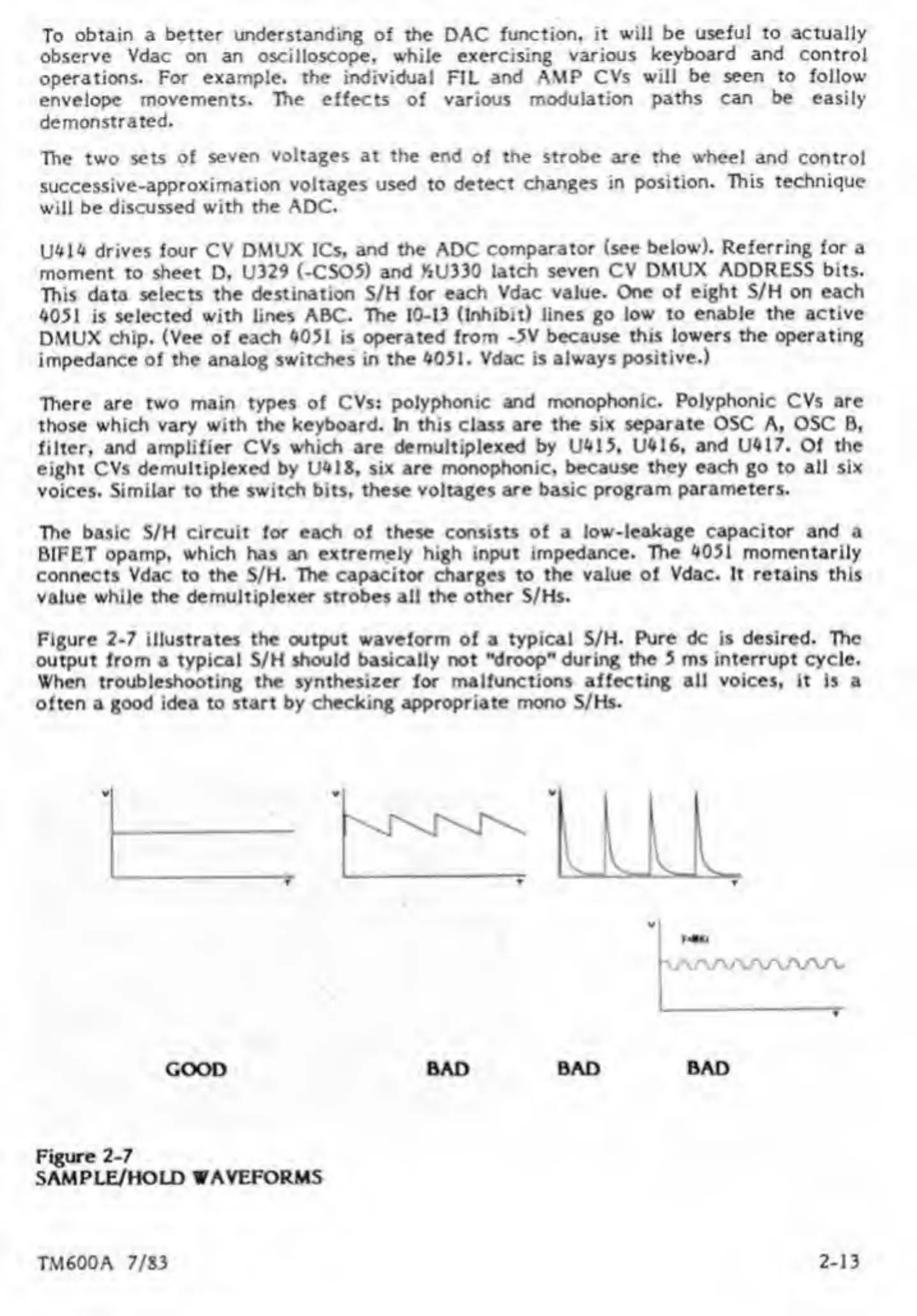
Figure
2-7
illustrates
the
output
waveform
of
a
typical
S/H.
Pure
dc
is
desired.
The
output
from
a
typical
S/H
should
basically
not
"droop”
during
the
5
ms
interrupt
cycle.
When
troubleshooting
the
synthesizer
for
malfunctions
affecting
all
voices,
it
is
a
often
a
good
idea
to
start
by
checking
appropriate
mono
S/Hs.
BAD
BAD
BAD
Figure
2-7
SAMPLE/HOLD
WAVEFORMS
TM600A
7/83
2-13

Other manuals for Sequential PROPHET-600

Related product manuals