EasyManua.ls Logo

Sequential PROPHET-600 - Page 78

Sequential PROPHET-600
92 pages
Print Icon
To Next Page IconTo Next Page
To Previous Page IconTo Previous Page
Loading...
V
flu
im
n
1
1
X
w
w
w
*
i
TTo
t
r“
•tw
y
y
W
*
-1
t
-•T
M.jf
,M
|
•Ol'f.fl
*»C4"Tl
'
-nr
-4*1
»WC
»•
ll
1
M(140I
iMItat
H
M4i)<iia^CIKI
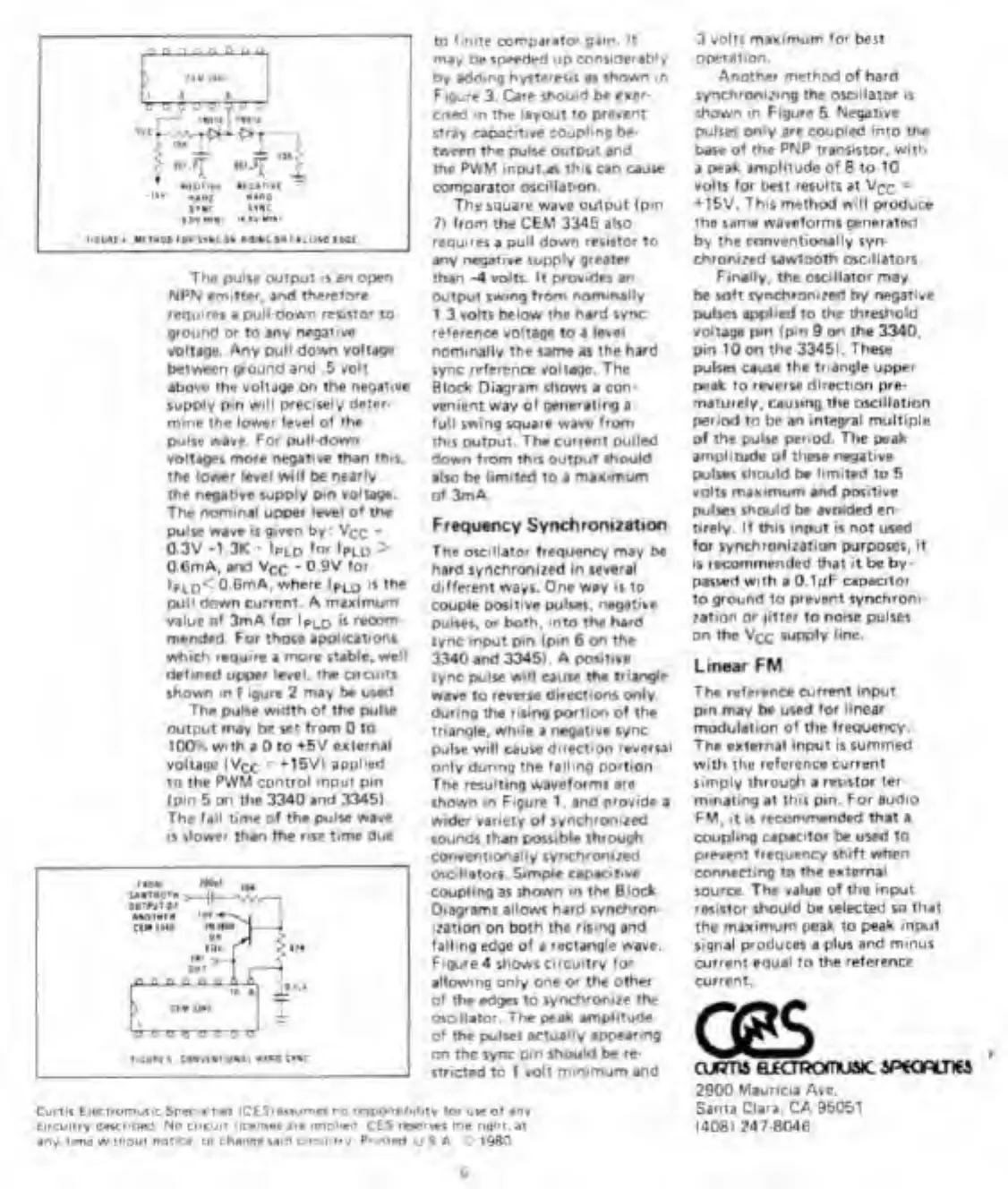
The
puli*
output
ii
an
open
NPN
emitter.
and
therefore
requires
a
pull
(town
reuslor
to
ground
Of
to
any
negative
voltage
Any
Dull
(town
voltage
between
(pound
and
.5
volt
above
the
voltage
on
the
negative
vuppiy
pm
will
precisely
deter-
mine
the
lowe'
level
o*
the
pulse
wave.
For
pull-down
voltages
move
negative
than
this,
the
lower
level
will
be
nearly
the
negative
supply
pm
voltage.
The
nominal
upper
level
of
the
pulse
wave
it
given
by:
Vcc
-
0.3V
-1
3*C
l
PlD
lor
l
PLO
>
0
.6mA,
and
V
cc
-
0.9V
for
Ino*0.6mA.
where
l
PlQ
it
the
pull
down
current.
A
maximum
value
of
3mA
fo*
lp
LD
it
recom
mended
For
thotc
applications
which
reau're
a
more
stable.
well
defined
upper
level,
the
cncuitt
shown
m
I
igure
2
may
be
used
The
pulse
width
of
the
pulte
output
may
be
tet
from
0
to
tOOS
wi
th
a
0
to
*5V
external
voltage
IV
C
c
"
*15V)
applied
to
the
PtVM
control
input
pm
(pm
5
on
the
3340
and
33451
The
fall
time
of
the
pulse
wave
it
slower
than
the
rise
time
due
to
finite
comparator
gain.
It
may
be
speeded
up
eontiderahiy
by
adding
hysteresis
at
thown
in
F
igure
3
Care
should
be
exer
cited
m
the
layout
to
prevent
stray
capacitive
coupling
be
tween
the
pulse
output
and
the
PWM
mput.at
this
can
cause
comparator
otciUat*on.
The
square
wave
output
Ipm
7)
from
the
CEM
3345
aHo
requires
a
pull
down
retittor
to
any
negative
supply
greater
than
-4
volts
It
provides
an
Output
swing
from
nominally
1
3
volts
below
the
hard
sync
reference
voltage
to
a
level
nominally
the
same
as
the
hard
sync
reference
voltage.
The
Block
Diagram
shows
a
con¬
venient
wav
o!
generating
a
full
swing
square
wave
from
this
output.
The
current
pulled
down
from
this
output
should
also
be
limited
to
a
maximum
of
3mA
Frequency
Synchronization
The
oscillator
frequency
may
be
hard
synchronized
in
several
different
ways.
One
way
n
to
couple
positive
pulses,
negative
pulses,
or
both,
into
the
hard
sync
input
pin
(pm
6
on
the
3340
and
3345)
A
positive
syne
pulse
will
cause
the
triangle
wave
to
reverse
directions
only
during
the
using
portion
of
the
triangle,
while
a
negative
sync
pulse
will
cause
direction
reversal
only
during
the
falling
portion
The
resulting
waveforms
are
shown
m
Figure
1.
and
provide
a
wider
variety
ol
synchronized
sounds
than
possible
through
conventionally
synchronized
oscillators
Simple
capacitive
coupling
as
shown
in
the
Block
Diagrams
allows
hard
synchro*
zation
on
Both
the
rismg
and
lading
edoe
of
a
roctanglc
wave,
Fig^e
4
shows
circuitry
for
allowing
only
one
O'
the
Other
of
th#
edges
to
synchronize
the
oscillator
The
peak
amplitude
of
the
pulses
actually
appearing
on
the
sync
pin
should
be
re
stricter)
to
1
volt
minimum
and
Curtis
t
lecuomuiic
Spec
lies
ICC
Si
assumes
"O
lesPOnsbiMv
for
uw
ol
»"v
circuitry
described
No
circuil
iicansei
ai*
implied
CES
iesei.es
me
right.
at
in.
ime
w
mom
not-C#
to
chanqa
said
cucil'v
Prime*!
USD
C
198“
6
3
volts
mavimum
tor
best
operation.
Another
method
of
hard
synchronizing
the
oscillator
is
shown
in
Figure
5
Negative
Pulses
only
are
coupled
into
th#
base
of
the
**NP
transistor,
with
a
peak
amplitude
of
8
to
10
volts
for
best
results
at
V
cc
«
*
15V.
Thu
method
will
produce
the
same
waveforms
generated
by
the
conventionally
syn
chronized
sawtooth
oscillators
Finally,
the
oscillator
may
be
soft
synchronized
by
negative
pulses
applied
to
the
threshold
voltage
pm
(pm
9
on
the
3340
pin
10
on
th*
33451.
These
pulses
cause
the
triangle
upper
peak
to
reverse
direction
pre¬
maturely,
causing
ttae
oscillation
period
to
be
an
integral
multiple
of
the
pulse
period.
The
peak
amplitude
of
these
negative
pulses
should
be
limited
to
5
volts
maximum
and
positive
pulses
should
Be
avoided
en
tirely.
If
this
input
is
not
used
for
synchronization
(Mrposes,
it
is
itcommended
that
it
be
by
passed
with
a
0
IpF
capacitor
to
ground
to
prevent
synchros
zation
or
litter
to
none
pulses
on
the
*
u
W*lv
line.
Linear
FM
The
reference
current
input
pin
may
be
used
for
linear
modulation
ol
the
frequency.
The
external
input
is
summed
with
tho
refeieoce
current
simply
through
a
resistor
ter¬
minating
at
this
pm.
For
audio
FM,
it
•!
recommended
that
a
coupling
capacitor
be
used
to
prevent
frequency
shift
when
connecting
to
the
external
source
The
value
of
the
input
resistor
should
be
selected
so
that
the
maximum
peak
to
peak
input
signal
produces
a
plus
and
minus
current
equal
to
the
reference
current.
G2S
curtu
aKTncxnuaic
aPKnnca
2900
Mauricia
Ave.
Santa
Clara.
CA
95051
14081
247
8046

Other manuals for Sequential PROPHET-600

Related product manuals