12
13Connections
Sequential Prophet Rev2 User’s Guide
Connections
Connections
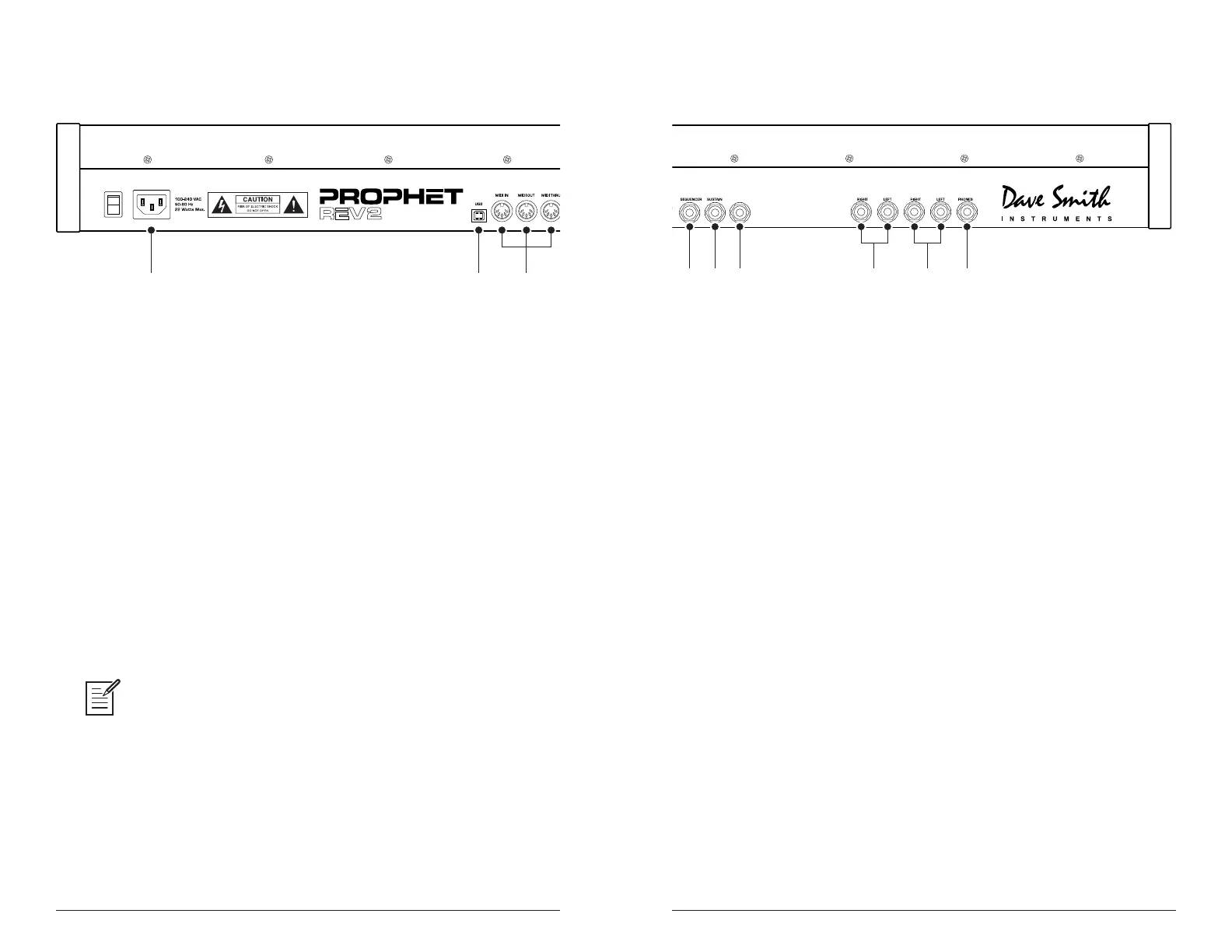
1. AC Power Connector—Accepts a standard, grounded IEC power
cord. Operates over a range of 100 to 240 volts and 50 to 60 Hz.
2. USB—For bidirectional MIDI communication with a computer. The
Prophet Rev2 is a Class Compliant USB device and does not require
additional drivers when used with Mac OS or Windows. See “Using
USB” on page 70 for more information.
3. MIDI In, Out, and Thru—Standard 5-pin MIDI DIN connectors.
4. Sequencer—Accepts a momentary, normally open or normally closed
footswitch to turn the sequencer or arpeggiator on and off. Alternatively, an
audio signal connected to this jack can be used to either control sequencer/
arpeggiator playback, or to gate the lter and amplier envelopes while
notes are held. See Pedal/CV on page 13 for more information about
choosing the appropriate mode for these behaviors.
Audio signals used to drive the arpeggiator/sequencer should not exceed 5
volts peak-to-peak.
5. Sustain—Accepts a momentary, normally open or normally closed
footswitch to control sustain.
1 2 3
4 5 6 9
PEDAL/CV
MAIN A OUTPUT
7 8
B OUTPUT
4 5 6 9
PEDAL/CV
MAIN A OUTPUT
7 8
B OUTPUT
6. Pedal/CV—Accepts a standard expression pedal that has a variable
resistor on a TRS (tip-ring-sleeve) ¼ inch phone plug. Once connected,
you can use the modulation matrix to route the pedal to control a variety
of things such as volume or lter cutoff frequency to add expressiveness
to live performance.
7. B Audio Outputs—Unbalanced, ¼ inch audio outputs. Connect audio
cables to these jacks if you want separate stereo outputs for Layer B. If
no cables are connected, Layer B is output on the Main A Outputs.
8. Main/ A Audio Outputs—Unbalanced, ¼ inch audio outputs. These
are the main stereo outputs for the synth. They carry Layer A and also
Layer B if no cables are connected to the “B Audio Outputs” jacks.
9. Headphones—A ¼ inch stereo headphone jack. Headphone volume is
controlled by the master volume knob on the front panel.



 To Next Page