31
How to measure
Measure both the front and rear toe-in
using the set-up tool from HUDY
7.1 Front Toe-in - Setting
Adjust the front toe-in to -0.5 degrees
(fronts of front wheels pointing slightly
outwards).
7.2 Rear Toe-in - Setting
Adjust the rear toe-in to +2 degrees
(fronts of rear wheels pointing inwards).
8 Caster angle
Caster angle is the angle of an imaginary line between the top pivot
ball and the bottom pivot ball of the steering block, with respect to
a line perpendicular to the ground. Caster angle affects on- and off-
power steering, as it will tilt the chassis more or less depending on
how much caster is applied.
In general changing caster has an effect on on-throttle handling.
Giving more caster results in more on-throttle oversteer (or less
understeer). Effects on off-throttle balance is quite little and difficult
to predict.
How to adjust
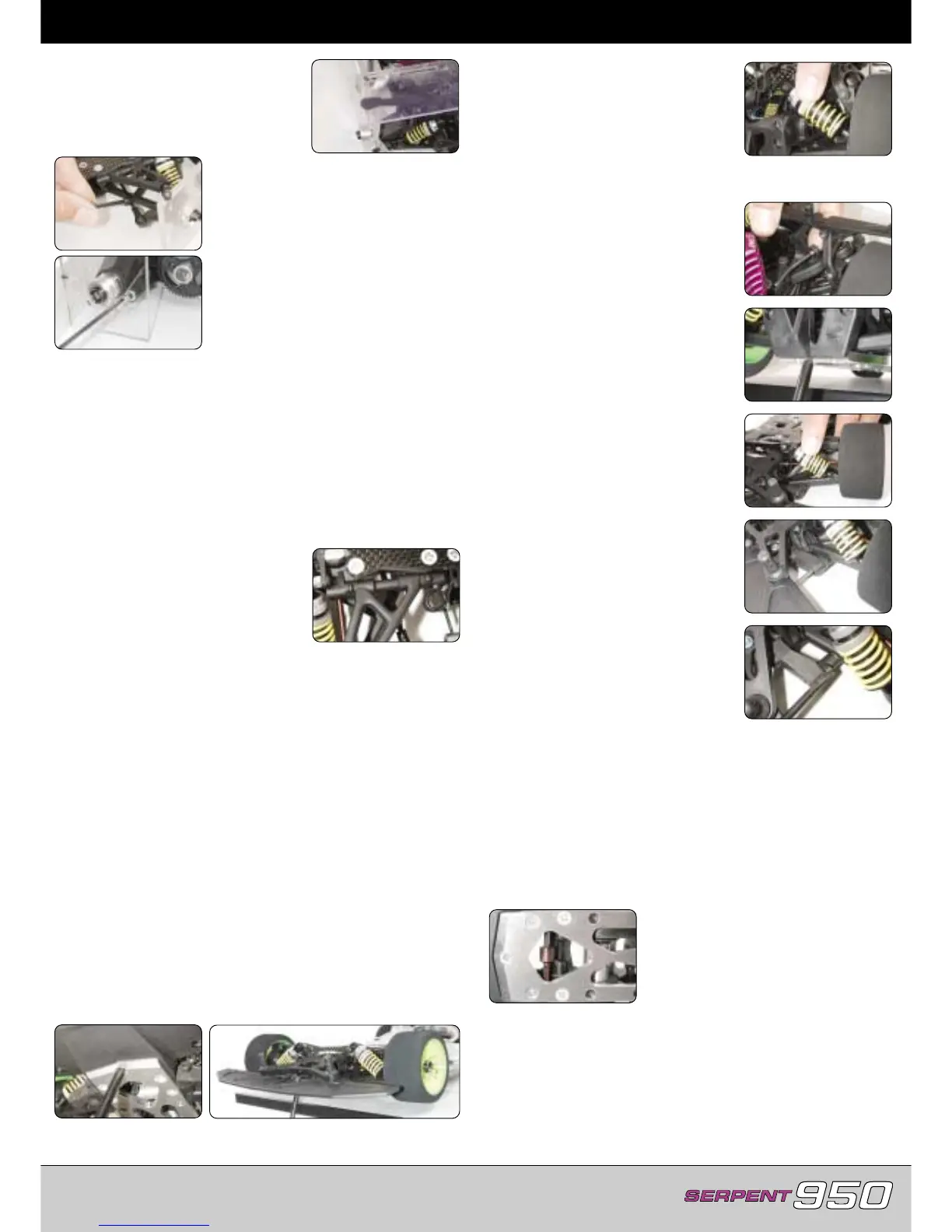
The caster angle is adjusted with nylon
spacers which are inserted either in front
of or behind the upper front suspension
arm. More spacers in front of the arm
will increase the caster angle. More
spacers behind the arm will decrease the
caster angle.
8.1 Caster - Setting
Set the front caster gap to 2mm (2mm shim in front of the upper
arm, 1+4mm shims behind).
9 Checking for suspension tweak
A "tweaked" car is an unbalanced car, and has a tendency to pull to
one side under acceleration or braking. Tweak is caused by an
uneven wheel-load on one particular axle. Now that the suspension
geometry set-up has been completed, you must check for suspen-
sion tweak before you reconnect the anti-roll bars.
Perform these initial steps:
A Place the car on a flat reference surface.
B Make sure that both front and rear anti-roll bars are disconnect-
ed.
C Put a set of good tires on the car, important is that the left
wheels have the same size than the right ones
9.1 Checking for tweak from the front of the car. Lift and drop the
front end of the car a few cm's to let the suspension settle. Place a
sharp tool underneath the chassis at its middle point, and lift the
front end. If one front wheel lifts before the other, the rear of the
car is tweaked.
9.2 Adjust the preload on the rear
springs until both front wheels lift at the
same time. If, for example, the front right
wheel lifts earlier, you must increase the
preload on the rear left spring, and
decrease the preload on the rear right
spring. You must adjust both rear
springs, otherwise you will change the
ride height.
9.3 Reconnect the rear anti-roll bar, and
check for tweak again by lifting the front
end of the car. If again one front wheel
lifts before the other, the rear anti-roll bar
is tweaked. Adjust the length of one or
both rear anti-roll bar pushrods until both
front wheels lift at the same time.
9.4 Checking for tweak from the rear of
the car. Lift and drop the rear end of the
car a few cm's to let the suspension set-
tle. Place a sharp tool underneath the
chassis at its middle point, and lift the
rear end. If one rear wheel lifts before
the other, the front of the car is tweaked.
9.5 Adjust the preload on the front
springs until both rear wheels lift at the
same time. If, for example, the rear right
wheel lifts earlier, you must increase the
preload on the front left spring, and
decrease the preload on the front right
spring. You must adjust both front
springs, otherwise you will change the
ride height.
9.6 Reconnect the front anti-roll bar, and
check for tweak again by lifting the rear
end of the car. If again one rear wheel
lifts before the other, the front anti-roll
bar is tweaked. Loosen the screw on the
left front anti-roll bar mount. Adjust the
eccentric cam until both rear wheels lift
from the ground at the same time.
Tighten the screw to secure the adjusting
cam.
10 Anti-roll bars
Anti-roll bars are used to adjust the car's side-traction. In general,
increasing the hardness of an anti-roll bar on one particular axle
decreases the side-traction of that axle and increases the side-trac-
tion of the other axle. For example, if you make the front anti-roll
bar harder, you decrease the side-traction of the front and increase
the side-traction of the rear. This will result in less steering (more
understeer).
Changing the front anti-roll bar has more effect on turning-in
(entering a turn, decelerating, off-power).
Changing the rear anti-roll bar has more effect on powering-out
(exiting a turn, accelerating, on-power).
How to adjust
You adjust the front anti-roll bar by turn-
ing both blades to an equal angle. The
flat of the blade in a horizontal position
is the softest position; the vertical posi-
tion is the hardest position.
10.1 Front anti-roll bar - Setting
Adjust the front anti-roll bar to the (softest) horizontal position.
10.2 The rear anti-roll bar is non-adjustable unless you obtain the
optional adjustable anti-roll bar (#909335). This can be adjusted
the same as the front.
By changing which anti-roll bar mounting hole on the lower arm you
use changes the effect of the anti-roll bar. The inner hole gives a
softer setting were the outer holes give a harder setting (standard).


 To Next Page
 Loading...