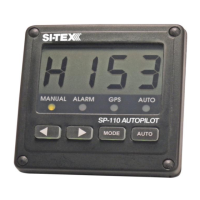
The SI-TEX SP-70 and SP-80 Autopilots are marine electronic devices designed to automatically steer a vessel, providing an aid to navigation. They feature four operating modes, watertight design, and a built-in navigation interface.
Function Description:
The autopilots offer several operating modes:
- STANDBY Mode: Allows manual steering while displaying compass information.
- POWER STEERING Mode: Features a push-button steering control and displays compass and rudder information.
- PILOT Mode: Steers to a constant heading.
- NAV Mode: Steers along a course line when connected to an appropriate navigation device.
The SP-70/SP-80 also includes a "Ghost Rudder" program. If the Rudder Feedback fails, the Autopilot uses its memory of rudder movement to calculate new rudder positions. This allows the Autopilot to steer even without the Rudder Feedback, although the quality of steering control may be reduced.
The devices receive information from LORAN, plotters, and GPS in NMEA 0183 format, enabling steering along a course line to a waypoint or through a series of waypoints grouped as a route. The Autopilot cannot steer solely based on navigation device information; it requires compass data.
Important Technical Specifications:
- Power Supply: 10VDC - 40VDC
- Steering Outputs: 20 Amperes Maximum
- SP-70 Control Unit Dimensions: 2.75 x 5.13 x 1.0 in. (7.0 x 13.3 x 2.5 cm)
- SP-80 Control Unit Dimensions: 6.0 x 3.1 x 1.0 in. (15.4 x 7.9 x 2.5 cm)
- Processor Dimensions: 6.3 x 15 x 2.7 in. (16.0 x 38.1 x 6.9 cm)
- Compass Dimensions: 5.8 x 4.2 x 3.0 in. (14.7 x 10.7 x 7.6 cm)
- Pump Dimensions: 4.8 x 7.5 x 4 in. (12.2 x 19.0 x 10.2 cm)
Adjustable Reversing Pump Specifications (Optional):
- Part Numbers: 20810016 (12VDC/18CI), 20810031 (24VDC/18CI), 20810018 (12V/30CI), 20810035 (24V/30CI)
- Operating Voltage: 12VDC or 24VDC
- Max Displacement: 73 in³ (18CI) or 122 in³ (30CI)
- Current @ 200 PSI: 4.5 Amps (18CI) or 6.0 Amps (30CI)
- Max Pressure: 800 PSI (18CI) or 500 PSI (30CI)
- Port Sizes: 3/8 inch compression fittings supplied
- Min Stall Pressure: 1200 PSI (84.0 Bar) (8,268 kPa)
- Oil Type: Any approved hydraulic steering fluid
- Operating Temperature: 0 to 50 Degrees Celsius (32 to 122 Fahrenheit)
- Lockvalve: Yes
- Lockvalve Leakage: Negligible
- Unbalanced Cylinder: Yes, up to 3/4 (1.9cm) diameter rod
- Weight: 5.0 lbs (2.27 kg) including wire
- Size: 10 inches x 3.75 inches x 4.75 inches (254mm x 95mm x 121mm)
- Shaft Seal: 100 PSI (6.89 Bar) (689 kPa) minimum
Usage Features:
- Set-up Routine: The autopilot requires a set-up routine to calibrate the steering system, check rudder movement, and adjust the compass. This involves moving the steering wheel to its limits, bleeding the hydraulic system (if applicable), and turning the vessel in a circle for compass calibration.
- Rudder Response Settings: The autopilot allows adjustment of Rudder Response (slow/fast) and Counter-Rudder sensitivity to optimize steering performance based on vessel speed and conditions.
- Turns and Course Changes: The system supports various methods for making course changes, including small course changes using the Red/Green keys and larger changes by pressing the Pilot Key.
- Power Steer Mode: In this mode, the Red or Green keys can be used to cause the steering wheel to move, allowing for precise steering adjustments.
- Dodge Function: Allows for temporary course changes to the left or right, returning to the original course when the key is released.
- Digital Rudder Angle Indicator (RAI): The SP-70 and SP-80 provide an electronic RAI that can be calibrated to accurately reflect rudder movements and show zero degrees when the vessel is traveling straight ahead, even with a slight rudder offset.
- Navigation Interface: The autopilot can connect to LORAN, GPS, or plotters via NMEA 0183 to steer along a programmed course. It includes a cross-track error feature and allows adjustment of the cross-track error direction interpretation.
- Second Station Option: An optional second station kit allows for remote autopilot operation from another location on the vessel. Only one control can operate the autopilot at a given time, with the active control having a steady display and the non-active control having a continuously flashing LCD display.
Maintenance Features:
- Warning: The autopilot is an aid to navigation and not a substitute for a qualified and alert person. It's crucial to monitor the course and supervise manual control when underway.
- Hydraulic System Checks: Regular checks for leaks, loose components, and air in the hydraulic system are essential, especially during the first several weeks after installation. The manual provides detailed pump bleeding instructions.
- Error Codes: The system displays various error codes (e.g., BLED, EEPR, F'CMP, F'DAT, GHrd, X8, XEAD, XEYS) to indicate specific issues, such as bleed mode, faulty EEPROM, compass sensor failure, navigation data problems, Ghost Rudder activation, battery voltage issues, faulty head, or stuck keys.
- Fuse Replacement: The SI-TEX Processor is protected against reversed power connection by a fuse. Instructions are provided for replacing the fuse and checking power supply polarity.
- Processor Mounting: The processor should be mounted horizontally to prevent damage from vibration.
- Cable Management: Proper routing and protection of cables from abrasion, stretching, and cutting are important for system longevity.
- Compass Location: The compass should be mounted in a stable position, away from magnetic materials or power cables, to ensure accurate readings.
- Rudder Feedback Installation: Detailed instructions are provided for installing and adjusting the rudder feedback mechanism, ensuring it moves freely without binding.
- Power Cable Installation: Instructions for connecting the power cable and using a breaker for protection are included.
- Fluxgate Compass Installation: Guidelines for mounting and orienting the fluxgate compass are provided, emphasizing the importance of correct alignment and avoiding magnetic interference.

 Need help?
 General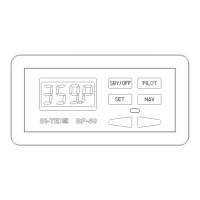

 To Next Page