DANGER
H
azard due to lack of effectiveness of the protective device
Persons and parts of the body to be protected may not be recognized in case of
non-observance.
b
Make sure that the optical properties of the front screens of the sender and
receiver are not changed, e.g., by:
°
beading water, mist, frost, or ice formation. If applicable, remove films or
other types of contamination, disconnect the voltage supply of the receiver
and then switch it back on.
°
Scratches or damage. Replace the device whose front screen is scratched or
damaged.
b
Make sure that all reflective surfaces and objects maintain a minimum distance
from the protective field.
b
Make sure that no dispersive media (e.g., dust, fog, or smoke) are within the
calculated minimum distance from the protective field.
Further topics
•
"Mount
ing", page 31
4.3.1 Scanning range and protective field width
Important information
DANGER
Hazard due to lack of effectiveness of the protective device
Persons and parts of the body to be protected may not be recognized in case of
non-observance.
b
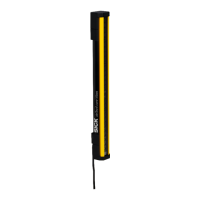
The safety light curtain can only be mounted to machines on which the protective
field width does not change when the safety light curtain is switched on.
Protective field width
T
he protective field width is the dimension of the light path between sender and
receiver. The maximum protective field width is limited by the scanning range.
The protective field width is automatically calibrated when the safety light curtain is
switched on during initialization and must not be changed during operation.
Scanning range
T
he scanning range limits the maximum protective field width. The protective field width
cannot change during operation.
The scanning range is reduced by using deflector mirrors.
Further topics
•
"Minimum dis
tance to reflective surfaces", page 20
•
"Technical data", page 57
•
"Deflector mirrors", page 68
4.3.2 Minimum distance from the hazardous point
Overview
A minimum dis
tance must be maintained between the safety light curtain and the
hazardous point. This distance is required to prevent a person or part of their body from
reaching the hazardous point before the end of the machine’s dangerous state.
PROJECT PLANNING 4
8021796/1DCM/2022-10-27 | SICK O P E R A T I N G I N S T R U C T I O N S | deTec4 Core Ex II 3GD
17
Subject to change without notice



 To Next Page
 Loading...