Need help?
Do you have a question about the SICK multiScan136 and is the answer not in the manual?
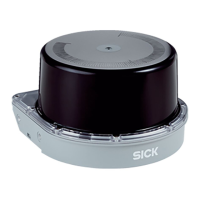
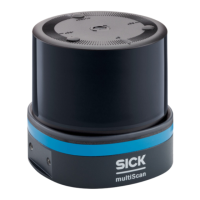
The SICK multiScan136 is a 3D LiDAR sensor designed for invisible object detection in monitored areas, suitable for both indoor and outdoor, and mobile or stationary applications. It operates by scanning its surroundings with laser beams and measuring distances and angles to objects in spherical coordinates relative to its measurement origin. The device uses an in-house technology from SICK, employing a multi-echo concept that statistically evaluates multiple single pulses to form a measured value. This process can evaluate up to three echo signals per measuring beam, providing reliable results even in adverse ambient conditions.
The multiScan136 emits pulsed laser beams from a laser diode. When a beam reflects off an object, it is received by the sensor, and the distance to the object is calculated based on the time-of-flight. The device features 16 scan layers, including a high-resolution planar scan layer at an elevation angle of 0° for precise navigation, and 15 conical scan layers (5 downwards, 10 upwards). One of the conical layers, at an elevation angle of 34.5°, is also high-resolution and can be used for tasks like checking overhangs in high-bay warehouses. The scan layers are numbered in ascending order with descending elevation angles. The conical shape of most scan layers means that when they hit a flat object, the scan lines are bent slightly upwards or downwards, with the curvature increasing with the elevation angle.
Laser beams are emitted by internally rotating sender-receiver units (SRUs), scanning the surroundings orbitally. The received measured values are assigned to the corresponding angular cut and direction. High-resolution scan layers (layers 6 and 14) send 24 pulses over an angular range of 0.125° every 0.125°, resulting in an angular resolution of 0.125°. Other scan layers send 24 pulses over an angular range of 0.125° every 1° of rotation, yielding a 1° angular resolution. This multi-layer technology with different vertical angles helps compensate for pitch angle, especially when the device is mounted on a vehicle, ensuring reliable object detection during acceleration or braking.
The device outputs data in its own coordinate system (X=0, Y=0, Z=0), which serves as the origin for all laser beams and distance measurements. The azimuthal (horizontal) angle is called theta, with the 0° azimuth beam aligned with the main viewing direction. The elevation angle (vertical angle), phi, is measured relative to the x-y plane, with negative values for positive z-values (above x-y plane) and positive values for negative z-values (below x-y plane).
Digital filters are available to pre-process and optimize measured distance values for specific application requirements, preventing faults. These include:
Measurement data is output in MSGPACK and Compact formats via UDP, both allowing segmented output. These formats include device identification, serial number, time stamp, and device status. MSGPACK is easier to integrate but requires more computing power and bandwidth, while Compact is more efficient but less descriptive. The actual vertical angle value of each scan layer can be read from the device. Data is recorded over a 360° azimuth range, with a "frame" being a 360° rotation for all scan layers. This frame is divided into segments, each containing data for all scan layers within a smaller azimuth interval. The device has two measuring modules pointing in opposite directions, with an azimuth offset, leading to different azimuth ranges recorded for each scan layer in a segment in raw data (RAW). Rectified data (RECTIFIED) rearranges the data so that start angles match, but this introduces a delay.
The device's ability to detect objects depends on their size and distance. Smaller objects may not be detected if laser beams pass by them. The smallest reliably detectable object size is calculated by a formula involving distance and minimum object angle. Object surfaces impact measurements through reflection, retroreflection, and specular reflection. Diffuse reflection varies with surface structure, shape, and color. Retroreflective surfaces (e.g., plastic reflectors) reflect energy in a targeted way, allowing more emitted energy to be received. Specular surfaces deflect the laser beam, potentially causing detection of other objects instead of the surface itself. Small objects may not reflect enough light if they are smaller than the laser beam diameter.
The multiScan136 is designed for easy parameterization and diagnostics using the browser-based SOPASair software or SOPAS ET configuration software. Connection can be established via Ethernet or an Ethernet USB adapter. The user interface allows for navigation in a live image of scan data, with zoom, rotate, and tilt functions. Different user levels (Maintenance, Authorized customer, Service) provide varying authorizations for device configuration. Passwords can be changed during initial commissioning for security. The device offers flexible input/output configurations, with multifunctional I/Os that can be digital inputs or outputs, controlling analysis cases, triggering data output, or signaling device readiness. ROS (Robot Operating System) drivers are available for integration.
During operation, the device is maintenance-free. However, depending on the assignment location and ambient conditions, preventive maintenance tasks are recommended:
If the optics cover is scratched or damaged, it must be replaced by SICK Support, and the device should be taken out of operation immediately for safety reasons. Repairs should only be performed by qualified and authorized SICK AG personnel to maintain warranty validity. For returns, it is recommended to consult SICK Service first and send the device in its original or equivalent padded packaging, including details of the contact person, application description, and fault description for efficient processing.
 General
| Brand | SICK |
|---|---|
| Model | multiScan136 |
| Category | Accessories |
| Language | English |

 To Next Page