3.4.7.5 Data reduction filter
A data reduction filter is an algorithm that selects, based on various criteria, the
relevant measurement data that should be excluded from the further processing.
3.4.7.5.1 Interval filter
The interval filter reduces the scan output rate by a configurable factor (reduction fac‐
tor). When the reduction factor is set to three, for example, the output rate is reduced to
one third. In this case, only every third measured value of a scan is output.
By combining the moving average filter with an averaging depth d and the interval filter
with a reduction factor of d, a “block average filter” can be implemented that outputs
the average over the previous scans while at the same time reducing the output rate by
a factor d.
3.4.7.5.2 Scan range filter
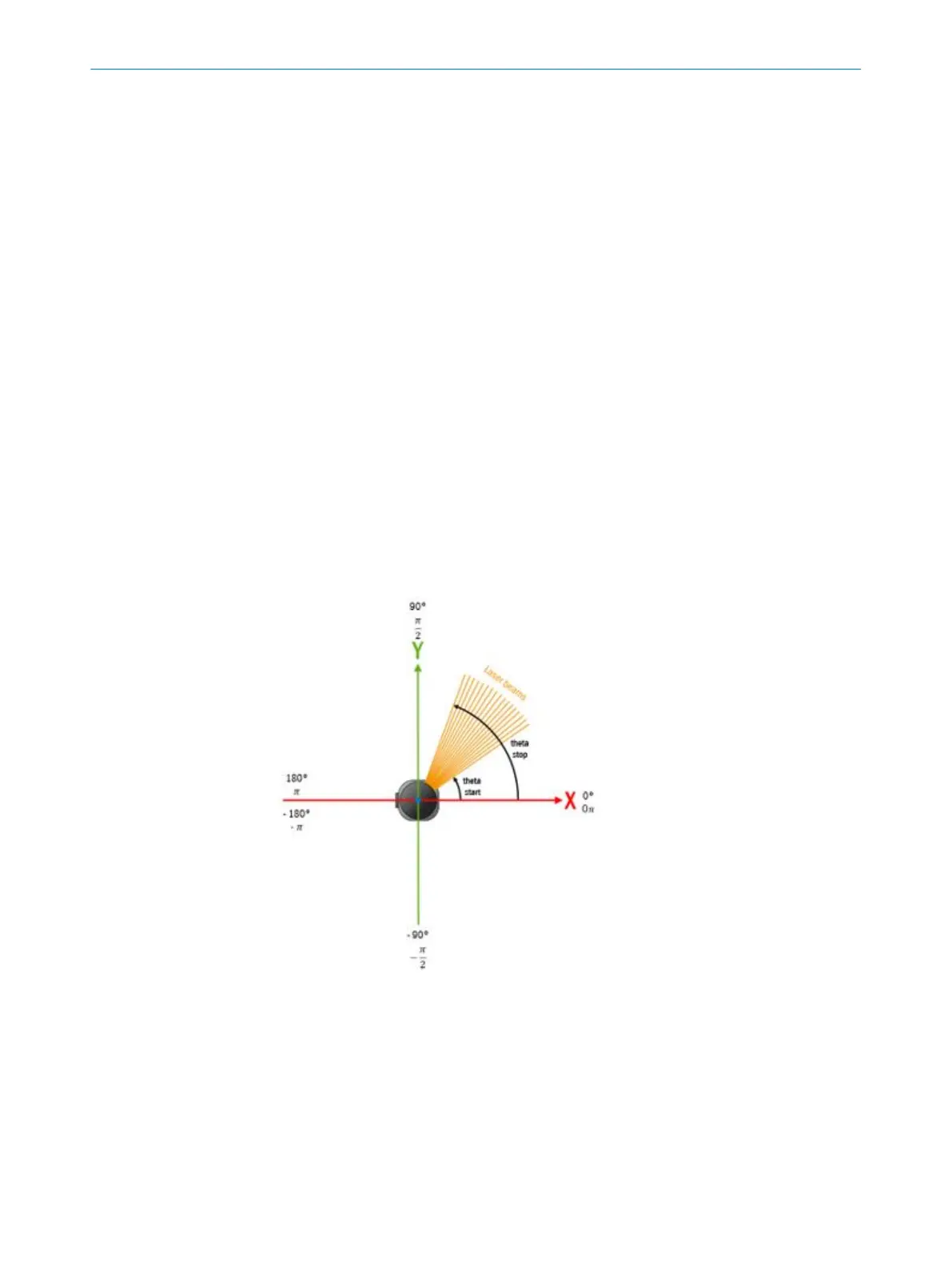
The scan range filter is used to restrict the horizontal angular range output per scan.
The scan range filter is switched off by default. When it is activated, it can be set to a
value between -180° and +180°.
The range can be restricted by increasing the start angle or reducing the stop angle.
Please note that the angle beam orthogonal to the front screen is defined as 0°, and
the direction of rotation of the device is set to counterclockwise.
If a complete range of the output data is outside the angular range, it is not output. If a
range is partially within the specified angular range, it is filled with 0values.
Figure 19: Definition of the thetaStart and thetaStop angle (top view)
3.4.7.5.3 Scan layer filter
The scan layer filter can be used to hide the measurement data of individual scan
layers.
3 PRODUCT DESCRIPTION
24
O P E R A T I N G I N S T R U C T I O N S | multiScan136 8027119/0000/2022-11 | SICK
Subject to change without notice


 To Next Page