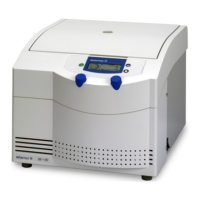
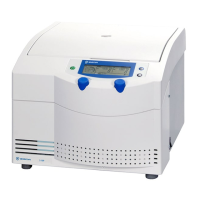
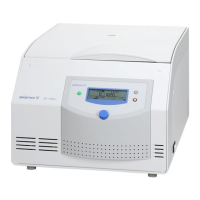
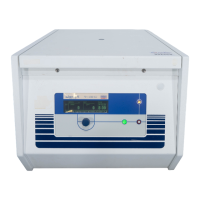
Laboratory centrifuge Sigma 2-7, Sigma 2-7 Cyto
Laboratory centrifuge Sigma 2-7 IVD
Version 07/2015, Rev. 1.12 of 16/07/2019 • sb
Translation of the original operating manual, part no. 0702802
3.6.5 Safety instructions for centrifugation
For safe operation, observe the following before starting the centrifuge:
• Ensure that the centrifuge was set up properly (see chapter 5 - "Set-up
and connection").
• Maintain a safety distance of at least 30 cm (12 inches) around the
centrifuge.
• Do not store any dangerous goods in the centrifuge area.
• Do not stay in the safety area longer than what is absolutely necessary
for the operation of the centrifuge.
• Only use the centrifuge with rotors and accessories that have been
approved by the manufacturer. We explicitly warn against the use of
equipment of poor quality. Breaking glass or bursting vessels can
cause dangerous imbalances at high speeds
• Ensure that rotor and buckets are correctly fitted (see chapter 6.2.2.1 -
" Installation of a rotor ").
• Observe the instructions on the installation of accessories (see chapter
6.2.2.2 - "Installation of accessories").
• The rotor must be loaded in a rotationally symmetrical manner at equal
weights.
• If liquids with a density > 1.2 g/cm
3
are used, reduce the speed (see
chapter 2.2.2.2 - "Density").
• Do not use the centrifuge if the rotor is loaded asymmetrically.
• Do not use the centrifuge with tubes that are excessively long.
3.6.6 Resistance of plastics
Chemical influences have a strong effect on the polymeric chains of
plastics, and, therefore, on their physical properties. Plastic parts can be
damaged if solvents, acids, or alkaline solutions are used.
• Refer to the resistance data (see chapter 11.4 - "Resistance data")!



 To Next Page