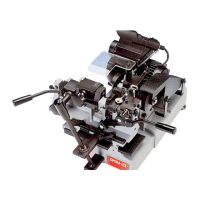
UNOCODE 299 Operating manual - English
44 Copyright Silca 2002
Fig. 32
Fig. 33
Electric contact not
working (during
calibrating or cutting).
a) wiring between the J14 connector on the electronic control board and cutter shaft is loose
or disconnected
b) wiring inside the Y axis carriage is not seeded properly or disconnected
c) defective electronic control board
d) wear on the brushes (ch. 7.11, page 53)
Key-cutting machine fails
to communicate with
computer.
a) wiring between 9-pin serial port and electronic circuit board not seeded properly or dis-
connected
b) serial cable between key-cutting machine and computer is faulty
c) computer serial port is not functional
d) defective electronic control board
The display shows the
message
‘TEMPERATURE
ALARM - Turn the
machine off’.
check that the fan on the back of the key-cutting machine is working:
not working a) fan faulty
b) electronic control board faulty
working electronic control board faulty
The display shows the
message: ‘I/O POWER
ALARM – check fuse F4’.
a) fuse F4 on the electronic control board faulty.
b) short circuit on the inlets. To find which inlet is causing the error message, disconnect the
J7-8-14-20 connectors one at a time and check each time whether the alarm disappears.
The display shows the
message: ‘DIGITAL
OUTLET
PROTECTION ALARM -
turn the machine off’.
internal fault on the electronic control board.
The display shows the
message: ‘CUTTER
MOTOR ALARM -
check fuse F1’.
a) fuse F1 on the electronic control board faulty.
b) cutter microswitch on protective cover triggered or disconnected (D4) (fig. 33).
c) cutter motor wiring disconnected.
d) internal fault on the electronic control board.
FAULT PROBABLE CAUSE
D3 D4


 To Next Page