GTJZ0612E&0812E&1012E&1212E Operation Manual 8-1 © Mar. 2022
8 TRANSPORTING AND LIFTING THE
MACHINE
TRANSPORTATION AND LIFTING
HAZARD
• Use a forklift or crane with the
proper lifting capacity to lift the
machine. Use good judgment and
planned movement to control the
machine.
• Transport vehicles must be
parked on level ground.
• Be sure to prevent the transporta-
tion vehicle from moving when
loading the machine. Refer to 1
Performance Parameters, page 1-
1.
• Before transportation and lifting,
check if the rigging anchor point
and its attached structure are in
good condition.
• Ensure that the vehicle capacity,
loading surface, belts or ropes are
sufficient to support the weight of
the machine.
• Be sure the machine is on a hori-
zontal plane or fixed before re-
leasing the brakes.
• When removing the wire rope
safety pin, prevent the guardrail
from falling. The guardrail must
be held tight at all times when
descending.
• Never transport people on the ma-
chine while the machine is being
towed or while the machine is en-
gaged in towing or lifting
operations.
• When using a forklift or crane to
lift the machine, pay attention to
prevent the machine from collid-
ing with nearby objects.
• Lock the wheels of the machine
after it has been loaded to prevent
the machine from rolling.
NOTICE
Do not pull/drag the machine unless an emergency,
failure or loss of power occurs. Refer to Emergency
Towing/Dragging, page 7-2.
LIFTING THE MACHINE
WITH A FORKLIFT
Follow these requirements when lifting the machine by
forklift:
1. Make sure the platform extension, controller and
chassis components are stable. Remove all loose
parts from the machine.
2. Fully lower the platform. Keep the platform down
during transportation.
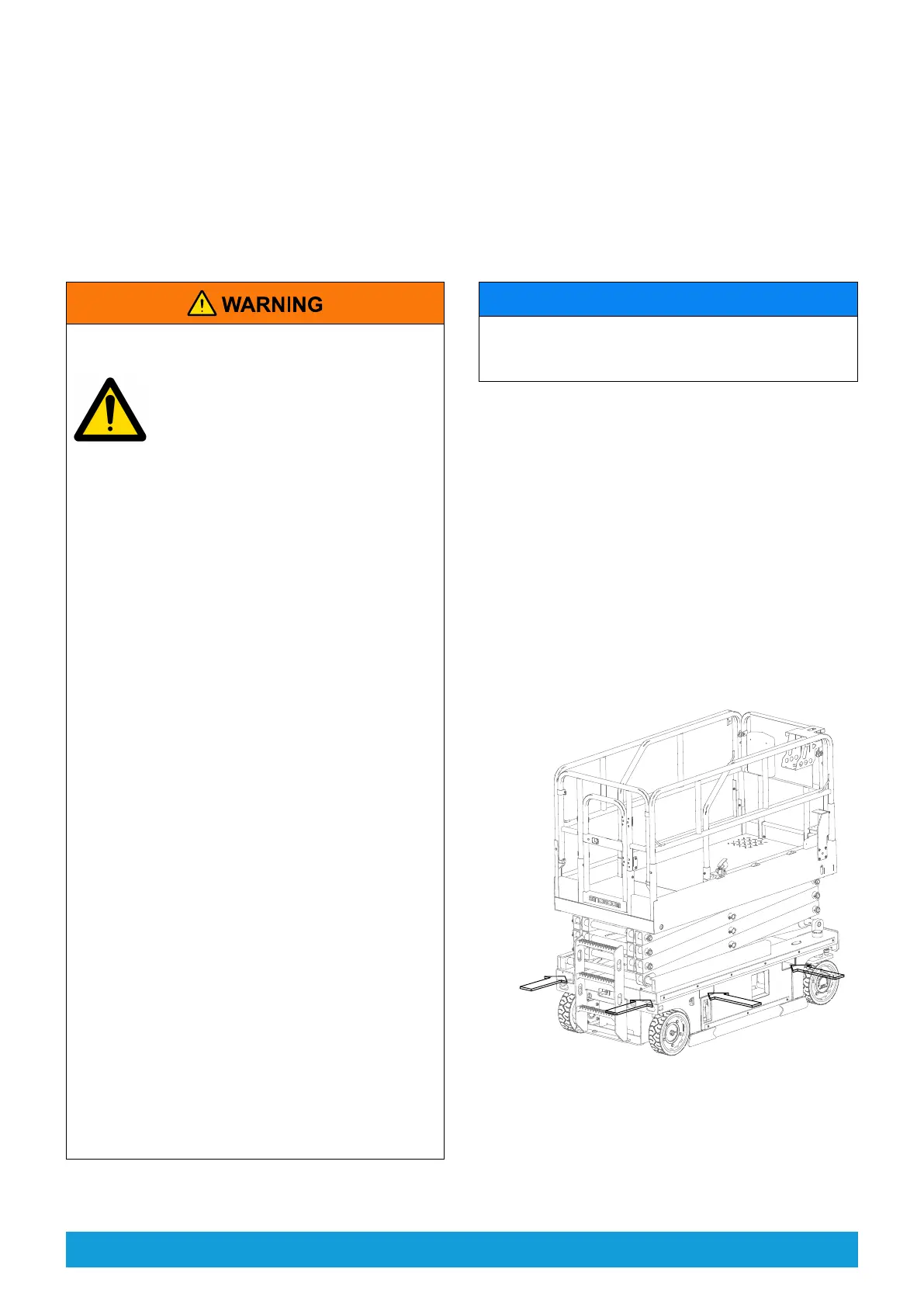
3. Use the forklift slots on the rear or side of the
chassis.
Figure 8-1
4. The forklift fork must align with the position of the
forklift slots.
5. Drive forward to the fork frame to insert it fully into
the slots.



 To Next Page