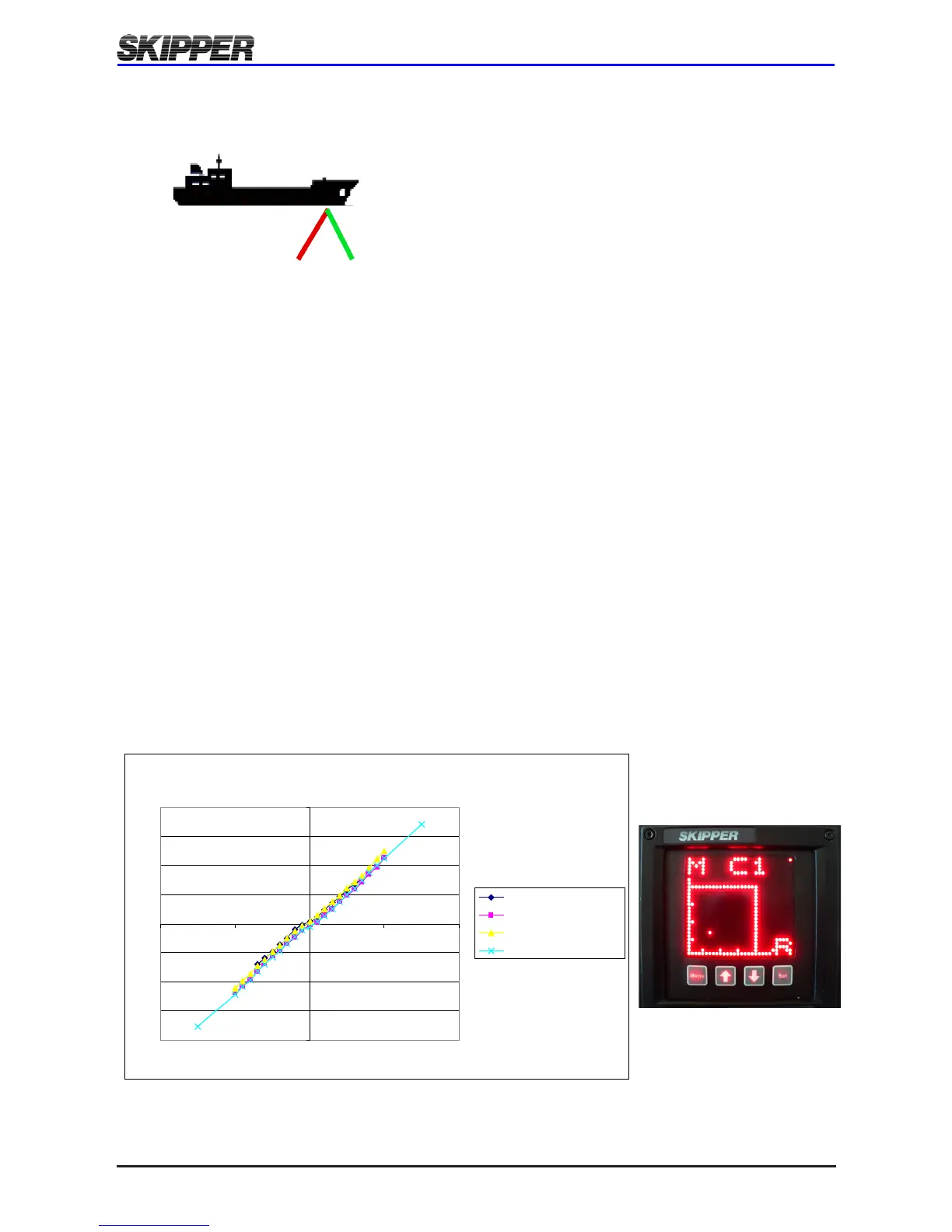
The Doppler system operates by sending a known frequency sound into the
water, and listening to the reected echo from the minute particles in the water.
If the particles are moving towards the sensor, the frequency goes up, if away,
the frequency goes down. By having two beams at 30 degrees from the vertical
we get 2 frequency values, one plus, one minus, and these can be adjusted to
show the speed of the vessel in the horizontal plane.
As the amount of particles in the water can vary, the system ensures it has
optimal signal return by adjusting the power and length of the sample, depending
on depth.
How calibration works.
Calibration is piecewise linear, i.e. a linear line is plotted from calibration point
to calibration point (sorted by size) and this linearity is applied to the incoming
values. This can be seen on the graph screen.


 To Next Page