20
USER GUIDEUSER GUIDE
USER GUIDEUSER GUIDE
USER GUIDE
ArAr
ArAr
Ar
tist and Engineer Headphonestist and Engineer Headphones
tist and Engineer Headphonestist and Engineer Headphones
tist and Engineer Headphones
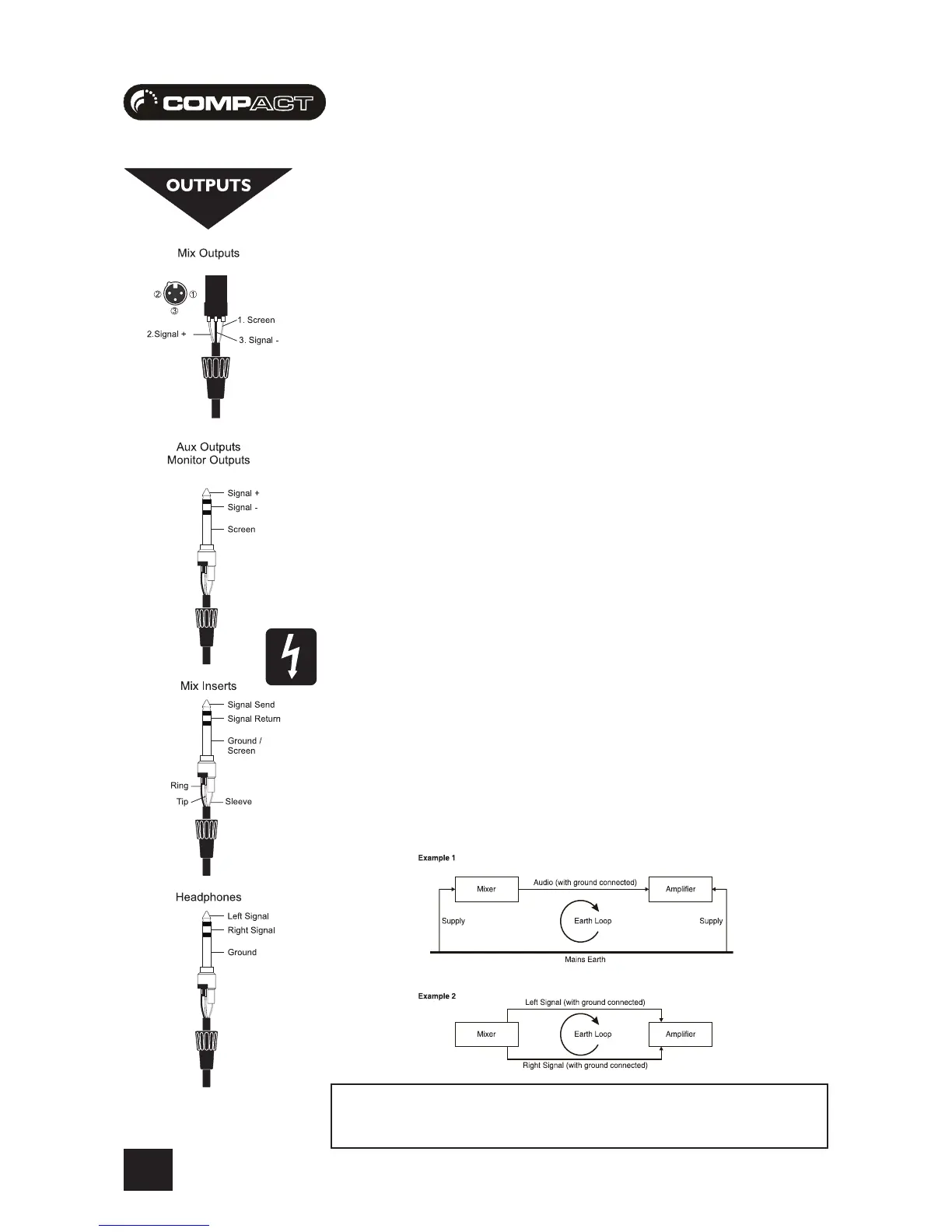
The Headphones outputs are on a 3-pole ‘A’ gauge jack, wired as a stereo output as shown, The
output level is designed ideally for headphones of 200Ω or greater. 8Ω headphones are not
recommended, although can be used.
Polarity (Phase)Polarity (Phase)
Polarity (Phase)Polarity (Phase)
Polarity (Phase)
You will probably be familiar with the concept of polarity in electrical signals and this is of particular
importance to balanced audio signals. Just as a balanced signal is highly effective at cancelling
out unwanted interference, so two microphones picking up the same signal can cancel out, or
cause serious degradation of the signal if one of the cables has the +ve and -ve wires reversed.
This phase reversal can be a real problem when microphones are close together and you should
therefore always take care to connect pins correctly when wiring audio cables.
Grounding and ShieldingGrounding and Shielding
Grounding and ShieldingGrounding and Shielding
Grounding and Shielding
For optimum performance use balanced connections where possible and ensure that all signals
are referenced to a solid, noise-free earthing point and that all signal cables have their screens
connected to ground. In some unusual circumstances, to avoid earth or ground ‘loops’ ensure that
all cable screens and other signal earths are connected to ground only at their source and not at
both ends.
If the use of unbalanced connections is unavoidable, you can minimise noise by following these
wiring guidelines:
• On INPUTS, unbalance at the source and use a twin screened cable as though it were
balanced.
• On OUTPUTS, connect the signal to the +ve output pin, and the ground of the output device
to -ve. If a twin screened cable is used, connect the screen only at the mixer end.
• Avoid running audio cables or placing audio equipment close to thyristor dimmer units or
power cables.
• Noise immunity is improved significantly by the use of low impedance sources, such as
good quality professional microphones or the outputs from most modern audio equipment.
Avoid cheaper high impedance microphones, which may suffer from interference over long
cable runs, even with well-made cables.
Grounding and shielding is still seen as a black art, and the suggestions above are only guidelines.
If your system still hums, an earth/ground loop is the most likely cause. Two examples of how an
earth loop can occur are shown below.
WARNING! Under NO circumstances must the AC power
mains earth be disconnected from the mains lead.





 To Next Page