29
USER GUIDEUSER GUIDE
USER GUIDEUSER GUIDE
USER GUIDE
The front panel drawing on page 10 shows typical initial
control positions which is a useful guide to setting up
the mixer for the first time.
USING YOUR COMPUSING YOUR COMP
USING YOUR COMPUSING YOUR COMP
USING YOUR COMP
ACT 4/10 MIXERACT 4/10 MIXER
ACT 4/10 MIXERACT 4/10 MIXER
ACT 4/10 MIXER
The final sound from your monitoring system can only ever be as good as the weakest link in the
chain, and especially important is the quality of the source signal because this is the starting point
of the chain. Just as you need to become familiar with the control functions of your mixer, so you
must recognise the importance of correct choice of inputs, microphone placement and input
channel settings. However, no amount of careful setting up can take account of the spontaneity
and unpredictability of live performance. The mixer must be set up to provide “spare” control range
to compensate for changing microphone position and the absorption effect of a large audience
(different acoustic characteristics from soundcheck to show).
MICROPHONE PLACEMENT
Careful microphone placement and the choice of a suitable type of microphone for the job is one
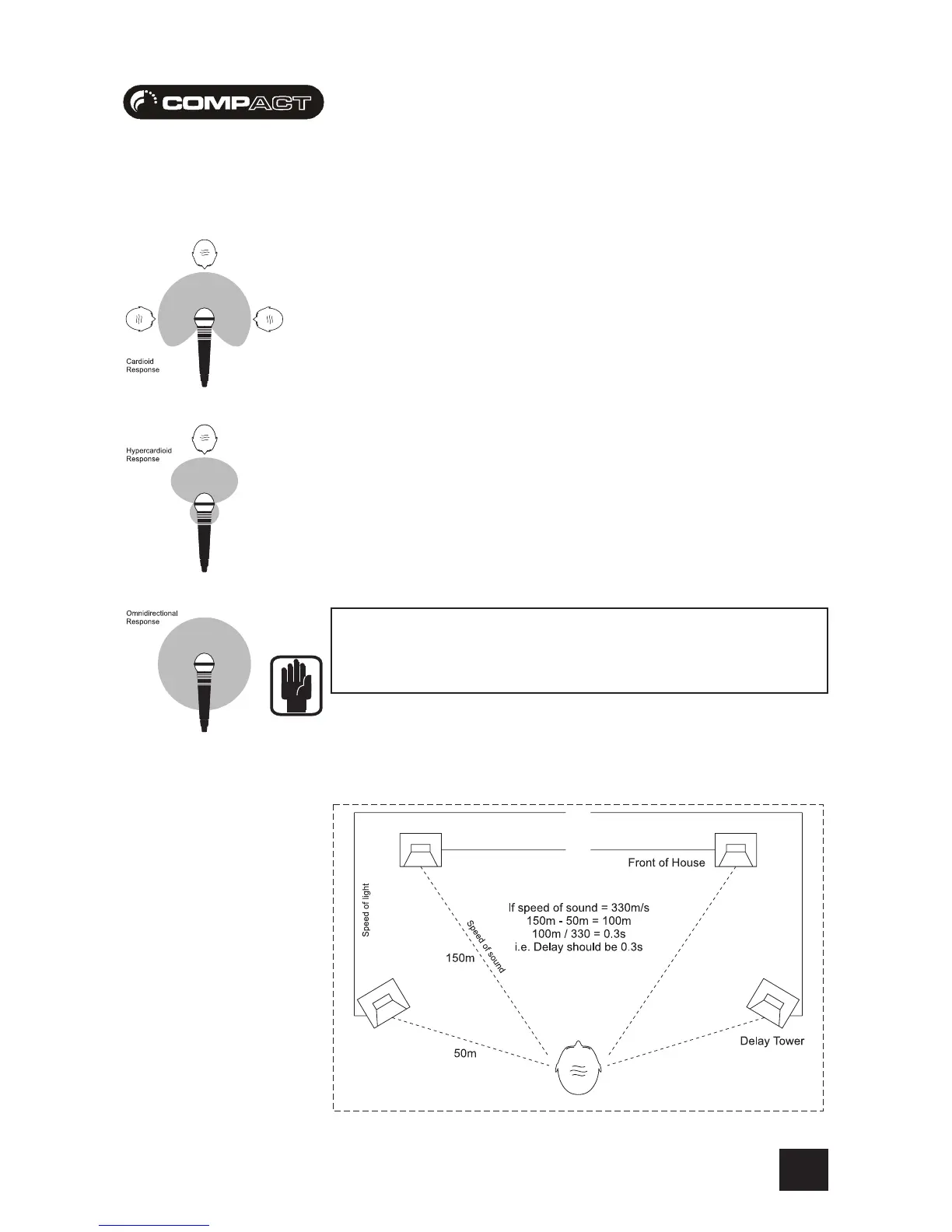
of the essentials of successful sound reinforcement. The diagrams on the left show the different
pick-up patterns for the most common types of microphone. Cardioid microphones are most
sensitive to sound coming from in front, and hypercardioid microphones offer even greater directivity,
with a small amount of pickup behind the microphone. These types are ideal for recording
vocalists or instruments, where rejection of unwanted sounds and elimination of feedback is
important. The aim should be to place the microphone as close as physically possible to the
source, to cut out unwanted surrounding sounds, allow a lower gain setting on the mixer and avoid
feedback. Also a well chosen and well placed microphone should not need any appreciable
equalisation.
There are no exact rules - let your ears be the judge. In the end, the position that gives the desired
effect is the correct position!
MONITORING TIPSMONITORING TIPS
MONITORING TIPSMONITORING TIPS
MONITORING TIPS
The diagram below shows how to set-up speakers in a live environment, the front of house
speakers are shown, although you should consult your studio monitor manual for precise placement.




 To Next Page