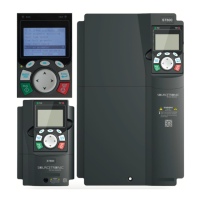
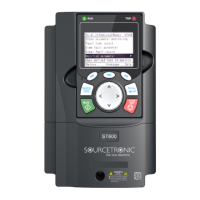
Frequency Inverter ST600 Series High-Performance Multifunction VFD Basic Operation Instructions
-122-
Step 1: Set P00.18=1, restore to default value
Step 2: Set P00.00=3 (VC), set P00.03, P00.04, and motor nameplate parameters in P02 group.
Step 3: Set P20.01 encoder parameters
When the encoder is resolver-type encoder, set the encoder pulse count value to (resolver pole pair
number × 1024), eg, if pole pair number is 4, set P20.01 to 4096.
Step 4: Ensure the encoder is installed and set correctly
When motor stops, observe whether P18.21 (resolver angle) fluctuates, if it fluctuates sharply, check
the wiring and grounding. Rotates the motor slowly, observe whether P18.21 changes accordingly, if
yes, it indicates motor is connected correctly; if the value of P18.02 keeps constant at a non-zero value
after rotating for multiple circles, it indicates encoder Z signal is correct.
Step 5: Autotuning of initial position of magnetic pole
Set P20.11=2 or 3 (3: rotary autotuning; 2: static autotuning), press RUN key to run the VFD.
a) Rotary autotuning (P20.11 = 3)
Detect the position of current magnetic pole when autotuning starts, and then accelerates to 10Hz,
autotuning corresponding magnetic pole position of encoder Z pulse, and decelerate to stop.
During running, if ENC1o or ENC1d fault occurred, set P20.02=1 and carry out autotuning again.
After autotuning is done, the angle obtained from autotuning will be saved in P20.09 and P20.10
automatically.
b) Static autotuning
In cases where the load can be disconnected, it is recommended to adopt rotary autotuning (P20.11=3)
as it has high angle precision. If the load cannot be disconnected, users can adopt static autotuning
(P20.11=2). The magnetic pole position obtained from autotuning will be saved in P20.09 and P20.10.
Step 6: Closed-loop vector pilot-run
Adjust P00.10 and speed loop and current loop PI parameter in P03 group to make it run stably in the
whole range. If oscillation occurred, reduce the value of P03.00, P03.03, P03.09 and P03.10. If current
oscillation noise occurred during low speed, adjust P20.05.
Note: It is necessary to re-determine P20.02 (encoder direction) and carry out magnetic pole position
autotuning again if the wiring of motor or encoder is changed.
3. Commissioning procedures for pulse train control
Pulse input is operated based on closed-loop vector control; speed detection is needed in the
subsequent spindle positioning, zeroing operation and division operation.
Step 1: Restore to default value by keypad
Step 2: Set P00.03, P00.04 and motor nameplate parameters in P02 group
Step 3: Motor parameter autotuning: rotary parameter autotuning or static parameter autotuning
Step 4: Verity the installation and settings of encoder. Set P00.00=3 and P00.10=20.00Hz to run the
system, and check the control effect and performance of the system.
Step 5: Set P21.00=0001 to set positioning mode to position control, namely pulse-string control.
There are four kinds of pulse command modes, which can be set by P21.01 (pulse command mode).
Under position control mode, users can check high bit and low bit of position reference and feedback,
P18.02 (count value of Z pulse), P18.00 (actual frequency of encoder), P18.17 (pulse command


 To Next Page
 Loading...