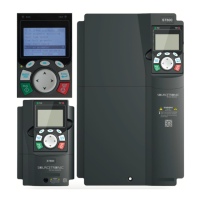
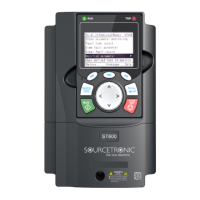
Frequency Inverter ST600 Series High-Performance Multifunction VFD Basic Operation Instructions
-123-
frequency) and P18.19 (position regulator output) via P18, through which users can figure out the
relation between P18.8 (position of position reference point) and P18.02, pulse command frequency
P18.17, pulse command feedforward P18.18 and position regulator output P18.19.
Step 6: The position regulator has two gains, namely P21.02 and P21.03, and they can be switched
by speed command, torque command and terminals.
Step 7: When P21.08 (output limit of position controller) is set to 0, the position control will be invalid,
and at this point, the pulse train acts as frequency source, P21.13 (position feedforward gain) should
be set to 100%, and the speed acceleration/deceleration time is determined by the acceleration
/deceleration time of pulse train, the pulse train acceleration/deceleration time of the system can be
adjusted. If the pulse train acts as the frequency source in speed control, users can also set P21.00
to 0000, and set the frequency source reference P00.06 or P00.07 to 12 (set by pulse train AB), at this
point, the acceleration/deceleration time is determined by the acceleration/deceleration time of the
VFD, meanwhile, the parameters of pulse train AB is still set by P21 group. In speed mode, the filter
time of pulse train AB is determined by P21.29.
Step 8: The input frequency of pulse train is the same as the feedback frequency of encoder pulse,
the relation between them can be changed by altering P21.11 (numerator of position command ratio)
and P21.12 (denominator of position command ratio)
Step 9: When running command or servo enabling is valid (by setting P21.00 or terminal function 63),
it will enter pulse train servo running mode.
4. Commissioning procedures for spindle positioning
Spindle orientation is to realize orientation functions like zeroing and division based on closed-loop
vector control
Frequency
Deceleration time of spindle orientation
Speed of
accurate-stop
of spindle
Time
P21.09 Completion
range of positioning
Running command
Zeroing command
Zeroing selection terminal 1
Positioning completion signal
Hold time of positioning completion signal
P21.10 Detection time
for positioning completion
P21.25 Hold time of positioning completion signal
Step 1–4: These four steps are the same as the first four steps of the commissioning procedures for
closed-loop vector control, which aim to fulfill the control requirements of closed-loop vector control,
thus realizing spindle positioning function in either position control or speed control mode.
Step 5: Set P22.00.bit0=1 to enable spindle positioning, set P22.00.bit1 to select spindle zero input. If
the system adopts encoder for speed measurement, set P22.00.bit1 to 0 to select Z pulse input; if the
system adopts photoelectric switch for speed measurement, set P22.00.bit1 to 1 to select photoelectric
switch as zero input; set P22.00.bit2 to select zero search mode, set P22.00.bit3 to enable or disable
zero calibration, and select zero calibration mode by setting P22.00.bit7.
Step 6: Spindle zeroing operation
a) Select the positioning direction by setting P22.00.bit4;


 To Next Page
 Loading...