IM-P706-03 CTLS Issue 1
29
SP7-20 Smart Positioner
3.3.3 Pneumatic connections
Notes:
-
The positioner must only be supplied with instrument air that is free of oil, water, and dust.
-
The purity and oil content must meet the requirements of Class 3:3:3 in accordance with ISO 8573-1.
Notice
Damage to components! Contamination on the air pipe and positioner can damage components.
-
Dust, splinters, and any other particles of dirt must be blown-out before the pipe is connected.
Pressure above 6 bar (90 psi) can damage the positioner or actuator.
-
Provisions must be made (e.g., by using a pressure reducer) to make sure that the pressure does not
rise above 6 bar (90 psi)*, even in the event of a fault.
Information on double acting actuators with spring-return mechanism
On double-acting actuators with spring-return
mechanism, a pressure that significantly exceeds
the supply air pressure value can be generated
during operation by the springs in the chamber
opposite the springs.
This may damage the positioner or adversely affect
control of the actuator.
To eliminate the possibility of this occurring, it is
recommended to install a pressure compensation
valve between the springless chamber and the
supply air for these types of applications. It enables
the increased pressure to be transferred back to
the air inlet line.
The opening pressure of the check valve should be
< 250 mbar (< 3.6 psi).
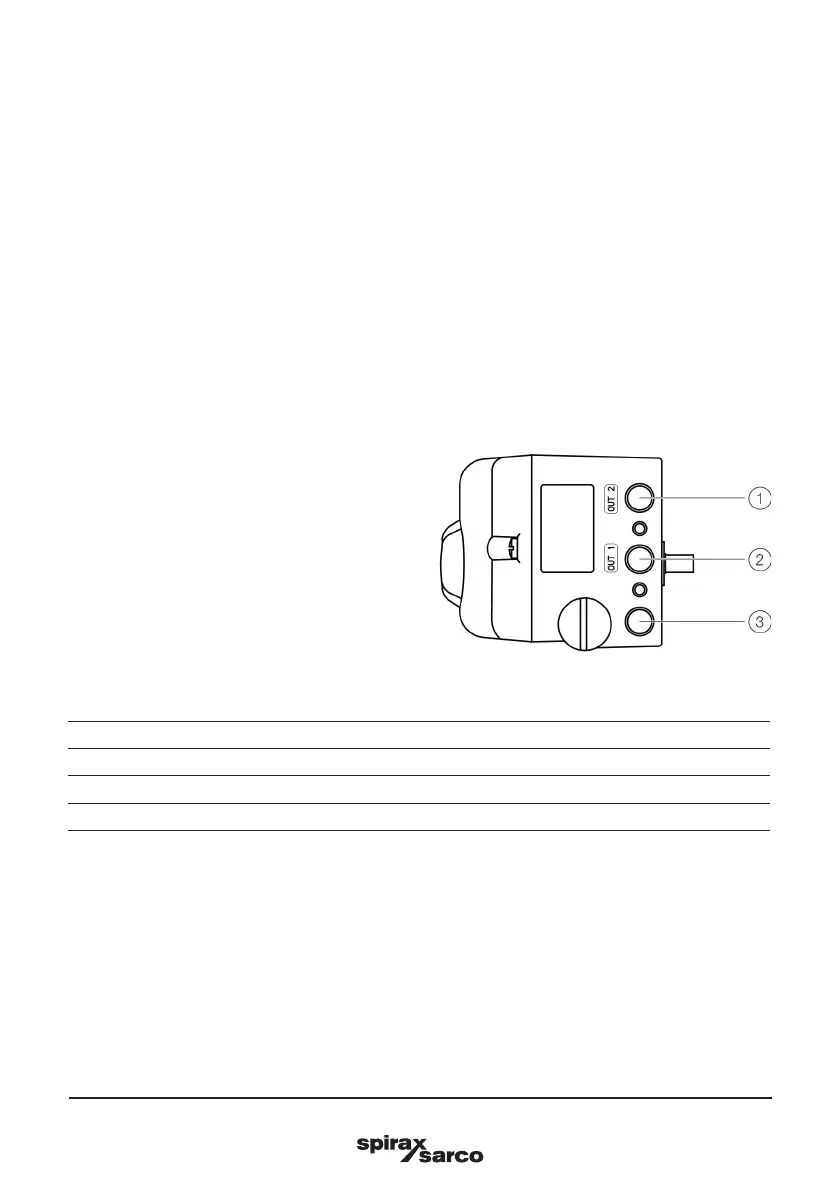
Marking Pipe connection
IN Supply air, pressure 1.4 to 6 bar (20 to 90 psi)
OUT1 Output pressure to the actuator
OUT2 Output pressure to the actuator (2. Connection with double acting actuator)
Join the pipe connections according to the designation, observing the following points:
-
All pneumatic piping connections are located on the right-hand side of the positioner. ¼ 18 NPT tap holes
are provided for the pneumatic connections. The positioner is labeled according to the tap holes available.
-
We recommend that you use a pipe with dimensions of 12 × 1.75 mm.
-
The supply air pressure required to apply the actuating force must be adjusted in line with the output
pressure in the actuator. The operating range of the positioner is between 1.4 to 6 bar (20 to 90 psi)***.
(1) OUT 2
(2) OUT 1
(3) IN
Fig. 19


 To Next Page