IM-P736-02 EMM Issue 3
20
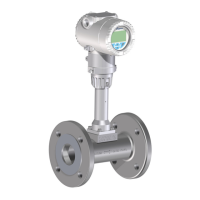
VLM30 In-Line Vortex Flowmeter
3.1 Installation Conditions
General
A Vortex meter can be installed at any point in the pipeline system. However, the following installation
conditions must be considered:
-
Compliance with the ambient conditions.
-
Compliance with the recommended inlet and outlet sections.
-
The flow direction must correspond to that indicated by the arrow on the sensor.
-
Compliance with the required minimum interval for removing the transmitter and replacing the sensor.
-
Avoidance of mechanical vibrations of the piping (by fitting supports if necessary).
-
The inside diameter of the sensor and the piping must be identical.
-
Avoidance of pressure oscillations in long piping systems at zero flow by fitting gates at intervals.
-
Attenuation of alternating (pulsating) flow during piston pump or compressor conveying by using
appropriate damping devices. The residual pulse must not exceed 10%. The frequency of the conveying
equipment must not be within the range of the measuring frequency of the flowmeter.
-
Valves/gates should normally be arranged in the flow direction downstream of the flowmeter (typically:
3 × DN). If the medium is conveyed through piston/plunger pumps or compressors (pressures for fluids
> 10 bar/145 psi), it may be subject to hydraulic vibration in the pipeline when the valve is closed. If
this does occur, the valve absolutely has to be installed in the flow direction upstream of the flowmeter.
Suitable damping devices (e.g. air vessels) might need to be fitted.
When fluids are measured, the sensor must always be filled with measuring medium and must not run dry.
-
When fluids are measured and during damping, there must be no evidence of cavitation.
-
The relationship between the measuring medium and the ambient temperature must be taken into
consideration.
-
At high measuring medium temperatures > 150 °C (> 302 °F), the sensor must be installed so that the
transmitter or terminal box is pointing to the side or downward.


 To Next Page