9.4.3 Setting the Idle in Drive for an Automatic Gearbox
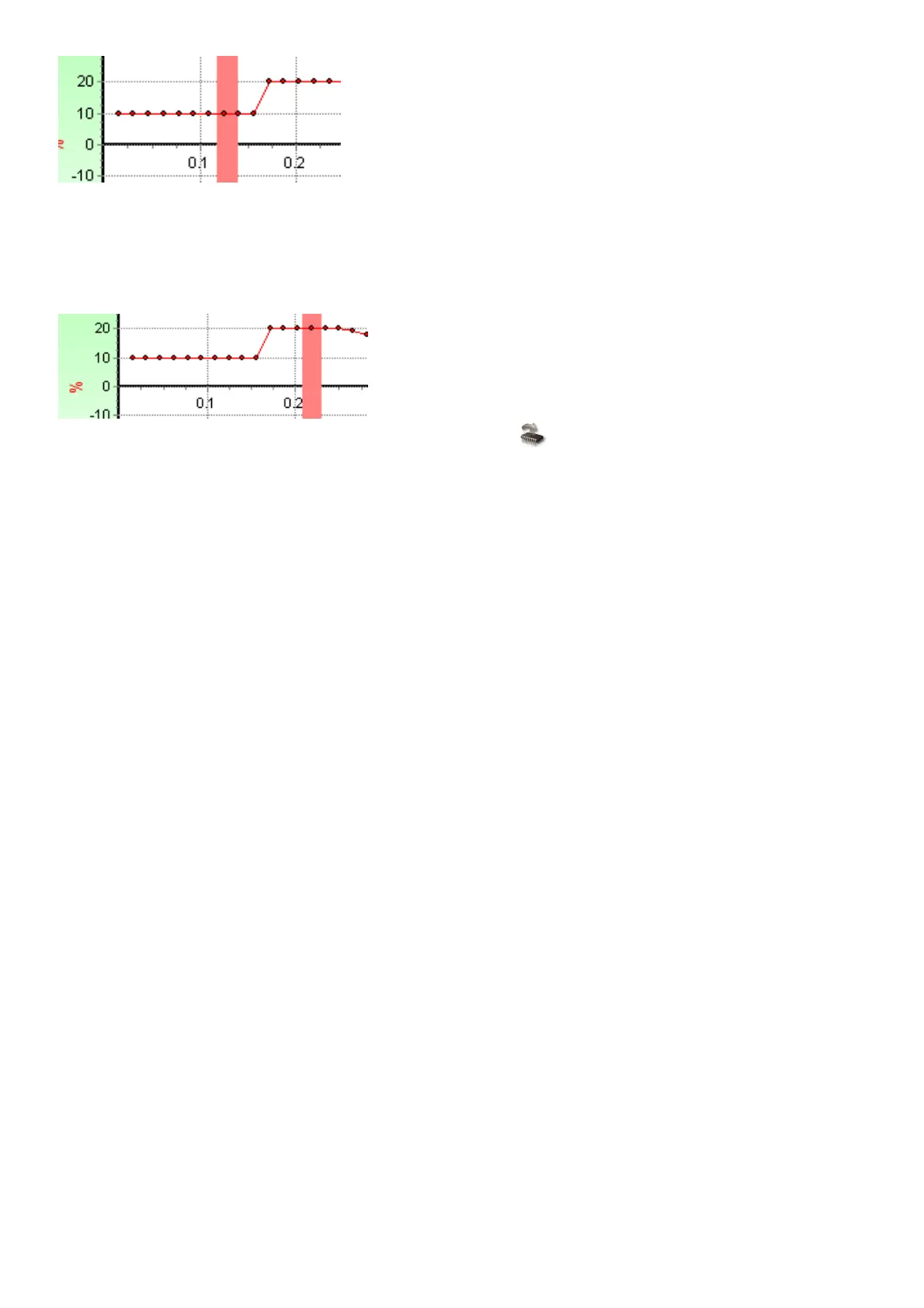
Put the gearbox in drive. The vacuum bar should move a bit to the right. This is due to load on the
engine by the torque converter. Now adjust the vacuum map graph around the vacuum bar till it
idles at the right mix again. Always adjust 2 dots in front and 2 at the back to the same level to
cater for variation in vacuum.
Save the maps again with the Write to ECU button. If you started with a set of standard
maps, you car should be OK now. For fine tuning you may go on a dyno or set it according to the
explanation in this manual.
From here on do not adjust the main jet slider as it will adjust all other values. If you do use it for
tuning, always return to the same value of the initial setting. You may fine tune the idle jet anytime.
9.4.4 Accelerator Pump Setting
Because fuel mixture is calculated, and idle to running is a unique program developed, the ECU
will automatically cater for fueling required during acceleration. Thus you most probably will not
require extra fuel. Another reason for this is that the ECU uses an external MAP sensor which is
situated close to the engine. The vacuum signal is therefore direct and fast. Vacuum is calculated
before every injection cycle. Any changes in vacuum are immediately catered for in the next
injector pulse. If you go to the vacuum map and press the throttle quickly, you should not be able
to see the bar move to the right. If it is sluggish you will have a flat spot. This is normally the result
of too long or too thin vacuum line or too small port at the manifold. Setting these values too large
will only waste fuel and gain nothing. So the norm is to only tune till the flat spot is gone.
1. Select TPS or MAP. Setting both comes later with more experience.
2. Set the Max RPM. Normally 1500 to 2000 RPM’s.
3. Select a percentage enrichment starting with 10% increments. Normally 40 to 50%.
4. Select sensitivity by starting with 10 (least sensitive) and work towards 1 (most sensitive).
Normally 2 to 4.
5. Kick the accelerator pedal in and release. Listen and feel for the flat spot. Sometimes it sounds
like a flat spot but it is actually the noise of the vacuum being eliminated at the throttle. Rather
look at the RPM’s and feel for a jerk pulling off.
6. Increase the sensitivity towards 1 and repeat point 5 till you are satisfied. You may also
increase the enrichment till the desired results are achieved.
7. Always look at the exhaust for black smoke indicating too much fuel. You can also use the
air/fuel (lambda) gauge to indicate correctness.
9.4.5 Fuel Cut-Off Setting
Here is something the carburetors did not have. On the ECU you can cut the fuel supply to the
engine completely when decelerating or down hills. This makes for a bit of fuel saving especially in
urban driving. This is done with 3 settings. All 3 conditions have to be met to activate the fuel cut
feature.



 To Next Page