26
3. Training
WARNING! Pulse rate monitoring systems may be inaccurate. Over exercising may
result in serious injury or death. If you feel faint stop exercising immediately.
• Do not overexert yourself or others when performing the training! Always respect
individual general and daily fitness!
3.1 CHOOSING AND MONITORING THE TARGET PULSE
The pulse rate in BPM ('Beats per Minute') indicates very well if you are training according to your target
and your current personal fitness level. The BPMs for the targets depend not at least on the age. You
should monitor your pulse in a suitable way.
• For pulse rate measurement you can put on a pulse rate belt or a pulse rate wristband.
Select a guide value for your target pulse as follows:
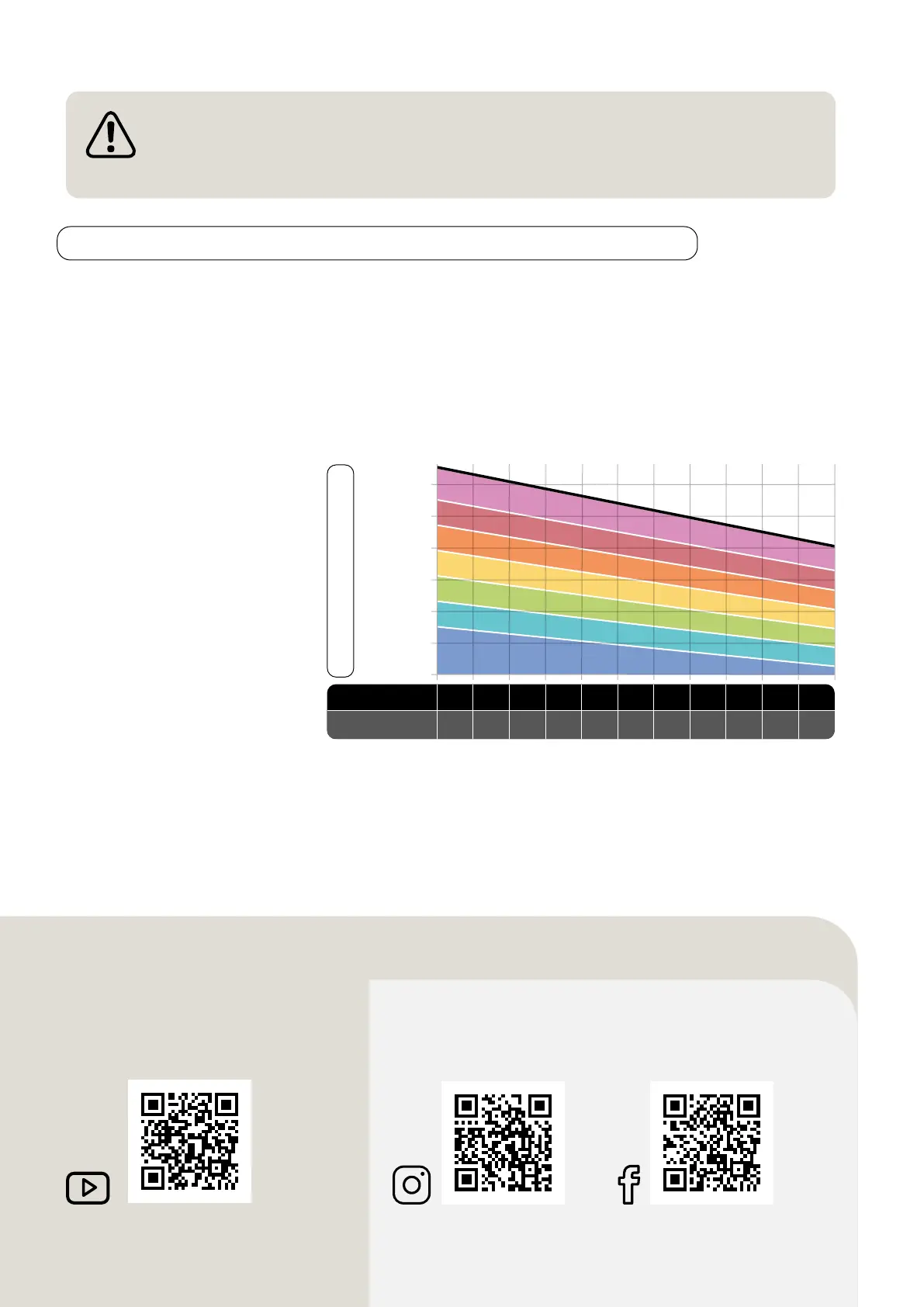
• Select your age in the graphic on the right.
• Below, your age-typical maximum pulse (MHR) is shown as an estimated value.
The Selection graph A allows
to determine a Target pulse
range.
• From your age value, go
up into the colour field
which corresponds to your
training target.
• Then go straight to the left
and read the target pulse
range from the scale.
BPM (Ranges)
Selection graph
AGE 20 25 30 35 40 45 50 55 60 65 70
MHR 200 195 190 185 180 175 170 165 160 155 150
190
170
150
130
110
90
70
High Intensity (!) High Intensity (!)
>>
90 %90 %
MHRMHR
Anaerob - Anaerob -
82 .. 90%82 .. 90%
Aerob 2 - Aerob 2 -
74 .. 82%74 .. 82%
Aerob 1 - Aerob 1 -
66 .. 74%66 .. 74%
Fat burning - Fat burning -
58 .. 66%58 .. 66%
Warm up / Cool -Warm up / Cool -
50 .. 58%50 .. 58%
Regeneration Regeneration
<<
50% 50%
In any case:
• Check if the determined target pulse suits your needs. If not, re-adjust it until you've found your
individual optimum value.
Link to the videos:
https://sportstech.link/stread_video
Videos and
other media
Further information
We are also on Social Media!
Product information, training content & much more
Instagram-page
https://sportstech.link/
instagram
Facebook-page
https://sportstech.link/
facebook


 To Next Page