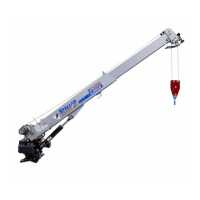
This chapter contains information regarding the operation of Stellar® Telescopic Cranes.
Please study the following pages to ensure your familiarity with the operation process. This
understanding is vital to the safe and efficient operation of the crane.
Operation
ATTENTION
Operators of Stellar® Telescopic Cranes must conform to the qualifications
specified in ANSI B30.5 - Chapter 5-3 Operation. Stellar Industries, Inc. is
not liable for accidents incurred by the crane because of the operator’s
non-fulfillment of current rules, laws and regulations.
Thoroughly plan the lift by understanding your loads and distances before positioning the
vehicle. For a complete and detailed description of job site set-up, please refer to the
AEM Safety Manual (Form C-70-2). Consider the following:
1. The vehicle should be positioned in an area free from overhead obstructions to
eliminate the need for repositioning. The vehicle should be placed so that it is
impossible for any portion of the equipment to come within the minimum required safe
distance of any power line. Maintain a clearance in accordance with ANSI B30.5: 5-
3.4.5 Operating Near Electric Power Lines.
2. Make certain that vehicle is parked on stable ground as close to the job as possible.
The supporting surface under the service truck must be able to support the weight of
the machine and its load.
Each day, inspect the crane for all of the following:
1. Vehicle for standard checks such as proper tire inflation and fluid levels.
2. Parking brake operation.
3. Hydraulic reservoir for proper oil level.
4. Hoses and gearboxes for evidence of oil leaks.
5. Crane controls for excessive wear, cleanliness and proper operation.
6. Operational aids such as decals for placement and legibility.
7. All securing hardware such as cotter pins, snap rings, hairpins, and pin keepers for
proper installation.
8. Crane hook and other loose parts for damage to structures or weld.
9. Wire rope for broken wires, extensive wear, distortion, and heat damage.
10. All safety guards for proper installation.
Replace/repair as necessary prior to operation. For a more detailed checklist of
scheduled inspection points, refer to the Stellar® Crane Inspection Log. This document is
an essential guide for the daily, monthly, quarterly and annual inspection tasks that will
help maintain the quality of your Stellar product.
Pre-Operation Inspection
Job-Site Setup
Chapter 2 - Operation



 To Next Page