Stonex S800 GNSS Receiver - User Manual - Ver.1-Rev.0 14
6.4.3 Installation of Rover
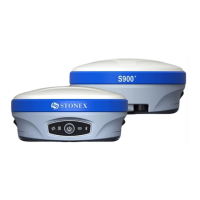
After the installation of base, start to install rovers.
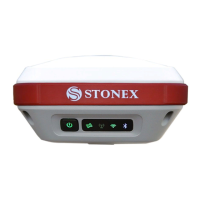
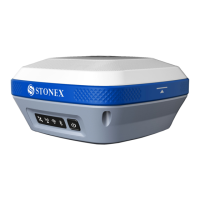
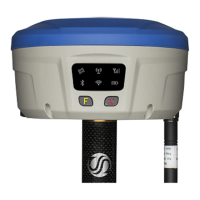
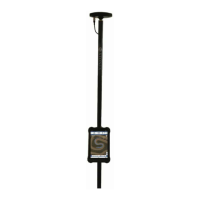
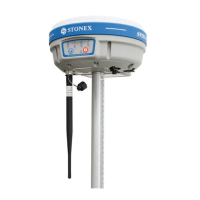
(1)Fix the bracket on the pole, fix the handheld to the bracket and then
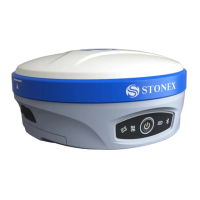
install the rover on the pole.
(2)Attach the internal radio antenna or connect the external radio
according to the chosen data link.
(3)Power on the receiver and select rover mode.
6.4.4 Configuration of Rover
Open SurPad software on the handheld to choose communication mode.
Click “Device” - “Working mode” to choose rover mode and configure its
data link, antenna parameters and satellite system and other settings. When
data link is internal radio, you need to configure the radio channel,
frequency, protocol and power.
Note:
1. If you want an high-precision surveying result (several cm), it’s
recommended to use a tripod to install rover;
2. When the coverage of surveying area is large (over 4 km from base),
the working distance too far for internal radio to meet the demand,
it’s recommended to use external radio to connect the receiver;
3. Under radio mode, frequency and protocol settings of base and
rover should be the same.
6.5 RTK Dynamic Measurement (Network)
6.5.1 Installations of Rover
Because RTK network mode is transmitting differential data by network,
differing from radio mode only on their transmission method, the
installations of the rover is similar to the UHF procedure.



 To Next Page