Return To Table of Contents
8 1089-009-002 REV B www.stryker.com
CAUTION
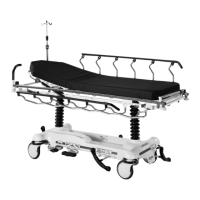
• Do not modify this stretcher. Modifying the unit can cause unpredictable operation resulting in injury to the patient
or operator. Modifying the unit will also void its warranty.
• To avoid damage, remove any equipment that may be in the way before raising or lowering the litter height.
• Do not raise the unit (hydraulics on base) with a patient lift under the stretcher.
• To avoid injury or damage to the equipment, do not allow the siderail to lower on its own.
• The weight capacity of the base hood is 60 lbs. Do not sit or stand on the base hood. Injury or damage to the
equipment could occur.
• Do not step on the base hood.
• Do not use the cutout for the oxygen bottle holder on the base hood for the storage of oxygen bottles or patient
belongings.
• If the stretcher is equipped with the optional foot end I.V. pole, the I.V. pole must be in the raised position when the
foot extension/defibrillator tray is installed. If the I.V. pole is not raised, the foot extension will not function properly
and injury could occur.
• To avoid damage, do not put items weighing more than 30 lbs. on the defibrillator tray/foot extender.
• Do not use the defibrillator tray/foot extender as a push/pull device because equipment damage could occur.
• Do not use the footboard/chartholder as a push/pull device because equipment damage could occur.
• Always store the I.V. caddy when not in use to avoid damaging it when the unit is moved.
• To avoid damage, do not put items weighing more than 30 lbs. on the serving tray.
• Do not use the serving tray as a push/pull device because equipment damage could occur.
• To avoid damage, the safe working load of the two-stage permanently attached I.V. pole is 40 lb.
• To avoid damage while transporting the stretcher, verify that the I.V. pole is at a low enough height to allow it to
safely pass through door openings and under light fixtures.
• Do not use the I.V. pole as a push/pull device because equipment damage could occur.
• To avoid damage, the weight of the I.V. bags should not exceed 12 lb. while the weight of any one item attached to
each stage of the three-stage permanently attached I.V. pole should not exceed 9.3 lb.
• The maximum PSI level for the drape support/oxygen tubing is 20 PSI (1.38 Bars/140 KPA).
• To avoid damage, do not put items weighing more than 40 lbs. in the upright oxygen bottle holder.
• Do not use the upright oxygen bottle holder as a push/pull device because equipment damage could occur.
• Before returning the unit to service after cleaning, ensure that the unit is functioning properly by verifying that all
labels are intact, raise/lower the stretcher height, brake/steer pedal locks properly in both positions, latch/unlatch
the siderails, raise/lower the fowler and gatch, and check all components for proper lubrication.
• Some cleaning products are corrosive in nature and may cause damage to the product if used improperly. If the
products suggested above are used to clean Stryker patient handling equipment, measures must be taken to
ensure that the stretcher is wiped with a damp cloth soaked in clean water and thoroughly dried following cleaning.
Failure to properly rinse and dry the stretcher will leave a corrosive residue on the surface of the stretcher, possibly
causing premature corrosion of critical components. Failure to follow the above directions when using these types
of cleaners may void this product’s warranty.
• Frequent or prolonged exposure to higher concentration disinfectant solutions may prematurely age the cover
fabric.
• The use of accelerated hydrogen peroxides or quaternaries containing glycol ethers may damage the cover.
NOTE
• Clean the base hood storage area regularly.
• The bottom of the brake pads should be cleaned regularly to prevent wax or floor remnant buildup.
Summary of Safety Precautions



 To Next Page