
 Need help?
Do you have a question about the Stryker M-1 and is the answer not in the manual?
Indicates that the user should consult the instruction manual or booklet for guidance.
Signifies that the user should consult the instructions for use for operating the device.
Alerts the user to a general warning associated with the product or its use.
Indicates a caution, warning of potential hazards or important precautions.
Identifies the catalogue number or reference number for the product.
Denotes the unique serial number assigned to the product.
Indicates the lot or batch code for identification purposes.
Provides information on US patents related to the product.
Confirms that the product meets European Union conformity requirements.
Identifies the European Authorized Representative for the product.
Indicates the manufacturer of the product.
Shows the date when the product was manufactured.
Specifies the maximum safe working load the product can handle.
Classifies the type of applied part according to electrical safety standards.
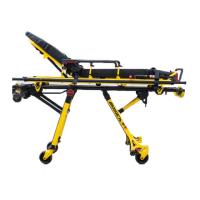
Describes the Stryker Model 6100 M-1® Roll-In System, its features, and capabilities.
Details the intended applications and patient population for the Stryker M-1® Roll-In System.
States the expected service life of the Stryker Model 6100 M-1® Roll-In System.
Lists any known contraindications for the use of the Stryker M-1® Roll-In System.
Provides technical specifications and measurements for the Stryker M-1® Roll-In System components.
Shows a diagram with labeled parts of the Stryker M-1® Roll-In System.
Provides contact details for Stryker Customer Service and Technical Support.
Shows where to find the serial number on the Stryker product.
Explains how to determine the date of manufacture from the serial number.
Details the process of installing the cot fastener system for the Stryker M-1® Roll-In System.
Provides essential rules and recommendations for operating the Stryker M-1® Roll-In System safely.
Outlines safe methods for lifting the product and occupants to prevent injuries.
Step-by-step guide on safely transferring a patient onto the Stryker M-1® Roll-In System.
Instructions for safely maneuvering the cot with a patient on board, including obstacle navigation.
Explains how to adjust the height of the Stryker M-1® Roll-In System for optimal patient care and ergonomics.
Detailed procedure for securely loading the Stryker M-1® Roll-In System into an ambulance or vehicle.
Step-by-step instructions for safely removing the Stryker M-1® Roll-In System from a vehicle.
Guidance on the optimal placement of operators and helpers during various operations.
How to adjust the backrest position on the Stryker M-1® Roll-In System for patient comfort.
Instructions for operating the siderails for patient safety and accessibility.
Guide to adjusting the footrest for patient comfort and leg elevation.
Procedure for adjusting the optional knee gatch feature of the Stryker M-1® Roll-In System.
How to engage and disengage the wheel locks for securing the Stryker M-1® Roll-In System.
Instructions for using the Steer-Lock feature to improve steering control.
Steps to attach the removable litter to the base of the Stryker M-1® Roll-In System.
Procedure for detaching the removable litter from the base of the Stryker M-1® Roll-In System.
Guide to adjusting cot height using retractable lifting handles.
Instructions for extending and retracting the lifting handles on the Stryker M-1® Roll-In System.
Detailed steps for using restraint straps to safely secure a patient on the cot.
How to properly adjust and secure the restraint straps for patient safety.
Instructions for using an extension for restraint straps for larger patients.
Guide for using the Pedi-Mate® system to secure an infant on the cot.
Steps for attaching the defibrillator platform to the Stryker M-1® Roll-In System.
Instructions for attaching the head extension and pillow for head support.
Guide to positioning and adjusting the optional three-stage IV pole.
Procedure for securely attaching an oxygen bottle to its holder on the cot.
Schedule and procedures for routine inspection and adjustment of the cot.
Items to inspect monthly or every two hours, whichever comes first.
Items to inspect every six months or 12 hours, whichever comes first.
Items to inspect annually or every 24 hours, whichever comes first.
 General
| Brand | Stryker |
|---|---|
| Model | M-1 |
| Category | Medical Equipment |
| Language | English |









 To Next Page