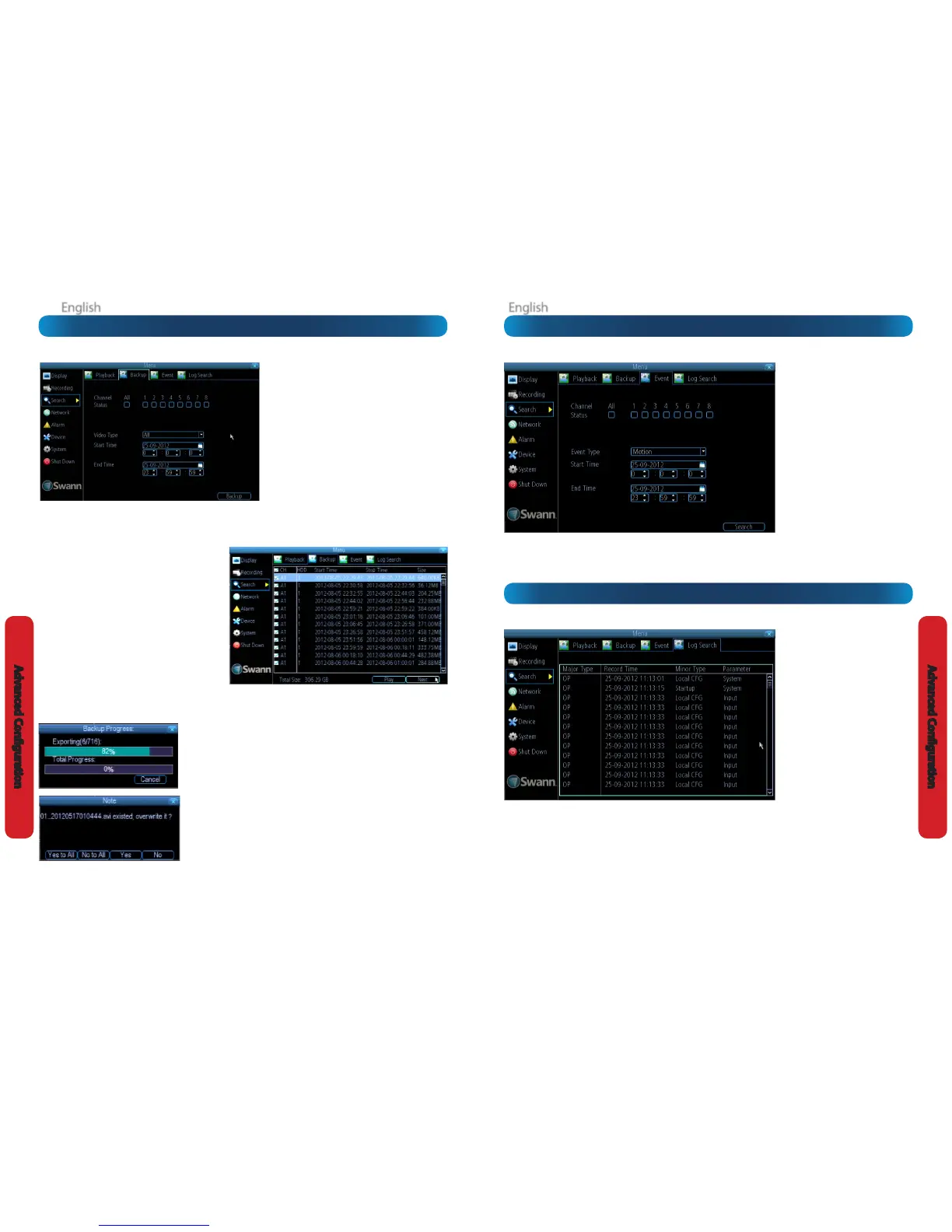
The Event Search menu will show you
recordings that were triggered by the
DVR detecting motion.
Typically, the majority of recordings
based upon “Events” are likely to be
recordings triggered by the DVR’s
motion detection feature.
The search function operates in the same
way as the main playback search: the
only dierence is you’ll select an Event
Type rather than a Video Type.
The Log Search displays a list of events,
presented in chronological order: the
most recent events will be at the end of
the list.
The Log will list all events that the DVR
monitored, whether or not any footage
was recorded as a result.
Search: Event
Search: Log Search
To backup footage:
• Connect a USB ash drive or a USB hard drive (HDD)
to the USB Port on front of the DVR.
• Choose the camera(s) you want to backup footage
from.
• From the Video Type menu, select the type(s) of
video you want to backup.
• Set your Start Time and End Time.
• Select Backup.
Note: The USB Ports are used for backing up footage,
or connecting the USB mouse. If you want to use an
external drive to record live video footage, use the eSATA
port on the rear of the DVR.
The Backup File List
Will show you a list of all the video events between the
start and end times you’ve selected. All the ticked les
will be part of the backup. Click Next to continue.
Refresh: Looks for devices to which footage can be
backed up to. This will include USB ash drives or hard
drives connected to the front USB port.
AVI Format File: When checked, the DVR will transcode
the footage into a le format that can be played back on
a computer.
About transcoding to AVI:
Don’t be put o by the complex word - transcoding is just
a shortening of “translating code”. Transcoding, while a
straight-forward process, is very processor intensive.
You may notice signicant slow-down (or apparent
non-responsiveness) on your DVR while the transcoding
takes place.
While the backup process is executed, the DVR will display a pair of progress
meters. The top one indicates the progress of the current video event; the lower
one shows the overall progress.
To end the backup process before it’s complete, choose Cancel. Some or all of the
incidents you selected will not have been copied. While backing up, particularly
when transcoding to AVI, the DVR might take a few moments to register that
you’ve selected Cancel.
Note that, while the backup is in progress the DVR will be inoperable locally.
It will continue recording and monitoring, but won’t respond to the mouse
being moved or buttons being pressed (at least, not quickly - cut it some slack,
it’s working really, really hard).
You’ll still be able to access the DVR remotely via the MyDVR software. However,
due to the system requirements of backing up footage, the DVR’s performance
might be reduced.
Backing up footage can be a slow process - doubly so when transcoding to AVI.
If you’re backing up more than a few minutes footage at a time, you’ve got time
to make a cup of coee, maybe call a friend or catch up on some TV. Seriously, it
can take a while - talk to any video editor about transcoding and they’ll tell you
it takes a long time.
Search: Backup





 To Next Page