
 Need help?
Do you have a question about the Synology DiskStation and is the answer not in the manual?
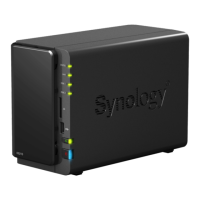
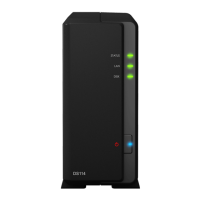
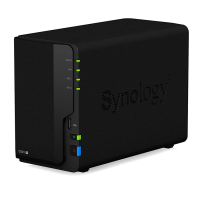
Hardware overview for 1-bay and 2-bay DiskStation models, detailing components and ports.
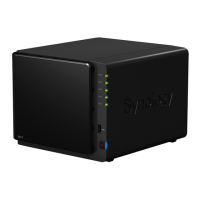
Hardware overview for 4-bay DiskStation models, detailing components and ports.
Hardware overview for 5-bay DiskStation models, detailing components and ports.
Initial setup and installation instructions for Synology DiskStation hardware.
Steps to access the DiskStation Manager (DSM) interface via Synology Assistant or web browser.
Overview of the DSM desktop, taskbar, icons, and application windows.
How to navigate and use the main menu for accessing DSM functions and settings.
Managing user accounts, desktop customization, and personal preferences.
Configuring IP address, server name, and network protocols like LAN, PPPoE, and Wireless.
Setting display language, email language, and codepage for filename conversion.
Configuring time zone, date, and NTP synchronization for accurate timekeeping.
Managing HDD hibernation, power recovery, fan speed, and scheduled power on/off.
Definition of a volume and explanation of supported Synology DiskStation volume types.
Creating, removing, repairing, and expanding storage volumes using Storage Manager.
Setting up and managing iSCSI targets and LUNs for block-level storage access.
Managing hard disk settings, including write cache, S.M.A.R.T. tests, and disk information.
Simplified setup for internet access using the EZ-Internet wizard.
Configuring router port forwarding rules for remote access to DiskStation services.
Registering and using a DDNS hostname for easy remote access to the DiskStation.
Securing web access with HTTPS, port changes, and session settings.
Configuring firewall rules to control network access and prevent unauthorized connections.
Implementing auto-block for failed login attempts to enhance security.
Enabling SMB, AFP, NFS, and FTP protocols for cross-platform file sharing.
Configuring SMB/CIFS service for Windows clients to access shared folders.
Configuring AFP service for Mac clients to access shared folders.
Enabling NFS service for Linux clients to access shared folders.
Accessing shared folders from local network clients using various methods.
Using FTP for remote file access and transfer over the internet.
Utilizing the web-based File Browser for file management and access.
Enabling and using File Station for file access via customized ports.
Backing up computer data to the Synology DiskStation using Data Replicator.
Methods for backing up DiskStation data locally or remotely (Network, Amazon S3).
Creating and managing various backup tasks like local, network, and system configuration backups.
Using Time Backup for versioned data backups and restoring shared folders.
Setting up and configuring Web Station for hosting websites with PHP and MySQL support.
Installing and configuring Mail Station for setting up an email server.
Configuring the DiskStation to act as a print server for connected USB printers.
Enabling and launching Photo Station for sharing photos, videos, and blogs.
Creating, editing, and deleting Photo Station user accounts separately from DSM.
Uploading, organizing, and viewing photo and video albums within Photo Station.
Personalizing and using the blog feature within Photo Station to share thoughts.
Enabling and configuring Audio Station for music playback from various sources.
Selecting audio sources like library, playlists, iPod, internet radio, and media servers.
Browsing music, changing views, searching, and managing playlists.
Using the music player and queue panel for playback control and output modes.
Enabling and configuring the Download Station application for file downloads.
Creating and managing download tasks for BitTorrent, HTTP, FTP, and NZB files.
Using eMule to search for and download files via ED2K and Kad networks.
Enabling and launching Surveillance Station for IP camera management and security.
Adding, editing, and configuring IP cameras, recording schedules, and guard settings.
Viewing real-time video feeds from connected cameras with PTZ and snapshot features.
Browsing, playing, and managing recorded event videos from cameras.
Configuring the DLNA/UPnP media server for streaming multimedia to DMA devices.
Setting up and enabling the iTunes service for music and video sharing.
Viewing system status, hardware information, and network details.
Monitoring CPU, memory, and network usage via the Resource Monitor application.
Procedures for downloading and installing DiskStation Manager (DSM) updates.
Installing, upgrading, uninstalling, and managing software packages.
Accessing DiskStation features via Synology's mobile applications.
Detailed technical specifications for 1-bay Synology DiskStation models.
Detailed technical specifications for 2-bay Synology DiskStation models.
Detailed technical specifications for 4-bay Synology DiskStation models.
Explanation of LED status indicators for 1-bay DiskStation models.
Explanation of LED status indicators for 2-bay DiskStation models.
Explanation of LED status indicators for 4-bay DiskStation models.
 General
| Model | DiskStation |
|---|---|
| Category | Network Storage Server |
| CPU | Varies by model |
| Memory | Varies by model |
| Drive Bays | Varies by model |
| Maximum Internal Raw Capacity | Varies by model |
| USB Ports | Varies by model |
| eSATA Ports | Varies by model |
| Dimensions | Varies by model |
| Weight | Varies by model |
| Operating System | DiskStation Manager (DSM) |
| Network Interface | Gigabit Ethernet |
| Power Supply | Varies by model |


 To Next Page