SYNRAD® 32-1 Operator’s Manual Version 2.2
50
Technical Reference
Integrating 32-1 safety features
The Integrating 32-1 safety features section includes subsections:
Remote Keyswitch functions
The 32-1 DB-9 Connector allows system integrators or end-users to integrate 32-1 laser safety
features into their control system. In particular, the 32-1 Remote Keyswitch function serves to
disable DC power to the laser’s RF driver. Without power, the RF driver cannot supply PWM or
tickle signals to the resonator, causing the CO gas to remain in a zero-energy state.
Pin 9, the Remote Ready LED Output, is a current- and voltage-limited output
meant only for direct connection to an LED or LED-input optoisolator.
Important
Note:
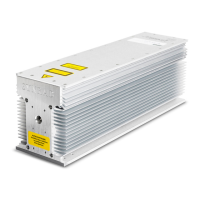
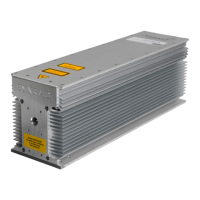
OEM lasers
On OEM lasers, 5-seconds after power-up DC power is applied to the RF driver. To reset a fault
condition, remove DC power for 30 seconds and then reapply power to the laser or toggle
(open, then close) the Remote Keyswitch signal via pins 6 and 7 on the DB-9 Connector. To use
this “remote reset” functionality, open and then close a “dry-circuit” (zero voltage) switch or
relay contact between Pin 6, Remote Keyswitch Input, and Pin 7, Remote Keyswitch Output.
Reconnecting Pin 6 to Pin 7 applies power to the RF driver and begins a ve-second delay
after which lasing is enabled.
Your control system can monitor the laser’s power-on status through the DB-9 Connector by
connecting your system’s input between Pin 9, Remote Ready LED Output, and Pin 2, Signal
Ground. The Remote Ready LED Output goes active when the laser is enabled, indicating that
lasing is possible after the ve-second delay. The output is inactive when lasing is disabled.
Refer back to the, DB-9 pin assignment tables for specic details.
32-1 lasers may be hard-mounted to equipment by removing several of the bot-
tom panel screws and replacing these with longer screws to secure the laser to
optical assemblies. This mounting method is only recommended as long as the
screws do not support the weight of the laser. For a sturdier attachment, the laser
may be clamped to optical assemblies by applying clamping forces between top
and bottom cover screws. Do not apply clamping forces on the longitudinal cen-
terline.
Note:




 To Next Page