laser safety
3
Synrad
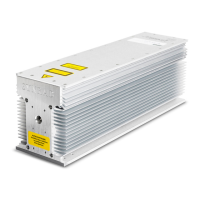
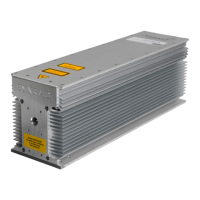
Series 48Series 48
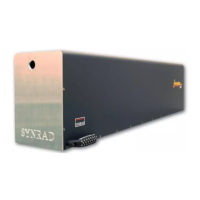
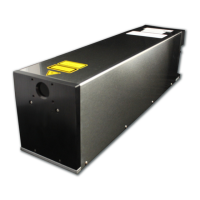
Series 48Series 48
Series 48 operator’s manual
Hazard information
Series 48 lasers should be installed and operated in manufacturing or laboratory facilities by trained
personnel only. Due to the considerable risks and hazards associated with the installation and operational
use of any equipment incorporating a laser, the operator must follow product warning labels and instruc-
tions to the user regarding laser safety.
Exercise safe operating practices per ANSI Z136.1-2000 at all times when actively lasing.
To prevent exposure to direct or scattered laser radiation, follow all safety precautions specified through-
out this manual.
Do not place your body or any combustible object in the path of the laser beam.
Always wear safety glasses or protective goggles with side shields to reduce the risk of damage to the eyes
when operating the laser.
A CO
2
laser is an intense heat source and will ignite most non-metallic materials under the proper
conditions. Never operate the laser in the presence of flammable or explosive materials, gases, liquids, or
vapors.
The use of controls or adjustments or performance of procedures other than those specified herein may
result in exposure to hazardous invisible laser radiation, damage to, or malfunction of the laser. Severe
burns will result from exposure to the laser beam.
Safe operation of the laser requires the use of an external beam block to safely block the beam from
traveling beyond the desired work area. Use a water-cooled beam dump or power meter, or similar non-
scattering, noncombustible material as the beam block. Never use organic material or metals as the beam
blocker; organic materials, in general, are apt to combust or melt and metals act as specular reflectors
which may create a serious hazard outside the immediate work area.
Other hazards
The following hazards would be typical for this product family when incorporated for intended use: (A)
risk of injury when lifting or moving the unit; (B) risk of exposure to hazardous laser energy through
unauthorized removal of access panels, doors, or protective barriers; (C) risk of exposure to hazardous
laser energy and injury due to failure of personnel to use proper eye protection and/or failure to adhere to
applicable laser safety procedures; (D) risk of exposure to hazardous or lethal voltages through unautho-
rized removal of covers, doors, or access panels; (E) generation of hazardous air contaminants that may be
noxious, toxic, or even fatal.
Additional laser safety information
The SYNRAD web site (http://www.synrad.com/LaserFacts/lasersafety.html) contains an online laser
safety handbook that provides information on (1) Laser Safety Standards for OEM’s/System Integrators
including product classification, product housing, product features, and other CDRH requirements; (2)
Laser Safety Standards for End Users including Class I installations, Class IV installations, laser hazards,
ANSI Standard, U.S. State requirements, and OSHA; (3) References and Sources including CDRH,
ANSI/OSHA; and (4) Assistance with Requirements.
In addition, the Occupational Safety and Health Administration (OSHA) provides an online Technical
Manual (located at http://www.osha-slc.gov/dts/osta/otm/otm_iii/otm_iii_6.html). Section III, Chapter 6
and Appendix III are good resources for laser safety information.
Another excellent laser safety resource is the Laser Institute of America (LIA). Their comprehensive web
site is located at http://www.laserinstitute.org.




 To Next Page