technical reference
32
Synrad
Series 48Series 48
Series 48Series 48
Series 48 operator’s manual
Technical overview
The Technical overview section includes subsections:
■ Introduction
■ Plasma section
■ Optical resonator
■ Control circuitry
■ Optical setup
Introduction
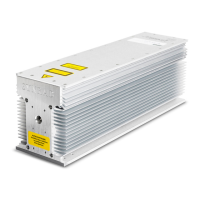
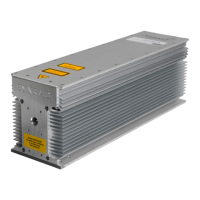
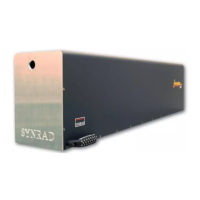
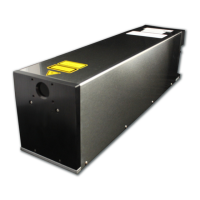
Series 48 lasers incorporate the latest technology in sealed carbon dioxide devices, combining the best
features of both waveguide and free space CO
2
laser technology. The all-metal laser tube construction
features the ruggedness, stable optical support, and small size of waveguide lasers. Its larger bore (4.8 mm)
eliminates the high optical power density of waveguide lasers with their predisposition to optical degra-
dation and incorporates the mode purity and easy optical alignment of free space TEM
00
lasers. Low cost
is achieved by using simple extruded and welded aluminum structures packaged together with compact,
state-of-the-art RF power supplies. The laser is self-contained requiring only the application of power,
cooling air or water, and a control signal. It is therefore ideally suited for overhead installation where the
laser is gantry-mounted since no RF cable runs are required.
48 Series lasers emit a laser beam with a wavelength of 10.6 microns (µm). The beam shape is square at
the laser output aperture, changing to circular at distances of approximately one meter or more from the
laser. The laser beam diverges due to diffraction at a full angle of 4 mrad (milliradians), with the beam
waist at the output aperture of the laser.
The method of RF excitation on which the Series 48 is based provides excellent discharge stability, easily
controlled output power and modulation, and convenient interfacing to automated systems. Coupling
between the RF driver and the laser is based on patented switching and transmission line technology.
The RF drive operates at around 45 MHz and is matched to the resonant frequency of the plasma tube.
Power control of the laser beam is achieved by pulse width modulation (PWM) of the RF drive circuit.
Modulation control can be used to gate the laser on and off at time intervals synchronized with auto-
mated processing equipment. It can also be used to control instantaneous power by adjusting the pulse
width (PWM duty cycle) at a fixed modulation frequency. Both methods can be used simultaneously.
Figure 3-1 Average laser output vs. percent PWM duty cycle
50 100
LASER OUTPUT POWER
(ARBITRARY SCALE)
% DUTY CYCLE




 To Next Page