22
3 OPERATION
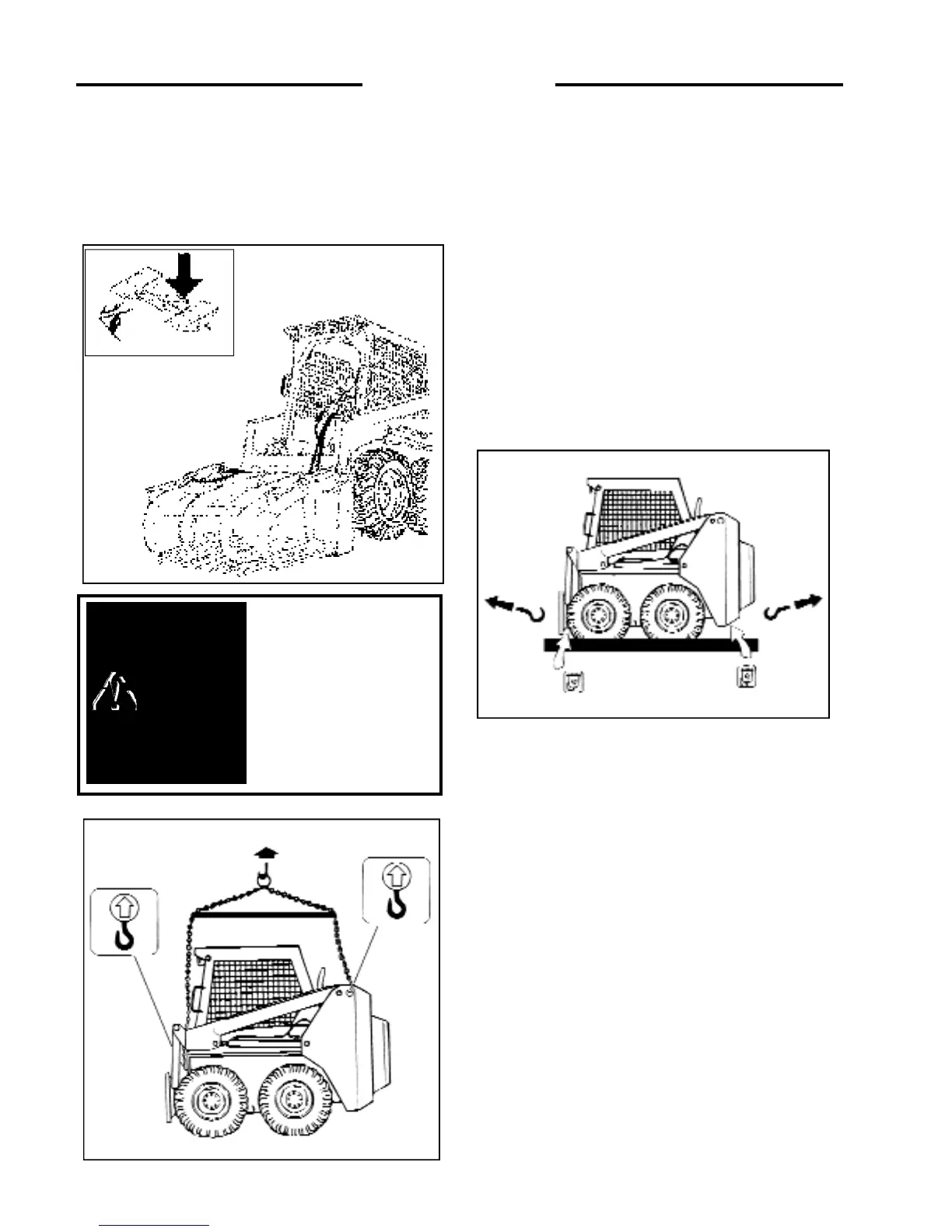
To close the grapple (Fig. 3.6B), push down on the toe of
the auxiliary pedal. The boom and the bucket pedals can be
used to raise and tilt the grapple as with a bucket .To
operate an attachment which requires a constant flow of oil
such as a sweeper, push down firmly on the toe of the
auxiliary pedal until the pedal locks in detent position.
When the auxiliary circuit is not in use return the auxiliary
pedal to neutral position, otherwise starting the loader may
be difficult or impossible.
3. 7 LIFTING
The loader is equipped with features to use in lifting (for
example by crane onto a flatbed trailer or a flat car), for
securing, and for extraction (from mud or snow).
To lift using a crane, first follow the shut-off procedure.
(See Section 3.1C).
Once this is done, attach properly rated cables, chains or
straps to lift points provided (See Fig. 3 .7). To prevent
marking the operator guard or chafing of the lifting cable,
a lifting frame should be used.
3. 8 TOWING
1. When winching or towing a stuck loader from the rear,
always lower the lift arms until the attachment is
resting on the ground and then follow the shut-off
procedure (See Section 3.1C).
2. When winching or towing a stuck loader from the
front, lower the attachment so that the front attachment
points are accessible and have an assistant block the
attachment, then follow the shut - off procedure (See
Section 3.1C).
3. Attach a properly rated chain, cable or towing strap to
the towing point provided (Fig. 3.8). The point was
designed to accommodate a chain, but a cable or strap
with a sufficiently large hook to prevent jamming in
the chain slot may be used.
Without special
attachment for handling
large heavy objects such
as large round bales, large
rectangular bundles, logs
and oil drums. Large
objects can be dangerous
due to the object rolling or
sliding down the loader
boom onto the operator.
WARNING
Fig. 3.6B
C3264
Fig. 3.8
C-726
C-725
Fig. 3. 7


 To Next Page