14
Precisely balancing a Steadicam takes practice, but because the Volt is assisting in all three axes, it doesn’t
have to be exact. However, the better you balance your system, the less battery will be used by the Volt for
corrections and the Volt motors will have maximum effect, so it is worth your time.
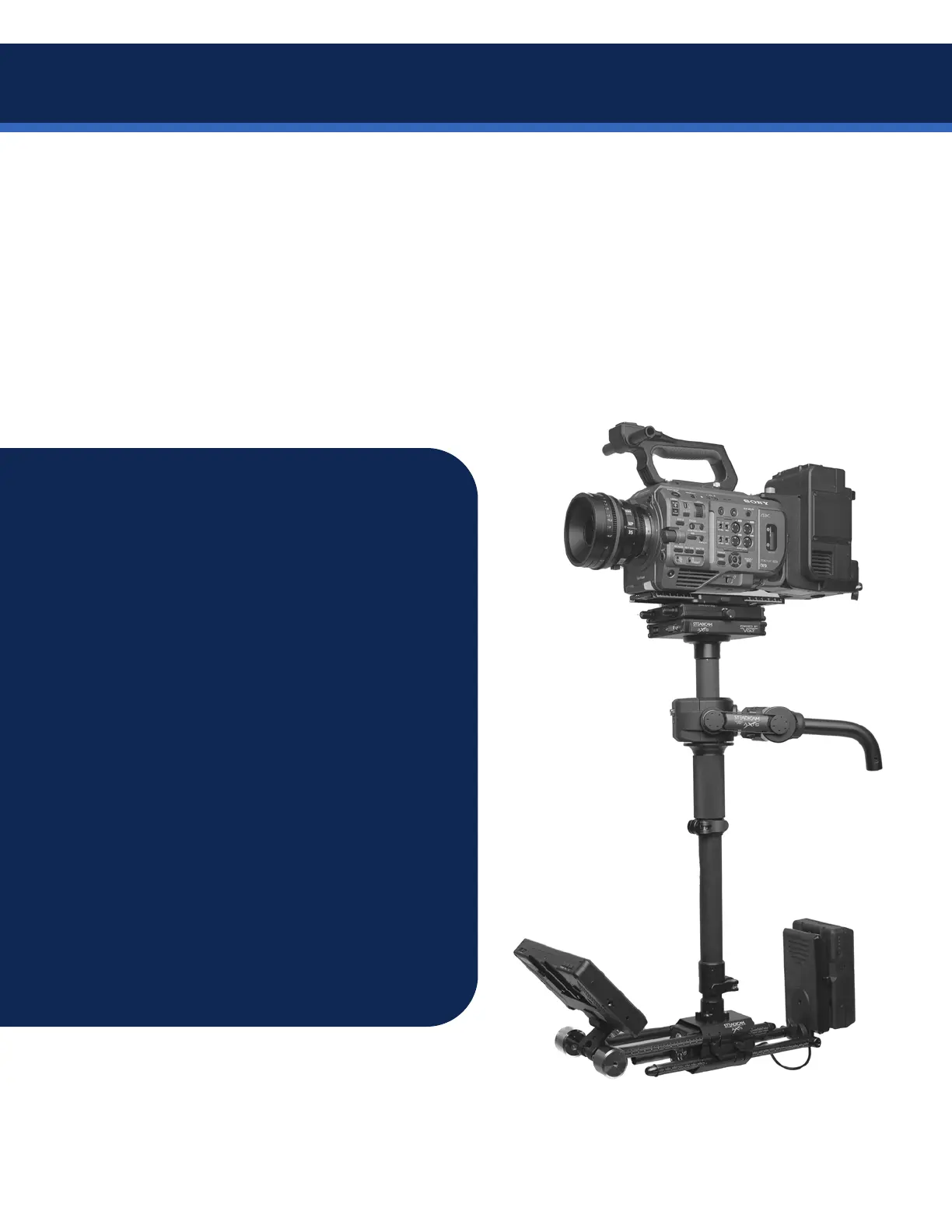
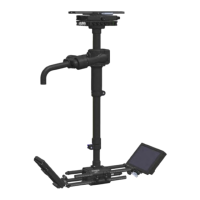
To balance the Steadicam Axis, you will place the sled onto the balance pin of the dock. Make sure your
stand is sturdy enough and has adequate ballast so it can’t tip over. Better yet, have an assistant secure the
stand while you balance. And never walk away from a Steadicam when it’s on the balance pin.
Do not install the Volt gimbal cable, and leave the Axis powered OFF during balancing.
NOTE: Balancing may require repeating a few steps or even going back to re-position the dovetail plate on
the camera. This is normal and is part of the art of operating. The more often you do it, the easier it will be to
see what adjustments are required at every step, and the faster you’ll become at balancing.
Three main steps to balancing the Axis sled:
• First is static balancing where we balance
the sled in all three axes (top-to-bottom,
fore-aft and side-to-side) so that the sled
hangs upright and is slightly bottom
heavy. We set the “drop time” to about 2
seconds in order to do the next step.
• Second is dynamic balancing, which, as
the name implies, adds movement. For
this step, we slowly spin the sled, then
adjust the battery and camera positions
until the post remains perfectly vertical
when spinning. This is a challenging
concept for many but is important to get
the most out of the Volt.
• Thenalstepistochangethetop-
to-bottom balance to fully neutral (no
drop time at all) so the sled is no longer
bottom heavy, giving the Volt motors
maximum effect in all axes.
Balance the Axis system


 To Next Page