42
Balancing FAQ’s
Do I really need to dynamically balance the Axis?
• Answer:AsledindynamicbalancepansatwithoutanyinputfromtheoperatorortheVolt.Theless
work the Volt motors must do, the better the response and the lower the power draw. Faster pans, and
whip pans in particular, generate a lot of force. The better the dynamic balance, the less compensating
force needs to be applied by the operator or the Volt motors, and the better your operating looks.
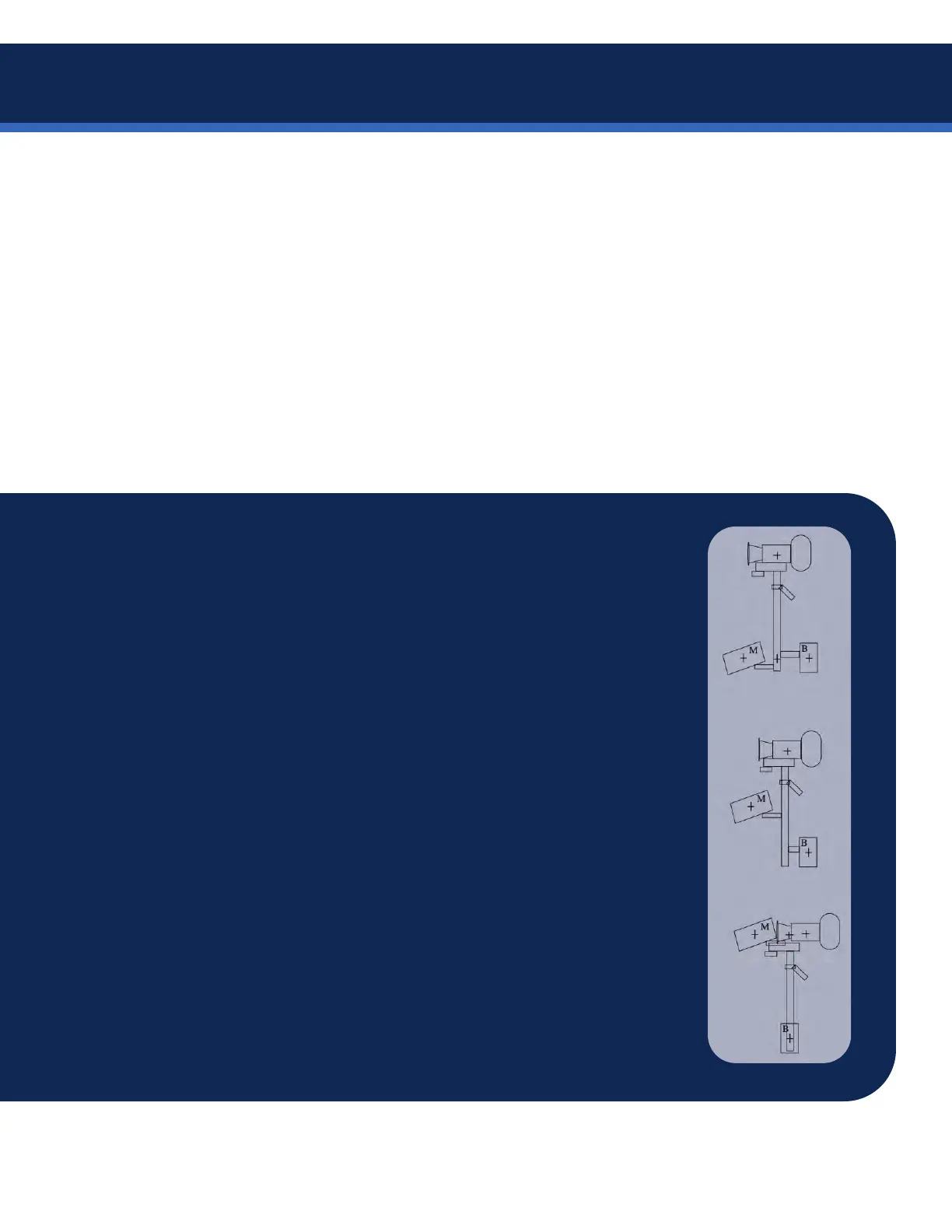
• See the diagram below for a visual demonstration of the relationship of monitor, battery and camera
placement on dynamic balance. It’s helpful to understanding where to place the camera CG when
building any Steadicam. Also, The Steadicam Operator’s Handbook includes much more about the
nuances of balancing and the physics behind dynamic balance.
Three gures to better understand dynamic balance:
ThetopgurelooksalotlikeyourAxissled.Thecamerac.g.iscenteredover
the post, and the monitor and battery are on the same horizontal plane, with
theircommonc.g.inthepost.Thisunitisindynamicbalanceandpansat.
Thesecondgurehasthebatteryloweredrelativetothemonitor.Thislooks
likemanyothersleds,oryourAxiswiththebatteryippeddown.Notethatthe
battery c.g. is moved closer to the post, and the camera c.g. has moved slightly
totherear.Why??Seethethirdgure.
Inthethirdgure,themonitorhasbeenraisedallthewayupinfrontofthe
camera. It’s absurd, of course, but it makes a point. Now the common monitor
and camera c.g. is over the post, and the battery’s c.g. is directly under the post.
So you can see that as the monitor is raised (or battery lowered) the camera
c.g. must move to the rear and the battery c.g. must move towards the post. As
you set up your Axis sled, take note of the battery, monitor and balance weight
arrangement to help you judge where to place the camera c.g. to achieve
dynamic balance much quicker.
FAQs and troubleshooting


 To Next Page