TIMBERWOLF
TW 150DHB
15
HANDLE blades with extreme caution to
avoid injury. Gloves should always be
worn when handling the cutter blades.
THE drive belts should be connected
while changing blades, as this will restrict
sudden movement of the rotor.
THE major components of this machine
are heavy. Lifting equipment must be
used for disassembly.
CLEAN machines are safer and easier to
service.
AVOID contact with hydraulic oil.
ALWAYS IMMOBILISE THE ENGINE BEFORE UNDERTAKING ANY MAINTENANCE WORK ON
THE CHIPPER BY REMOVING THE KEY AND DISCONNECTING THE BATTERY.
Only fit genuine Timberwolf replacement blades, screws and chipper spares. Failure to do so
will result in the invalidation of the warranty and may result in damage to the chipper, personal
injury or even loss of life.
1. Open the battery / tool box lid.
2. Remove the negative lead first and then the positive lead.
3. Clean, charge and/or top up the battery as required.
4. Refitting is the reverse of removal. Apply a smear of vaseline to the terminals to prevent
corrosion.
Size Pitch Head Torque Ibft Torque Nm
Blade Bolts M10 Standard T50 Torx 45 61
Hyd Motor Retaining Nuts M10 Standard 17mm Hex 34 46
Funnel Retaining Nuts M12 Standard 17mm Hex 38 51
General M8 Standard 13 mm Hex 17 23
General M10 Standard 17 mm Hex 34 46
General M12 Standard 19 mm Hex 60 80
Drain Bung in Fuel Tank 3/8” BSP - 22 mm Hex 25 33.8
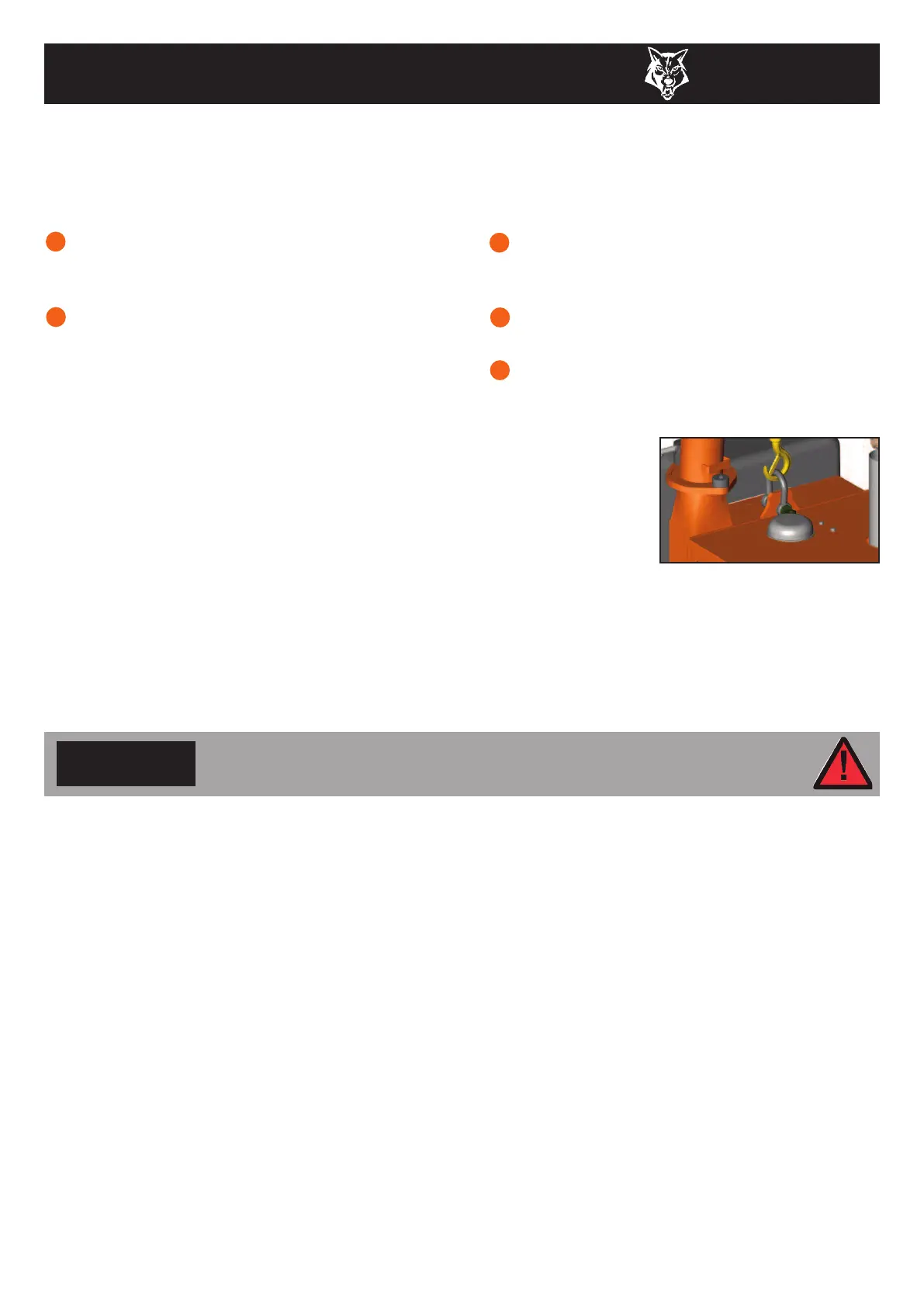
The lifting eye is designed to lift the machine’s weight only. Do not use
hoist hook directly on the lifting eye, use a correctly rated safety shackle.
Inspect the lifting eye prior to each use - DO NOT USE LIFTING EYE IF
DAMAGED.
SAFE MAINTENANCE
SAFE LIFTING OF THE CHIPPER
BATTERY REMOVAL AND MAINTENANCE
CHECK FITTINGS
WARNING
Refer to the battery safety section on pages 16-17.
SPARES
The Timberwolf TW 150DHB is subject to large vibrations during the normal course of operation.
Consequently there is always a possibility that nuts and bolts will work themselves loose. It is
important that periodic checks are made to ensure the security of all fasteners. Fasteners should be
tightened using a torque wrench to the required torque (see below). Uncalibrated torque wrenches
can be inaccurate by as much as 25%. It is therefore essential that a calibrated torque wrench
is used to achieve the tightening torques listed below.
SERVICE INSTRUCTIONS


 To Next Page